A potentiometer is used for the comparison of $e.m.f.$ of two cells ${E_1}$ and ${E_2}$. For cell ${E_1}$ the no deflection point is obtained at $20\,cm$ and for ${E_2}$ the no deflection point is obtained at $30\,cm$. The ratio of their $e.m.f.$'s will be
Easy
Download our app for free and get started
(a) Ratio will be equal to the ratio of no deflection lengths i.e. $\frac{{{E_1}}}{{{E_2}}} = \frac{{{l_1}}}{{{l_2}}} = \frac{2}{3}$

Download our appand get started for free
Experience the future of education. Simply download our apps or reach out to us for more information. Let's shape the future of learning together!No signup needed.*
Similar Questions
- 1A storage cell is charged by $5\, amp$ $D.C.$ for $18$ hours. Its strength after charging will be .............. $AH$View Solution
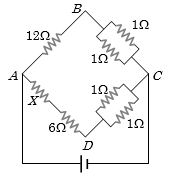
- 2For what value of unknown resistance $X$, the potential difference between $B$ and $D$ will be zero in the circuit shown in the figure ............... $\Omega$View Solution
- 3There are two electric bulbs of $40\, W$ and $100\, W$. Which one will be brighter when first connected in series and then in parallel,View Solution
- 4The length of a given cylindrical wire is increased by $100 \%$. Due to the consequent decrease in diameter the change in the resistance of the wire will be .................. $\%$View Solution
- 5View SolutionAssertion : In a simple battery circuit, the point of the lowest potential is negative terminal of the battery.
Reason : The current flows towards the point of the higher potential, as it does in such a circuit from the negative to the positive terminal.
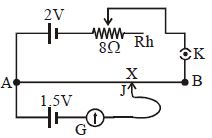
- 6In a potentiometer experiment shown here, for the position $X$ of the jockey $J,$ there occurs a null deflection in the galvanometer. Then the potential difference between points $A$ and $X$ is ................ $V$View Solution
- 7A cell of negligible resistance and $e.m.f.$ $2$ $volts$ is connected to series combination of $2$, $3$ and $5\, ohm$. The potential difference in volts between the terminals of $3\, ohm$ resistance will beView Solution
- 8By what percentage will the illumination of the lamp decrease if the current drops by $20 \%$ ?View Solution
- 9Two bulbs of $100\, W$ and $200\, W$ working at $220$ $volt$ are joined in series with $220$ $volt$ supply. Total power consumed will be approximately ........... $watt$View Solution
- 10A letter $A$ is constructed of a uniform wire with resistance $1.0\,\Omega \,per\,cm$. The sides of the letter are $20\, cm$ and the cross piece in the middle is $10\, cm$ long. The apex angle is $60^o$. The resistance between the ends is .............. $\Omega$View Solution