Two bulbs of $100\, W$ and $200\, W$ working at $220$ $volt$ are joined in series with $220$ $volt$ supply. Total power consumed will be approximately ........... $watt$
Medium
Download our app for free and get started
(a) ${P_S} = \frac{{{P_1}{P_2}}}{{{P_1} + {P_2}}} = \frac{{100 \times 200}}{{100 + 200}} = \frac{{200}}{3} \approx 65\,watt$

Download our appand get started for free
Experience the future of education. Simply download our apps or reach out to us for more information. Let's shape the future of learning together!No signup needed.*
Similar Questions
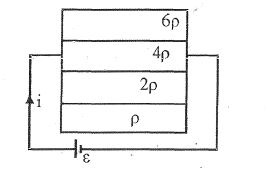
- 1If resistivity of all four wire connected in parallel is different as given in figure and all other dimensions of wire are same then current $i$ is (resistance of wire having resistivity $\rho $ is $R_0$ )View Solution
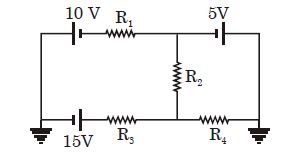
- 2In the circuit shown, current through $R_2$ is zero. If $R_4 = 2\,\Omega $ and $R_3 = 4\,\Omega $ , current through $R_3$ will be ................. $\mathrm{A}$View Solution
- 3Dimensions of a block are $1\,cm \times 1\,cm \times 100\,cm$. If specific resistance of its material is $3 \times {10^{ - 7}}\,ohm - m$, the resistance between the square faces isView Solution
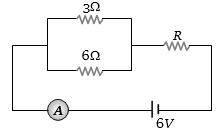
- 4If the ammeter in the given circuit reads $2\, A$, the resistance $R$ is ............ $ohm$View Solution
- 5The number of electrons flowing per second in the filament of a $110 \mathrm{~W}$ bulb operating at $220 \mathrm{~V}$ is : (Given $\mathrm{e}=1.6 \times 10^{-19} \mathrm{C}$ )View Solution
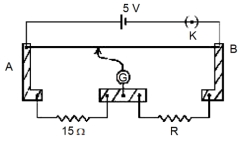
- 6A meter bridge setup is shown in the figure. It is used to determine an unknown resistance $R$ using a given resistor of $15\,\Omega$. The galvanometer $(G)$ shows null deflection when tapping key is at $43\,cm$ mark from end $A$. If the end correction for end $A$ is $2\,cm$. then the determined value of $R$ will be__________ $\Omega$View Solution
- 7The temperature dependence of resistances of $Cu$ and undoped $Si$ in the temperature range $300-400\ K$, is best described byView Solution
- 8$32$ cells, each of $emf$ $3V$, are connected in series and kept in a box. Externally, the combination shows an $emf$ of $84\, V$. The number of cells reversed in the combination isView Solution
- 9A current of $2\,A$ flows through a wire of crosssectional area $25.0\,mm ^2$. The number of free electrons in a cubic meter are $2.0 \times 10^{28}$. The drift velocity of the electrons is $...............\times 10^{-6}\,ms ^{-1}$ (given, charge on electron $=1.6 \times 10^{-19}\,C$ )View Solution
- 10View SolutionA potential difference is applied across the ends of a metallic wire. If the potential difference is doubled, then the drift velocity