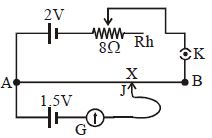
In a potentiometer experiment shown here, for the position $X$ of the jockey $J,$ there occurs a null deflection in the galvanometer. Then the potential difference between points $A$ and $X$ is ................ $V$
Medium


Download our appand get started for free
Experience the future of education. Simply download our apps or reach out to us for more information. Let's shape the future of learning together!No signup needed.*
Similar Questions
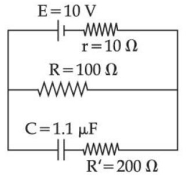
- 1As show in the figure, in steady state, the charge stored in the capacitor is....... $\times 10^{-6}\,C$.View Solution
- 2Electric room radiator which operates at $225\, volts$ has resistance of $50\, ohms$. Power of the radiator is approximately ............... $W$View Solution
- 3The resistance of a $5\, cm$ long wire is $10\, \Omega$. It is uniformly stretched so that its length becomes $20\, cm$. The resistance of the wire is ............. $\Omega$View Solution
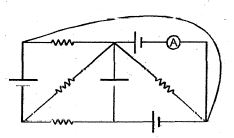
- 4In the circuit diagram shown, each battery is ideal having an e.m.f. of $1\ volt$. Each resistor has a resistance of $1\Omega $ Ammotor$(A)$ has a resistance of $1\Omega $ Find the reading of the ammeter and the total thermal power produced in the circuitView Solution
- 5A current of $2\, A$ passing through conductor produces $80\, J$ of heat in $10$ seconds. The resistance of the conductor is ............ $\Omega$View Solution
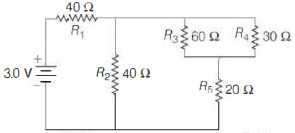
- 6In the circuit shown below, the resistances are given (in $\Omega$ ) and the battery is assumed ideal with emf equal to $3.0 \,V$. The resistor that dissipates the most power isView Solution
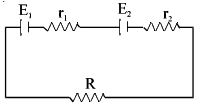
- 7Under what condition current passing through the resistance $R$ can be increased by short circuiting the battery of emf $E_2$. The internal resistances of the two batteries are $r_1$ and $r_2$ respectively.View Solution
- 8The current in a conductor is expressed as $I=3 t^2+4 t^3$, where $I$ is in Ampere and $t$ is in second. The amount of electric charge that flows through a section of the conductor during $t=1$ s to $t=2 \mathrm{~s}$ is_______ C.View Solution
- 9An expression for rate of heat generated, if a current of $I$ ampere flows through a resistance of $R$ $\Omega$, isView Solution
- 10Two cells, $e.m.f.$ of each is $E$ and internal resistance $r$ are connected in parallel between the resistance $R$. The maximum energy given to the resistor will be, only whenView Solution