Questions

5 Marks Questions

Take a timed test

6 questions · self-marked practice — reveal the answer and mark yourself.

Question 15 Marks
Derive an expression for the moment of inertia of a thin uniform rod about an axis passing through its one end and perpendicular to its length. Also determine the radius of gyration about the same axis.
Answer
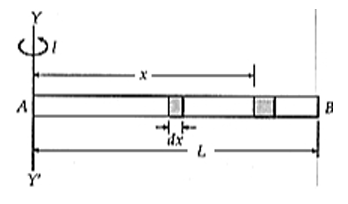
M.I. of a thin uniform rod about a perpendicular axis through its one end. Let a thin uniform rod AB of length L and mass M , which can rotate about an axis $YY ^{\prime}$ passing through its one end A and perpendicular to its length, as shown in Fig.
Image
Mass per unit length of the rod $=\frac{M}{L}$
Consider a small element of length $d x$ of the rod at a distance $x$ from the end $A$
Mass of this small length element $=\frac{M}{L} dx$
Moment of inertia of the small element about the axis YY',
$
dl=\text { Mass } \times(\text { distance })^2=\frac{M}{L} d x \cdot x^2
$
The moment of inertia of the whole rod about the axis $Y Y^{\prime}$ can be obtained by as under
$\begin{aligned} & I=\int d I=\int_0^L \frac{M}{L} d x \cdot x^2=\frac{M}{L} \int_0^L x^2 d x \\ & =\frac{M}{L}\left[\frac{x^3}{3}\right]_0^L=\frac{M}{3 L}\left[x^3\right]_0^L=\frac{M}{3 L}\left[L^3-0\right]=\frac{M L^3}{3 L} \quad \text { or } I=\frac{M L^2}{3}\end{aligned}$
Radius of gyration. Let $k$ be the radius of gyration of the rod about the axis YY'. Then
$
\begin{aligned}
& \frac{M L^2}{3}=M k^2 \\
& \text { or } k^2=\frac{L^2}{3} \\
& \text { or } k=\frac{L}{\sqrt{3}}
\end{aligned}
$
Thus the radius of gyration of the rod about an axis passing through its one end and perpendicular to its length is $\frac{L}{\sqrt{3}}$
View full question & answer
Question 25 Marks
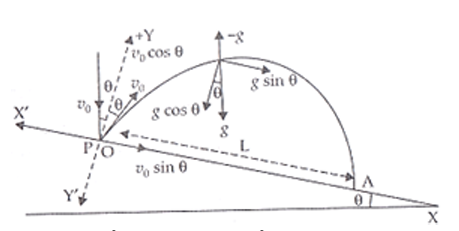
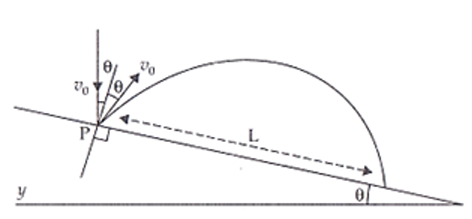
A particle falling vertically from a height hits a plane surface inclined to horizontal at an angle with speed $v_0$ and rebounds elastically as shown in the figure. Find the distance along the plane where it will hit the second time.
Image
Hint:
i. After rebound, particle still has speed $V_0$ to start.
ii. Work out angle particle speed has with horizontal after it rebounds.
iii. Rest is similar to if particle is projected up the incline.]
Answer
From the figure resolving the components of $v_0$ and $g$, we get
Image
$v_x=v_0 \sin \theta$ and $v_y=v_0 \cos \theta$
$g_x=g \cos \theta, g_y=g \sin \theta$ acting vertically downwards
Consider the motion of particle from O to A in new YOY' axis.
$
y=u_y t+\frac{1}{2} a_y t^2
$
Where, $z=0, \quad v_y=v_0 \cos \theta, \quad a_y=-g \sin \theta$
$
\begin{aligned}
& \therefore t=T \quad(\text { time of flight }), y=0 \\
& \Rightarrow 0=v_0 \cos \theta T-\frac{1}{2} g \sin \theta T^2 \\
& \Rightarrow T=\frac{2 v_0 \cos \theta}{g \cos \theta} \\
& T=\frac{2 v_0}{g}
\end{aligned}
$
Now consider the motion along OX axis.
$
\begin{aligned}
& x=L, u_x=v_0 \sin \theta, a_x=g \sin \theta, t=T=\frac{2 v_0}{g} \\
& x=u_x t+\frac{1}{2} a_x t^2 \\
& L=\left[\frac{2 v_5}{g}\right] v_0 \sin \theta+\frac{1}{2} g \sin \theta\left[\frac{2 v_0}{g}\right]^2 \\
& L=\frac{2 v_0^2}{g} \sin \theta+\frac{1}{2} g \sin \theta \cdot \frac{4 v_0^2}{g^2} \\
& =\frac{2 v_0^2}{g}[\sin \theta+\sin \theta]=\frac{4 v_0^2}{g} \sin \theta \\
& \Rightarrow L=\frac{4 v_0^2}{g} \sin \theta
\end{aligned}
$
Hence the value of L is $\frac{4 v_0^2}{g} \sin \theta$.
View full question & answer
Question 35 Marks
Explain the total energy in simple harmonic motion and show the graphical representation of energy in SHM.
Answer
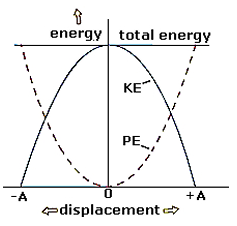
The total energy of the system of a block and a spring is equal to the sum of the potential energy stored in the spring plus the kinetic energy of the block and is proportional to the square of the amplitude.
$
\begin{aligned}
& \frac{1}{2} m \omega^2\left(A^2-x^2\right)+\frac{1}{2} m \omega^2 x^2 \\
& E=\frac{1}{2} m \omega^2 A^2
\end{aligned}
$
Hence, the total energy of the particle in SHM is constant and it is independent of the instantaneous displacement. Relationship between potential energy, kinetic energy, and time in Simple Harmonic Motion at $t=0$, when $x= \pm A$.
Image
View full question & answer
Question 45 Marks
A projectile is projected horizontally with a velocity u. Show that its trajectory is parabolic. And obtain expressions for:
i. Time of flight
ii. Horizontal range
iii. Velocity at any instant $t$.
Answer
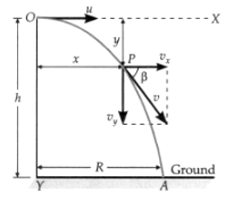
Projectile fired parallel to horizontal. As shown in figure, suppose a body is projected horizontally with velocity u from a point O at a certain height h above the ground level. The body is under the influence of two simultaneous independent motions:
i. Uniform horizontal velocity u.
ii. Vertically downward accelerated motion with constant acceleration g.
Under the combined effect of the above two motions, the body moves along the path OPA.
Image
Horizontal projection of a projectile.
Trajectory of the projectile. After the time $t$, suppose the body reaches the point P (x, y).
The horizontal distance covered by the body in time $t$ is
$
x=\text { ut } \therefore t=\frac{x}{u}
$
The vertical distance travelled by the body in time $t$ is given by
$
s=u t+\frac{1}{2} a t^2
$
or $y =0 \times t+\frac{1}{2} g t^2=\frac{1}{2} g t^2$ [For vertical motion, $u =0$ ]
or $y=\frac{1}{2} g\left(\frac{x}{u}\right)^2=\left(\frac{g}{2 u^2}\right) x^2\left[\because t=\frac{x}{u}\right]$
or $y = kx ^2$ [Here $k =\frac{g}{2 u^2}=$ a constant $]$
As $y$ is a quadratic function of $x$, so the trajectory of the projectile is a parabola.
Time of flight. It is the total time for which the projectile remains in its flight (from O to A ). Let T be its time of flight.
For the vertical downward motion of the body, we use
$s=u t+\frac{1}{2} a t^2$ or $h =0 \times T+\frac{1}{2} g T^2$
or $T-\sqrt{\frac{2 h}{g}}$
Horizontal range. It is the horizontal distance covered by the projectile during its time of flight. It is equal to $O A=R$. Thus $R =$ Horizontal velocity $\times$ time of flight $= u \times T$
or $R =u \sqrt{\frac{2 h}{g}}$
Velocity of the projectile at any instant. At the instant $t$ (when the body is at point P ), let the velocity of the projectile be v . The velocity v has two rectangular components:
Horizontal component of velocity, $v _{ x }= u$
Vertical component of velocity, $v _{ y }=0+ gt = gt$
$\therefore$ The resultant velocity at point $P$ is
$
v=\sqrt{v_x^2+v_y^2}=\sqrt{u^2+g^2 t^2}
$
If the velocity v makes an angle p with the horizontal, then $\tan \beta=\frac{v_y}{v_x}=\frac{g t}{u}$
or $\beta=\tan ^{-1}\left(\frac{g t}{u}\right)$
View full question & answer
Question 55 Marks
From a uniform disk of radius R , a circular hole of radius $\frac{R}{2}$ is cut out. The centre of the hole is at $\frac{R}{2}$ from the centre of the original disc. Locate the centre of gravity of the resulting flat body.
Answer
The centre of mass of an object is the point at which the object can be balanced. Mathematically, it is the point at which the torques from the mass elements of an object sum to zero. The centre of mass is useful because problems can often be simplified by treating a collection of masses as one mass at their common centre of mass. The weight of the object then acts through this point.
To solve this problem, first we assume that the whole disc was present whose centre of mass lies at the origin from which a small disc was cut out. So CM of remaining portion and cut out disc will lie exactly at the origin i.e Centre of Mass of the original disc at $x=0$
Mass per unit area of the original disc $=\sigma$
Radius of the original disc $= R$
Mass of the original disc, $M=\pi R^2 \sigma$
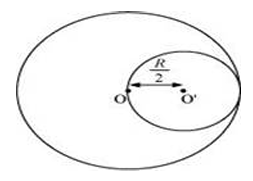
The disc with the cut portion is shown in the following figure:
Image
Radius of the smaller disc $=\frac{R}{2}$
Mass of the smaller disc, $M^{\prime}=\pi\left(\frac{R}{2}\right)^2 \sigma=\frac{1}{4} \pi R^2 \sigma=\frac{M}{4}$
Let $O$ and $O^{\prime}$ be the respective centers of the original disc and the disc cut off from the original. As per the definition of the centre of mass, the centre of mass of the original disc is supposed to be concentrated at O , while that of the smaller disc is supposed to be concentrated at $O ^{\prime}$.
It is given that:
$
O O^{\prime}=\frac{R}{2}
$
After the smaller disc has been cut from the original, the remaining portion is considered to be a system of two masses. The two masses are:
M (concentrated at O ), and
$
\left(-M^{\prime}=\frac{M}{4}\right) \text { concentrated at } O^{\prime}
$
(The negative sign indicates that this portion has been removed from the original disc.)
Let x be the distance through which the centre of mass of the remaining portion shifts from point O .
The relation between the centers of masses of two masses is given as:
$
x=\frac{m_1 r_1+m_2 r_2}{m_1+m_2}
$
For the given system 
$x=\frac{M \times 0-M \times\left(\frac{R}{2}\right)}{M+\left(-M^{\prime}\right)}$ (here M' is M/4)
$
=\frac{\frac{-M}{4} \times \frac{R}{2}}{M-\frac{M}{4}}=\frac{-M R}{8} \times \frac{4}{3 M}=\frac{-R}{6}
$
Note that shift in Centre of Mass is very less(only 0.16 R or $\frac{R}{6}$ ) as removed portion has very less mass as compared to the remaining portion.
(The negative sign indicates that the centre of mass gets shifted toward the left of point O and lies at $\frac{R}{6}$ left towards origin.)
View full question & answer
Question 65 Marks
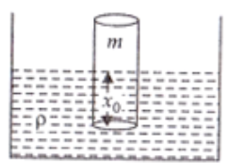
A cylindrical log of wood of height $h$ and area of cross-section A floats in a liquid. It is pressed and then released. Show that the log would execute S.H.M. with a time period.
$
T=2 \pi \sqrt{\frac{m}{A \rho g}}
$
Where $m$ is mass of the body and $\rho$ is the density of the liquid.
Answer
When the block is pressed downward into the liquid then an upward Buoyant force (B.F.) acts on it which moves the block upward and it moves upward from its mean position due to inertia and then again come down due to gravity. So the net restoring force on the block is given by = Buoyant force on the log by the liquid - weight of the log of wood
Image
Say, V is = the volume of liquid displaced by the block
When the block floats then,
Weight of the block is given by, $mg =$ buoyant force by the liquid or $m g=V \rho g,[V \rho g$ is the weight of the displaced liquid by the block] 
$m g=A x_0 \rho g \ldots$ (i) $\left[ x _0=\right.$ is the depth of the block into the liquid just before the block is pressed and volume displaced by the liquid, $V = Ax _0$ ]
A is the area of cross-section
$x_0=$ is the depth of the block into the liquid due to its own weight
Let x height again dip in liquid when pressed into it. Hence total height of block into the liquid $=\left(x+x_0\right)$
So net force acting upward on the block is given by $=\left[A\left(x+x_0\right)\right] \rho \cdot g-m g$
$
\begin{aligned}
& F_{\text {net }}=A x_0 \rho g+A x \rho g-A x_0 \rho g \\
& F_{\text {restoring }}=-F_{n e t}=-A x \rho g
\end{aligned}
$
(as Buoyant force is upward and displacement of the block, x is directed downwards)
$
\therefore F_{\text {restoring }} \propto-x
$
So motion is SHM with proportional constant k $=A \rho g$ 
Again from SHM equation, $a=-\omega^2 x \ldots$ (i)
$\begin{aligned} & F_{\text {restoring }}=-A \rho g x \\ & \Rightarrow m a=-A \rho g x \\ & \Rightarrow a=\frac{-A \rho g x}{m} \Rightarrow-\omega^2 x=\frac{-A \rho g x}{m} \quad \text { [putting the value of a from equation (i)] } \\ & \therefore \omega^2=\frac{A \rho g}{m}\end{aligned}$
with $k=A \rho g$ and $\omega=\frac{2 \pi}{T}$
Hence, $\left(\frac{2 \pi}{T}\right)^2=\frac{A \rho g}{m} \Rightarrow \frac{T}{2 \pi}=\sqrt{\frac{m}{A \rho g}} \Rightarrow T=2 \pi \sqrt{\frac{m}{A \rho g}}$
View full question & answer
5 Marks Questions - Physics STD 11 Science Questions - Vidyadip