A pulse is generated at lower end of a hanging rope of uniform density and length $L$. The speed of the pulse when it reaches the mid point of rope is ......

Medium


Download our appand get started for free
Experience the future of education. Simply download our apps or reach out to us for more information. Let's shape the future of learning together!No signup needed.*
Similar Questions
- 1A tuning fork of known frequency $256\,Hz$ makes $5$ beats per second with the vibrating string of a guitar. The beat frequency decreases to $2$ beats per second when the tension in the guitar string slightly increased. The frequency of the guitar string before increasing the tension was ..... $Hz$View Solution
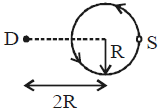
- 2A whistle $S$ of frequency $f$ revolves in a circle of radius $R$ at a constant speed $v$. What is the ratio of largest and smallest frequency detected by a detector $D$ at rest at a distance $2R$ from the centre of circle as shown in figure ? (take $c$ as speed of sound)View Solution
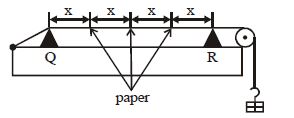
- 3The given diagram shows three light pieces of paper placed on a wire that is stretched over two supports, $Q$ and $R$ , a distance $4x$ apart. When the wire is made to vibrate at a particular frequency, all the pieces of paper, except the middle one, fall off the wire. Which of the following could be the wavelength of the vibration?View Solution
- 4Two whistles $A$ and $B$ produces notes of frequencies $660 Hz$ and $596 Hz$ respectively. There is a listener at the mid-point of the line joining them. Now the whistle $B$ and the listener start moving with speed $30 m/s$ away from the whistle $A.$ If speed of sound be $330 m/s,$ how many beats will be heard by the listenerView Solution
- 5A source of sound $S$ is moving with the velocity of $50\,m/s$ towards a stationary observer. The observer measures the frequency of the sound as $1000\,Hz.$ What will be the apparent frequency of the source when it is moving away from the observer after crossing him ... $Hz$ ? (Take velocity of sound in air is $350\,m/s$ )View Solution
- 6View SolutionTwo waves of same frequency and intensity superimpose with each other in opposite phases, then after superposition the
- 7An engine whistling at a constant frequency $n_0$ and moving with a constant velocity goes past a stationary observer. As the engine crosses him, the frequency of the sound heard by him changes by a factor $f$. The actual difference in the frequencies of the sound heard by him before and after the engine crosses him isView Solution
- 8An earthquake generates both transverse $(S)$ and longitudinal $(P)$ sound waves in the earth. The speed of $S$ waves is about $4.5\,km/s$ and that of $P$ waves is about $8.0\, km/s$. A seismograph records $P$ and $S$ waves from an earthquake. The first $P$ wave arrives $4.0 \,min$ before the first $S$ wave. The epicenter of the earthquake is located at a distance about ..... $km$View Solution
- 9An organ pipe $P_1$ closed at one end vibrating in its first overtone. Another pipe $P_2$ open at both ends is vibrating in its third overtone. They are in a resonance with a given tuning fork. The ratio of the length of $P_1$ to that of $P_2$ is :View Solution
- 10The extension in a string obeying Hooke's law is $x.$ The speed of sound in the stretched string is $v.$ If the extension in the string is increased to $1.5x$, the speed of sound will beView Solution