Question
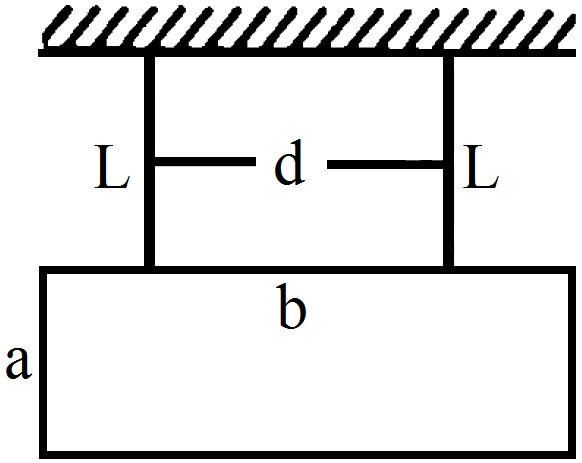
A rectangular plate of sides a and b is suspended from a ceiling by two parallel strings of length L each figure The separation between the strings is d. The plate is displaced slightly in its plane keeping the strings tight. Show that it will execute simple harmonic motion. Find the time period.
Answer

Here we have to consider oscillation of centre of mass, Driving force $\text{F}=\text{mg}\sin\theta.$ Acceleration $=\text{a}=\frac{\text{F}}{\text{m}}=\text{g}\sin\theta.$ For small angle $\theta,\ \sin\theta=\theta.$$\therefore\text{a}=\text{g}\theta=\text{g}\Big(\frac{\text{X}}{\text{L}}\Big)$[where g and L are constant]
$\therefore\text{a}\propto\text{x},$
So the motion is simple Harmonic Time period $\text{T}=2\pi\sqrt{\frac{\text{Displacement}}{\text{Acceleration}}}$$=2\pi\sqrt{\frac{\text{x}}{\Big(\frac{\text{gx}}{\text{L}}\Big)}}$
$=2\pi\sqrt{\frac{\text{L}}{\text{g}}}$

Need a full question paper?

Generate a complete, print-ready paper with questions like this in minutes — across 16+ boards, with answer keys.

Start Generating Free

Similar questions

When a capacitor is connected in series $LR$ circuit, the alternating current flowing in the circuit increases. Explain why.
A large conducting plane has a surface charge density $1.0\times10^{-4}\text{Cm}^{-2}.$ Find the electrostatic energy stored in a cubical volume of edge 1.0cm in front of the plane.
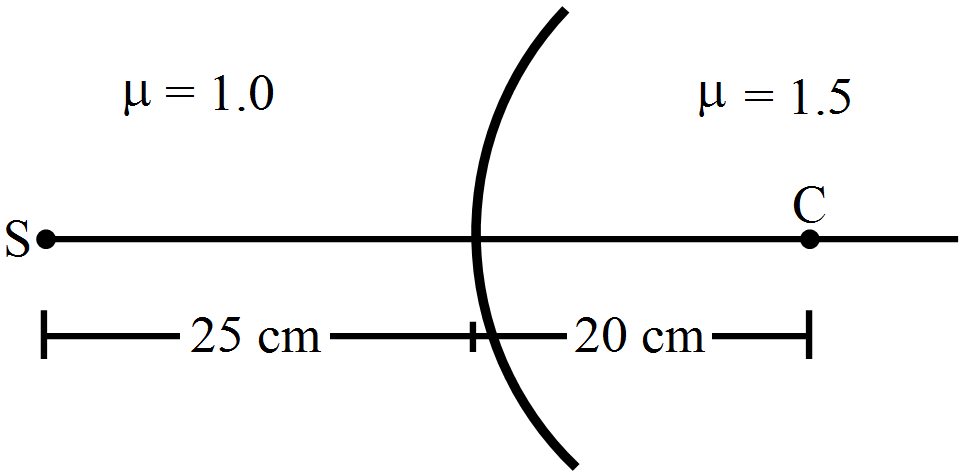
Locate the image formed by refraction in the situation shown in figure.
A cell of emf 'E' and internal resistance 'r' is connected across a variable load resistor R. Draw the plots of the terminal voltage V versus (i) R and (ii) the current I.
It is found that when R = 4$\Omega$, the current is 1 A and when R is increased to 9$\Omega$, the current reduces to 0.5 A. Find the values of the emf E and internal resistance r.
A capacitor of unknown capacitance is connected across a battery of $V$ volts. The charge stored in it is $360 \mu C$. When potential across the capacitor is reduced by $120 V,$ the charge stored in it becomes $120 \mu C$.
Calculate:
  1. The potential $V$ and the unknown capacitance $C$.
  2. What will be the charge stored in the capacitor, if the voltage applied had increased by $120 V$?
In a Coolidge tube, electrons strike the target and stop inside it. Does the target get more and more negatively charged as time passes?
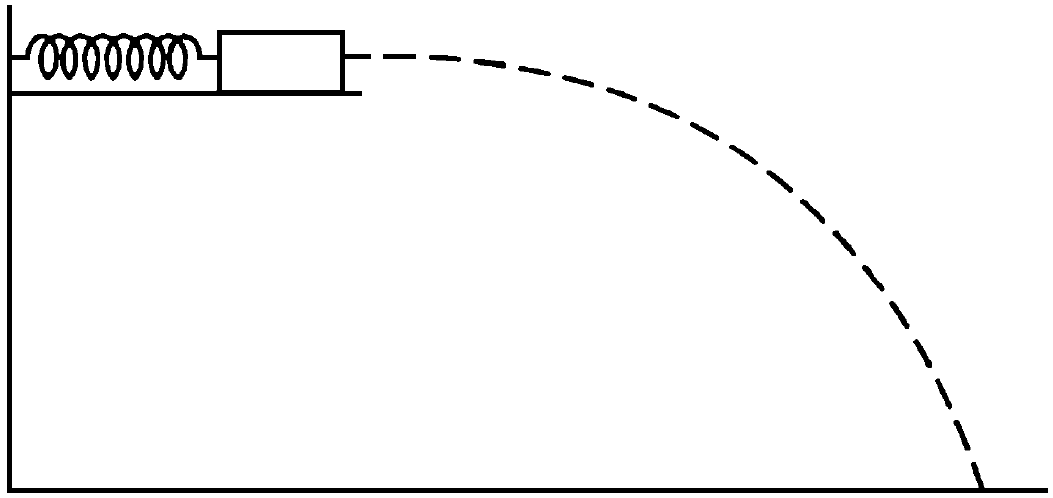
A small block of mass 100g is pressed against a horizontal spring fixed at one end to compress the spring through 5.0cm (figure). The spring constant is 100N/m. When released, the block moves horizontally till it leaves the spring. Where will it hit the ground 2m below the spring?
In a silicon transistor, the base current is changed by $20\mu\text{A}.$ This results in a change of $0.02V$ in base to emitter voltage and a change of $2m\ A$ in the collector current.
  1. Find the input resistance, $\beta- ac$ and trans conductance of the transistor.
  2. This transistor is used as an amplifier in $CE$ configuration with a load resistance $5\text{k}\Omega$ What is the voltage gain of the amplifier?
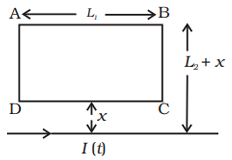
A rectangular loop of wire $\text {ABCD}$ is kept close to an infinitely long wire carrying a current $I ( t )= l _0\left(1-\frac{t}{T}\right)$ for $0 \leq t \leq T$ and $I (0)=0$ for $t > T \ ($Figure$)$. Find the total charge passing through a given point in the loop, in time $T$ .
The resistance of the loop is $R$.
Image
Consider Galileo's method of measuring the speed of light using two lanterns. To get an accuracy of about 10%, the time taken by the experimenter in closing or opening the shutter should be about one tenth of the time taken by the light in going from one experimenter to the other. Assume that it takes $\frac{1}{100}$ second for an experimenter to close or open the shutter. How far should the two experimenters be to get a 10% accuracy? What are the difficulties in having this separation?