Question 15 Marks
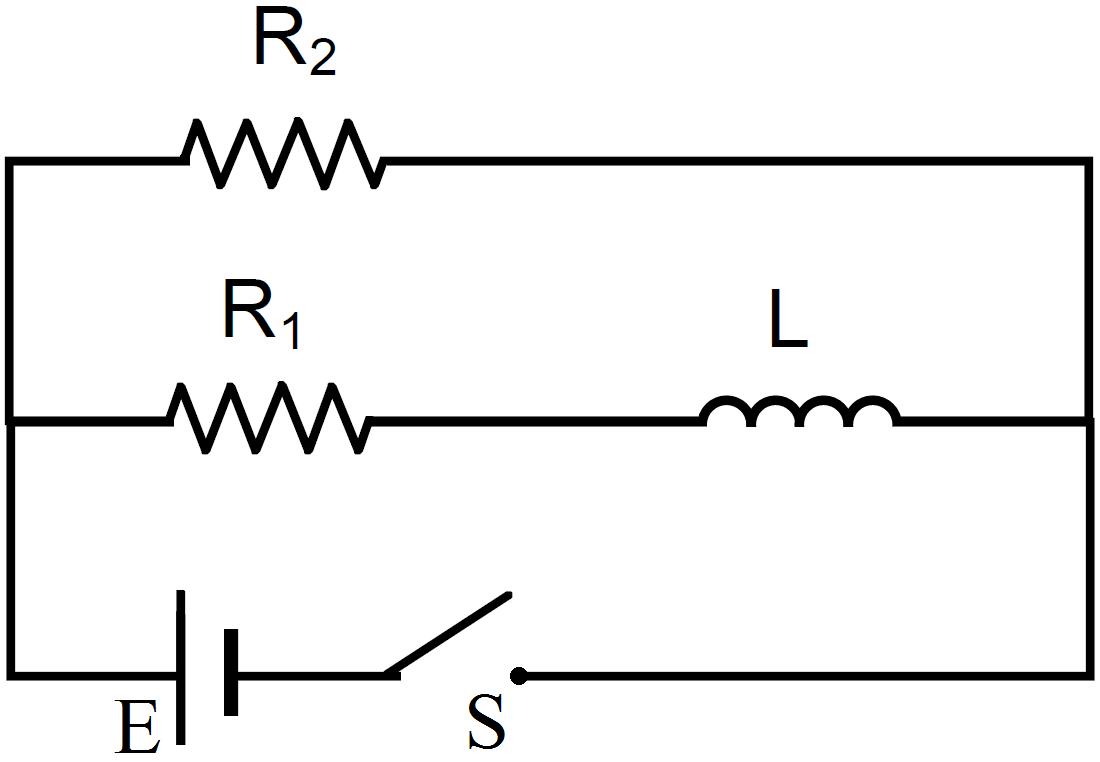
An inductor-coil of inductance 20mH having resistance $10\Omega$ is joined to an ideal battery of emf 5.0V. Find the rate of chenge of the induced emf at:
- t = 0
- t = 10ms
- t = 1.0s.
Answer
View full question & answer→$\text{L}=20\text{mH} ; \ \text{e}=5.0\text{V},\text{R}=10 \ \Omega$ $\tau=\frac{\text{L}}{\text{R}}=\frac{20\times10^{-3}}{10},\text{i}_0=\frac{5}{10}$ $\text{i}=\text{i}_0(1-\text{e}^{\frac{\text{t}}{\tau}})^2$ $\Rightarrow \ \text{i}=\text{i}_0-\text{i}_0\text{e}^{\frac{\text{-t}}{\tau^2}}$ $\Rightarrow\text{iR}=\text{i}_0\text{R}-\text{i}_0\text{R}\text{e}^{\frac{\text{-t}}{\tau^2}}$
$\frac{\text{dE}}{\text{dt}}=10\times\frac{5}{10}\times\frac{10}{20\times10^{-3}}\times\text{e}^{-0.01\times\frac{2}{10^{-2}}}$
$=16.844=17\text{V}/'$
- $10\times\frac{\text{di}}{\text{dt}}=\frac{\text{d}}{\text{dt}}\text{i}_0\text{R}+10\times\frac{5}{10}\times\frac{10}{20\times10^{-3}}\times\text{e}^{0\times\frac{10}{2\times10^{-2}}}$
- $\frac{\text{Rdi}}{\text{dt}}=\text{R}\times\text{i}^0\times\frac{1}{\tau}\times\text{e}^{\frac{\text{-t}}{\tau}}$
$\frac{\text{dE}}{\text{dt}}=10\times\frac{5}{10}\times\frac{10}{20\times10^{-3}}\times\text{e}^{-0.01\times\frac{2}{10^{-2}}}$
$=16.844=17\text{V}/'$
- $\text{For} \ \text{t} =1\text{s}$
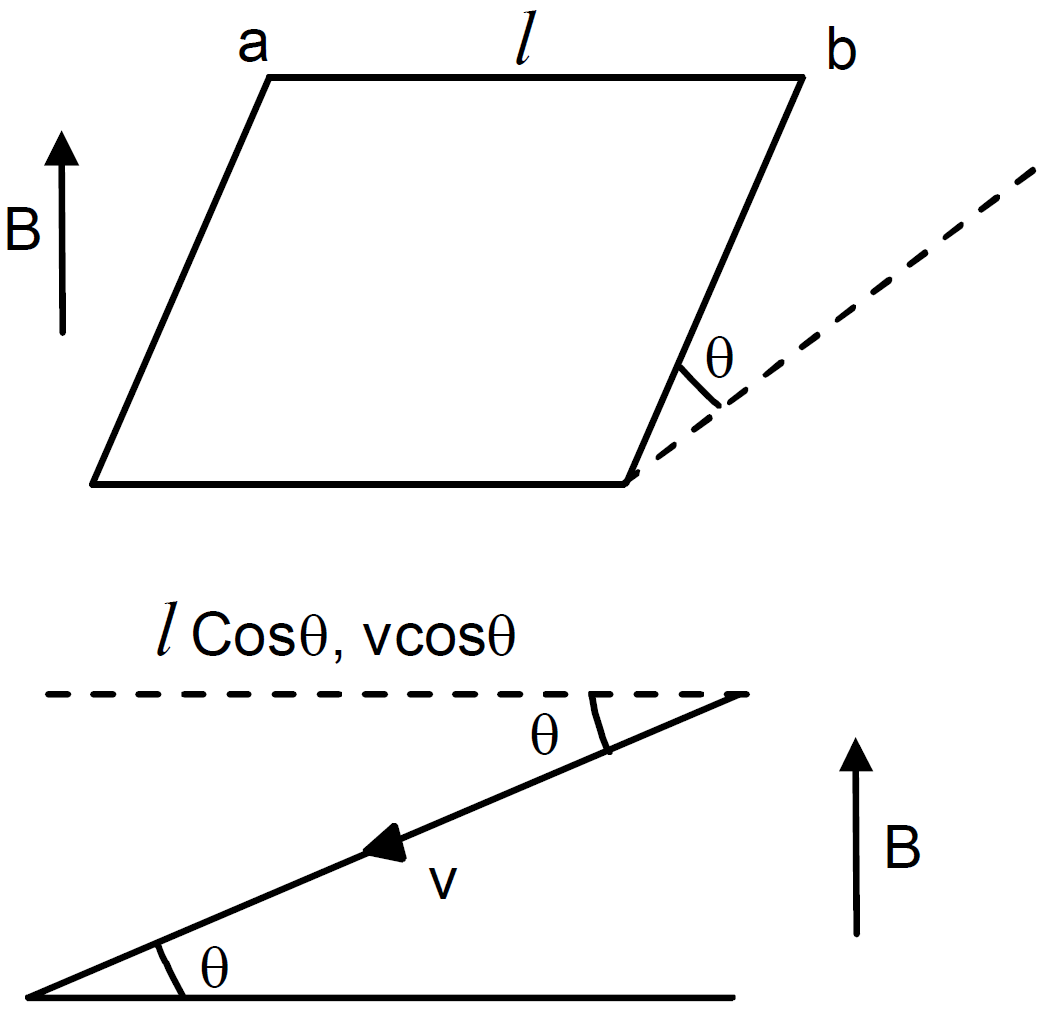
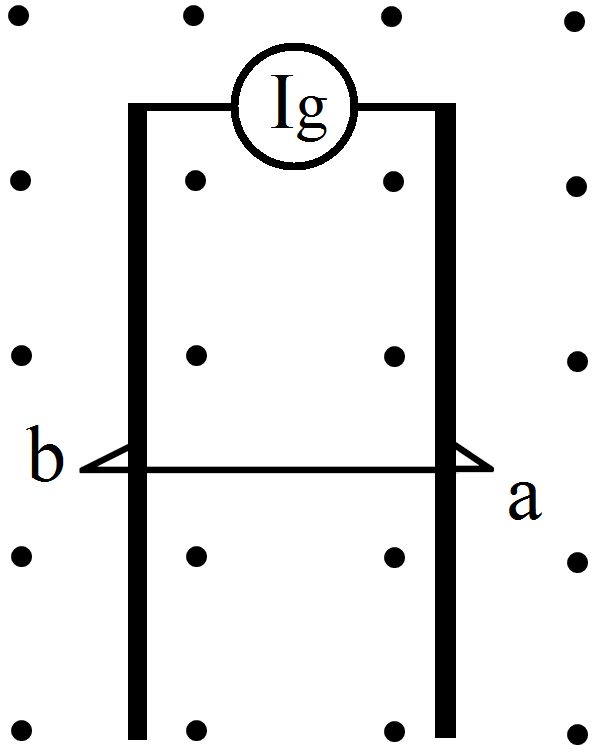
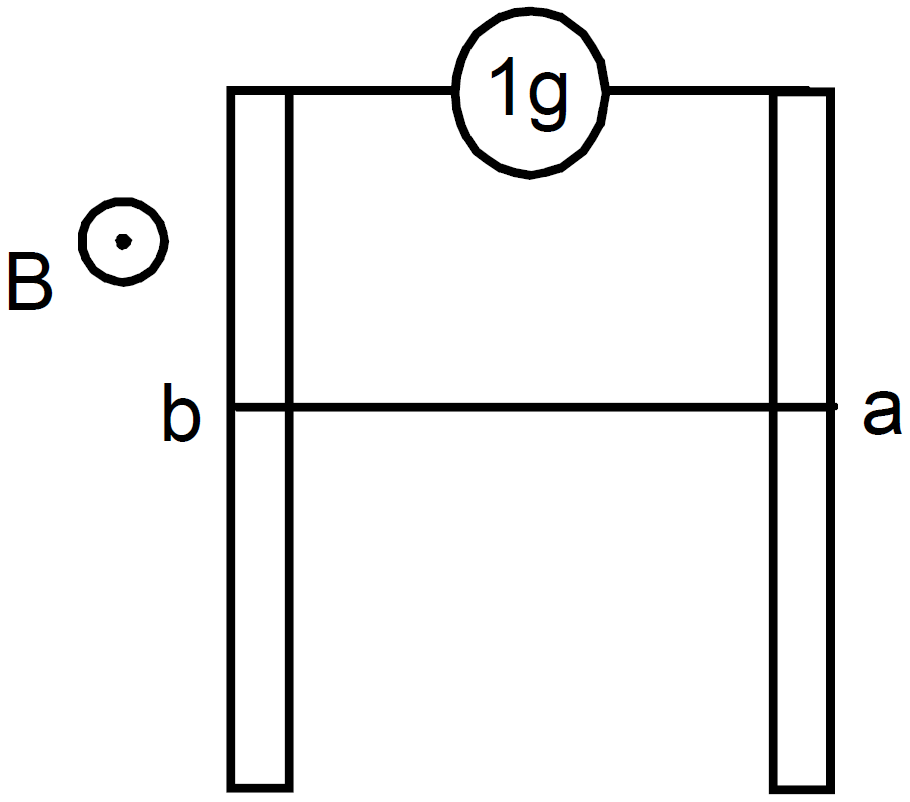
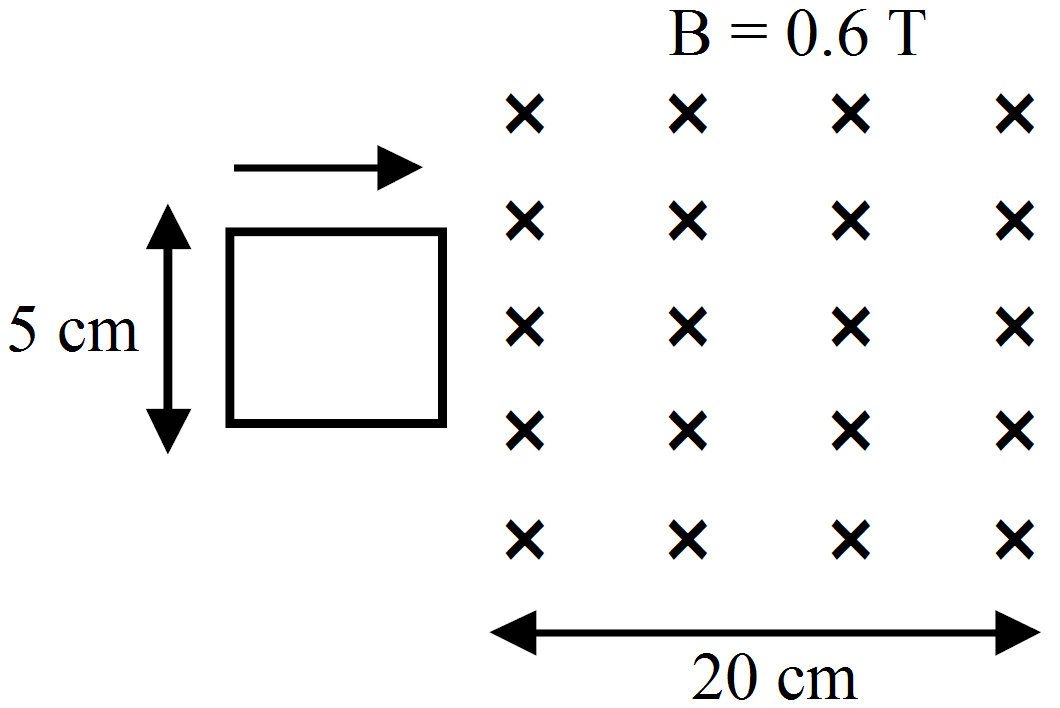
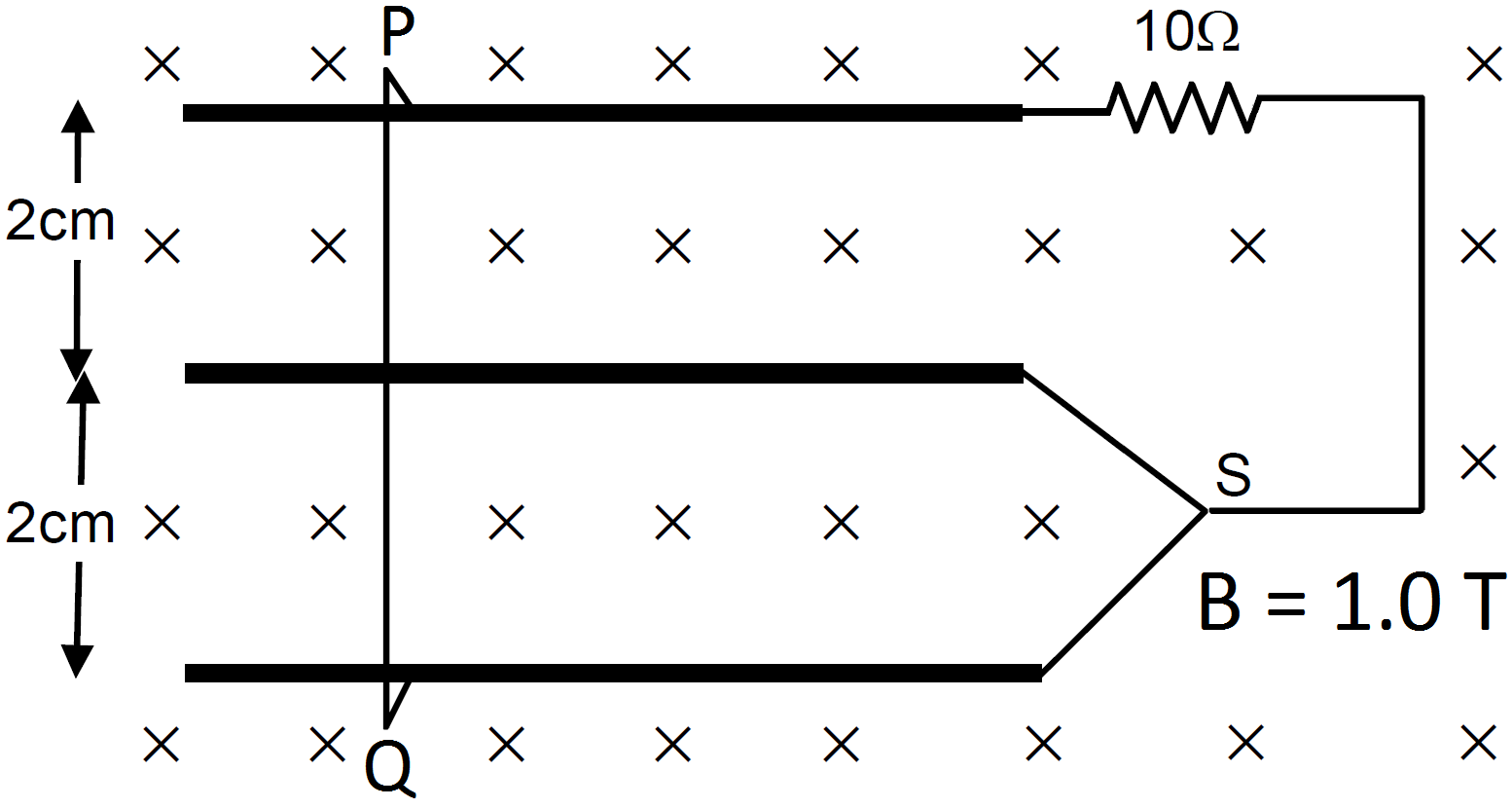
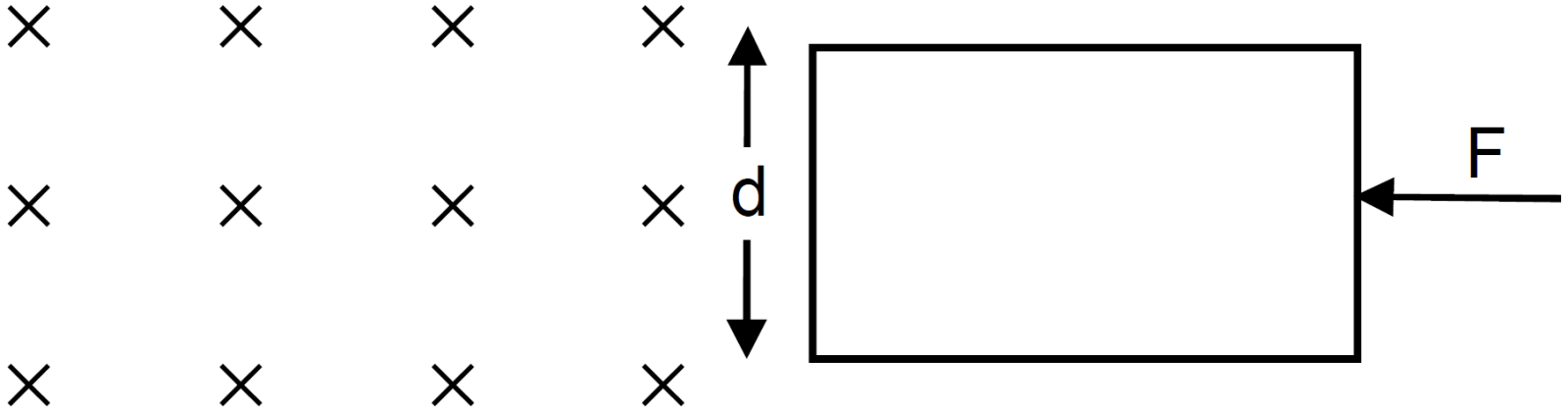
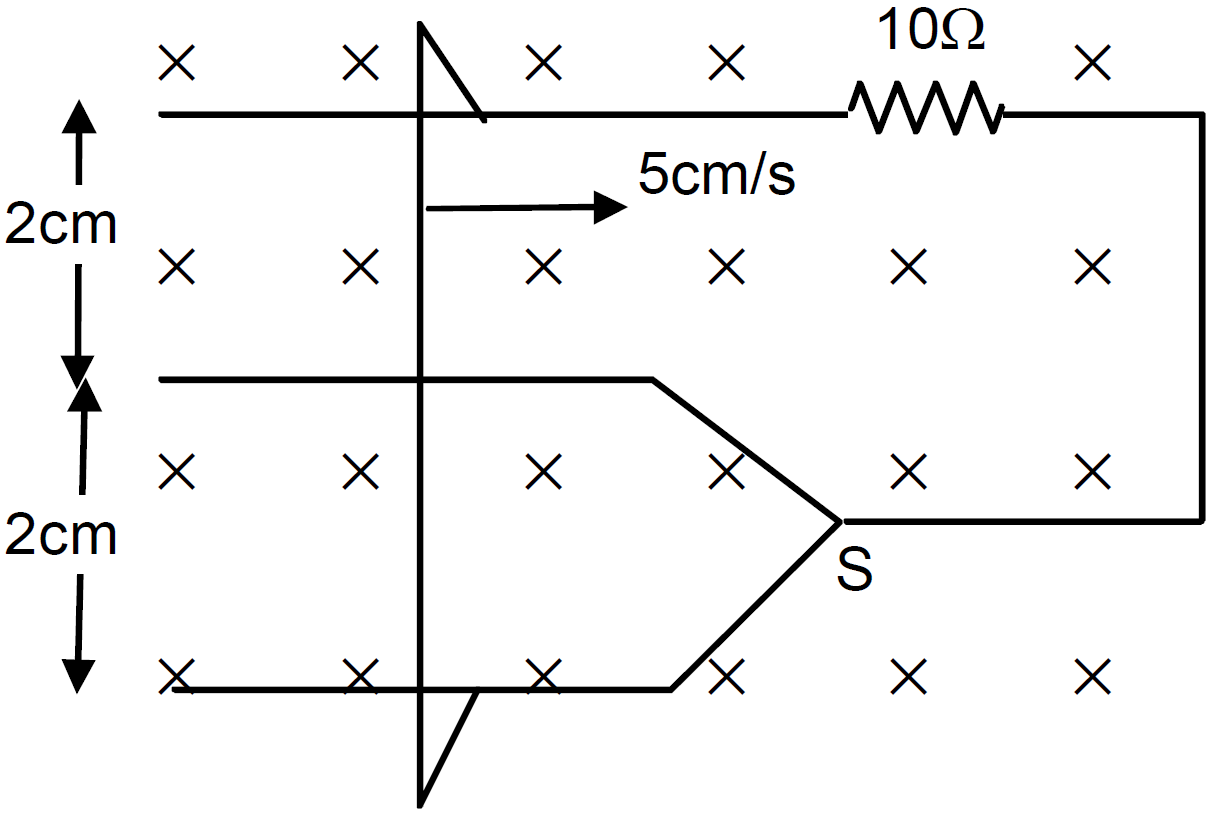 $\text{B}=1\text{T}, \ \text{V}=5\text{l} \ 10^{-2}\text{m}/',\text{R}=10\Omega$
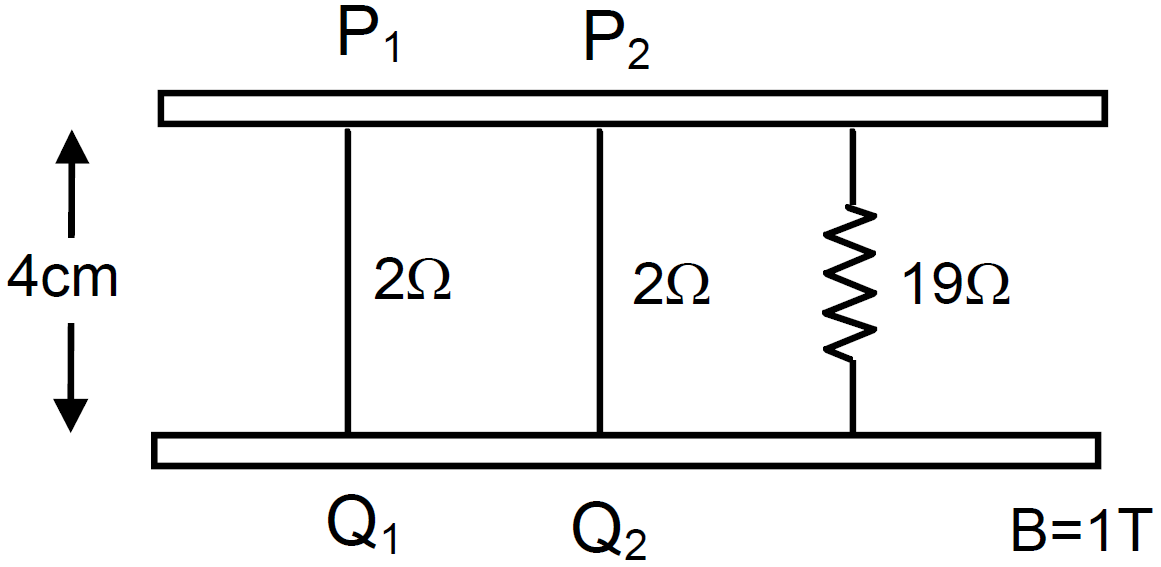
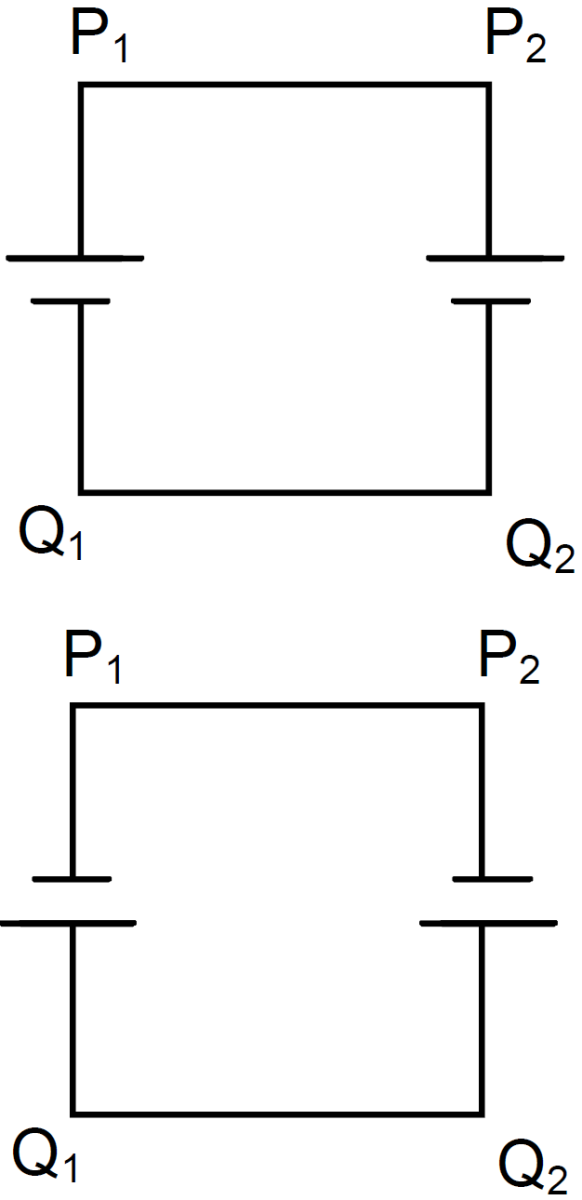
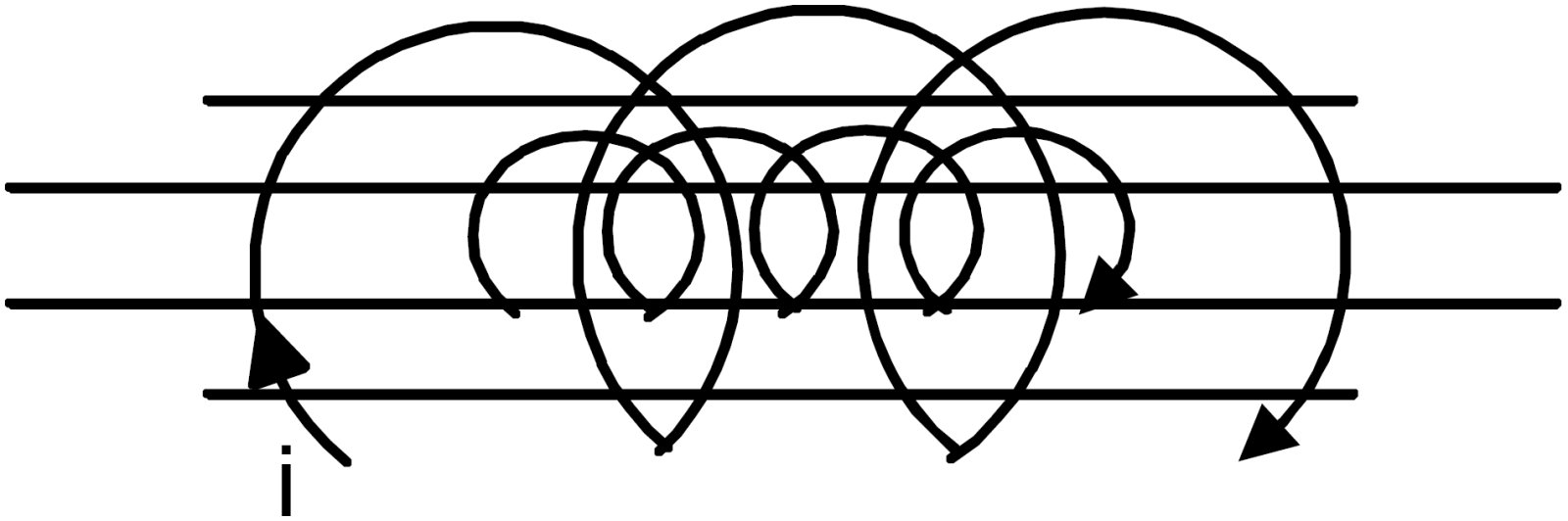
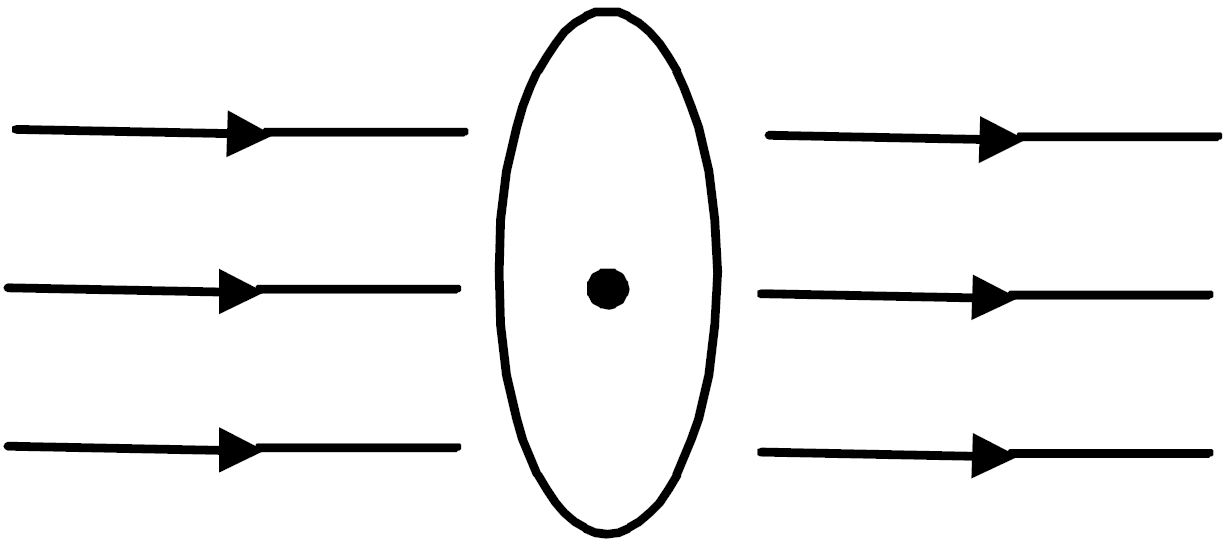
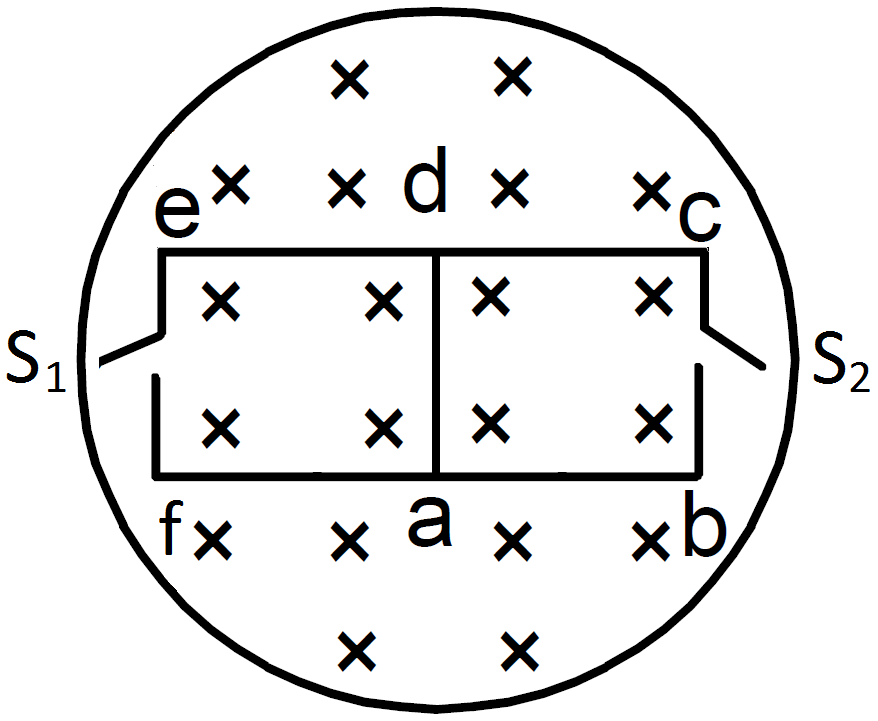
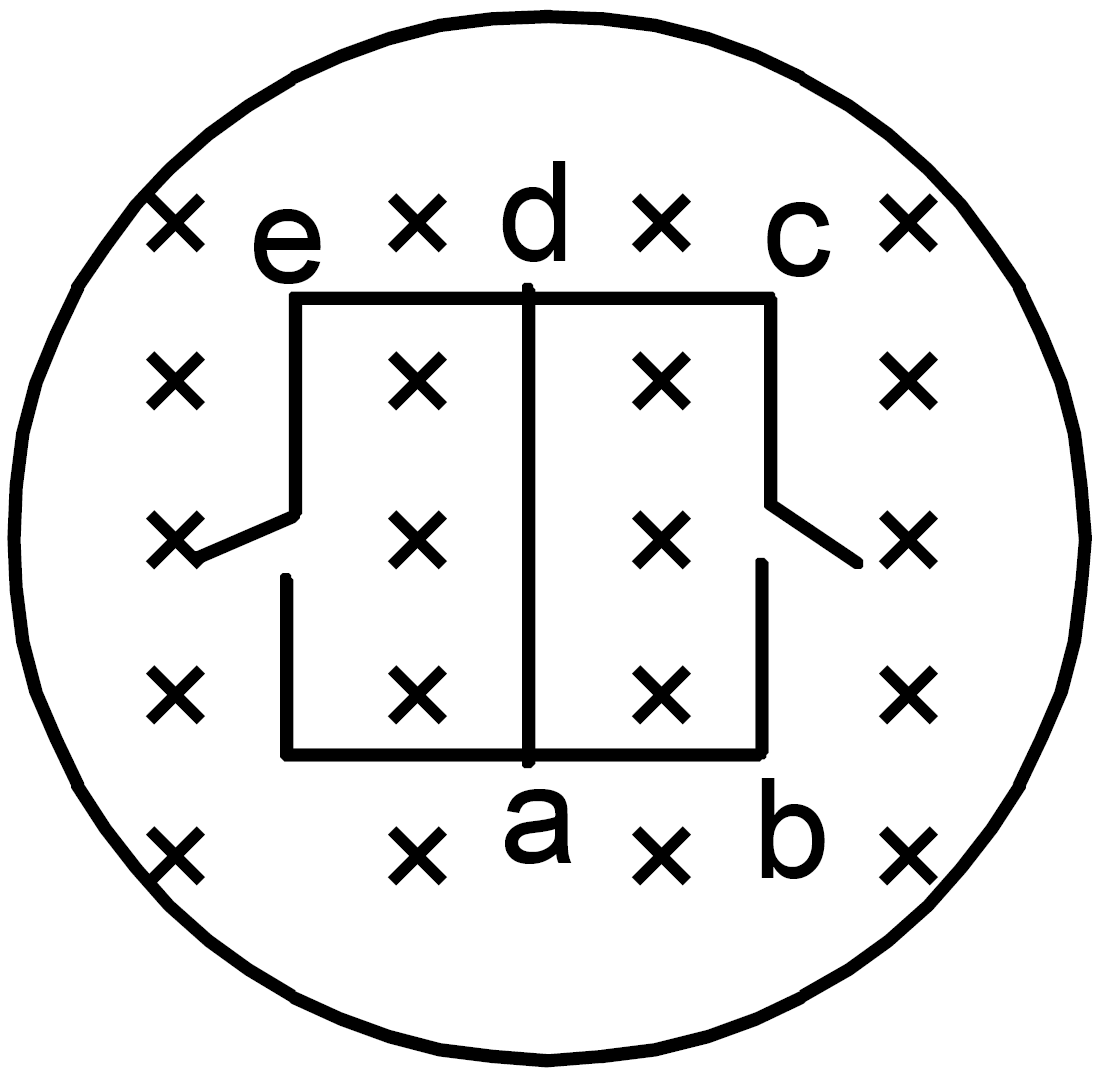
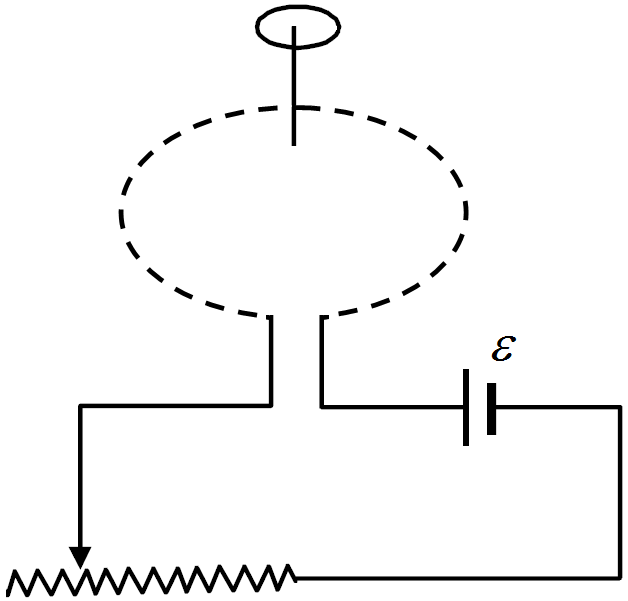
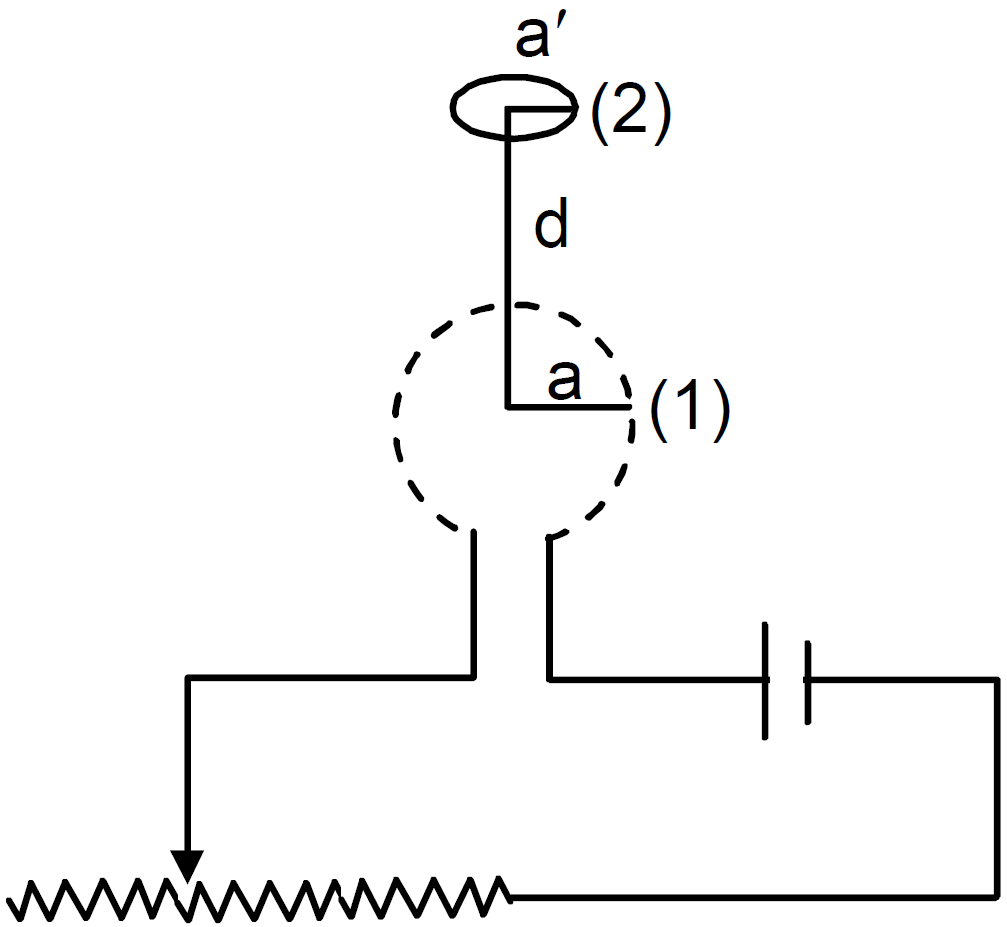
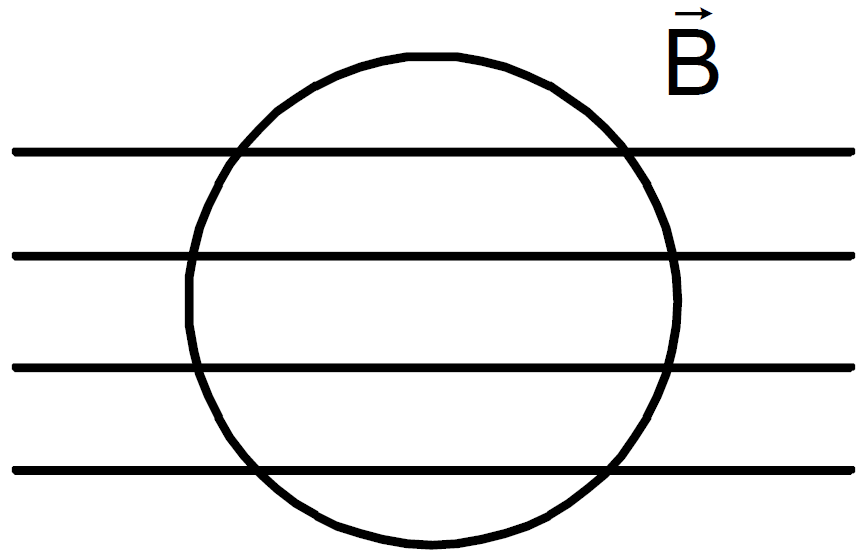 Magnetic field due to the coil (1) at the center of (2) is $\text{B}=\frac{\mu_0\text{Nia}^2}{2(\text{a}^2+\text{x}^2)^{\frac{3}{2}}}$ Flux linked with the second, $=\text{B}.\text{A}_{(2)}=\frac{\mu_0\text{Nia}^2}{2(\text{a}^2+\text{x}^2)^{\frac{3}{2}}}\pi\text{a}'^2$ E.m.f. induced $\frac{\text{d}\phi}{\text{dt}}=\frac{\mu_0\text{Na}^2\text{a}'^2\pi}{2(\text{a}^2+\text{x}^2)^{\frac{3}{2}}}\frac{\text{di}}{\text{dt}}$ $=\frac{\mu_0\text{N}\pi\text{a}^2\text{a}'^2}{2(\text{a}^2+\text{x}^2)^{\frac{3}{2}}}\frac{\text{d}}{\text{dt}}\frac{\text{E}}{\Big(\Big(\frac{\text{R}}{\text{L}}\Big)\text{x}+\text{r}\Big)}$ $=\frac{\mu_0\text{N}\pi\text{a}^2\text{a}'^2}{2(\text{a}^2+\text{x}^2)^{\frac{3}{2}}}\text{E}\frac{-1\frac{\text{R}}{\text{L}}\text{v}}{\Big(\Big(\frac{\text{R}}{\text{L}}\Big)\text{x}+\text{r}\Big)^2}$
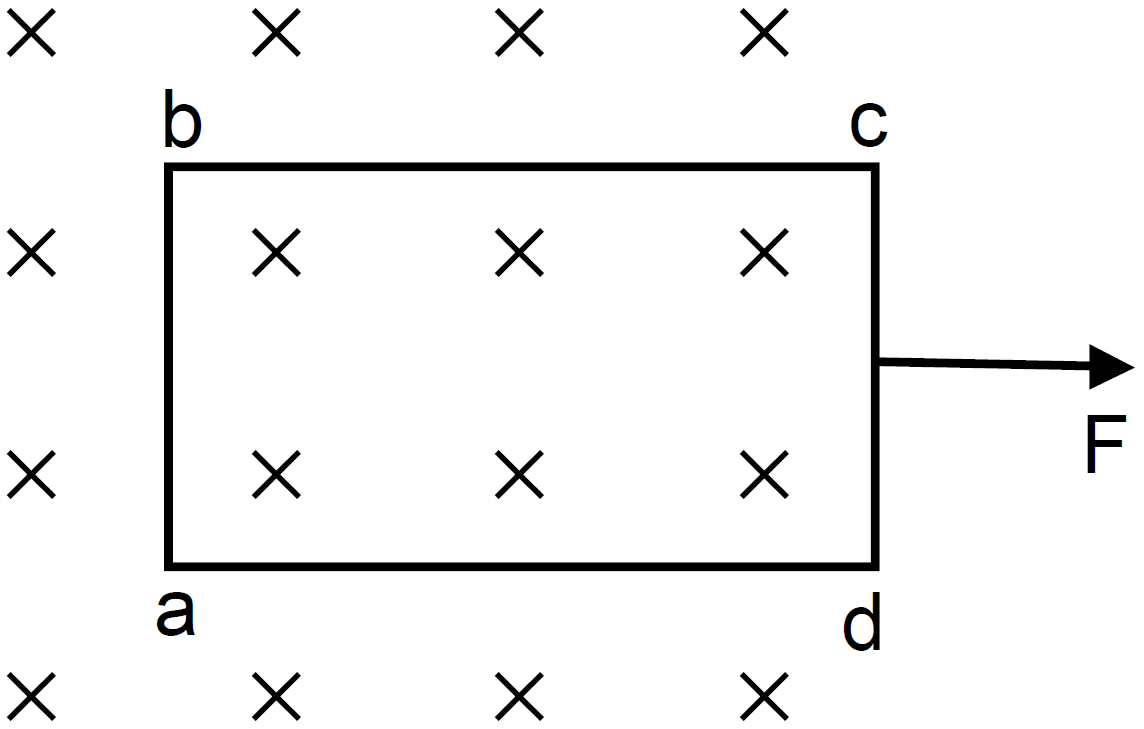
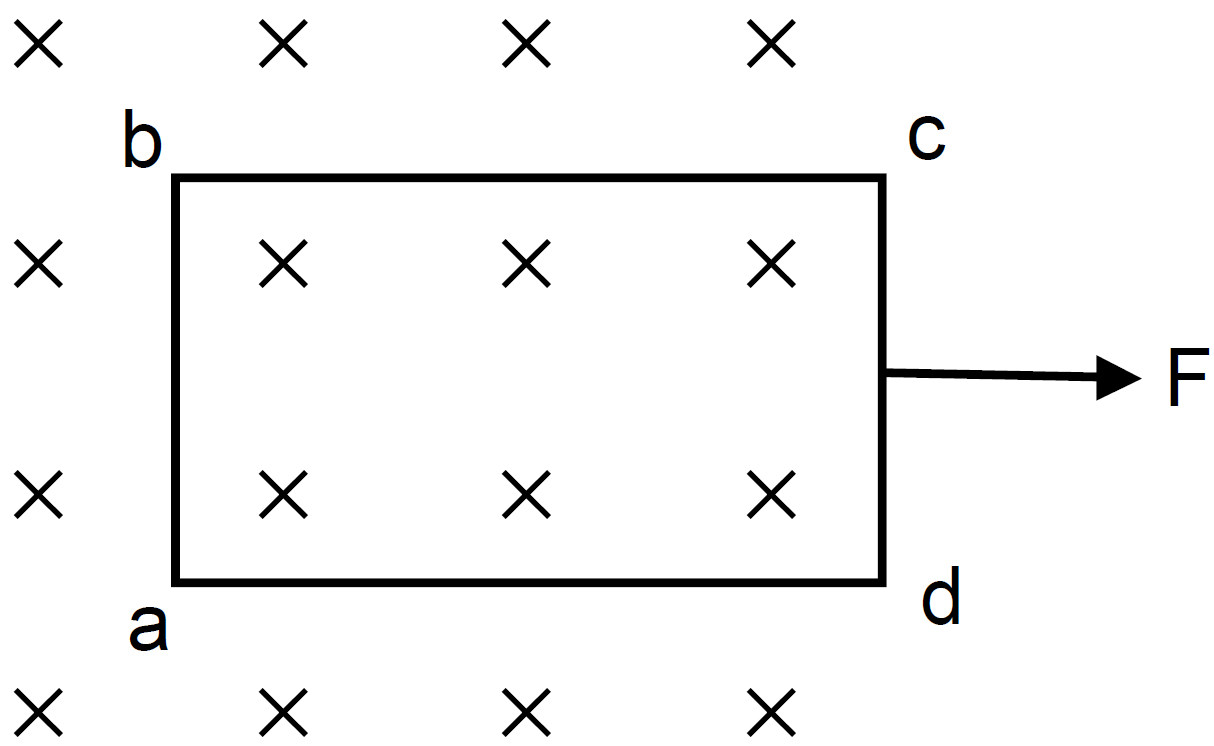
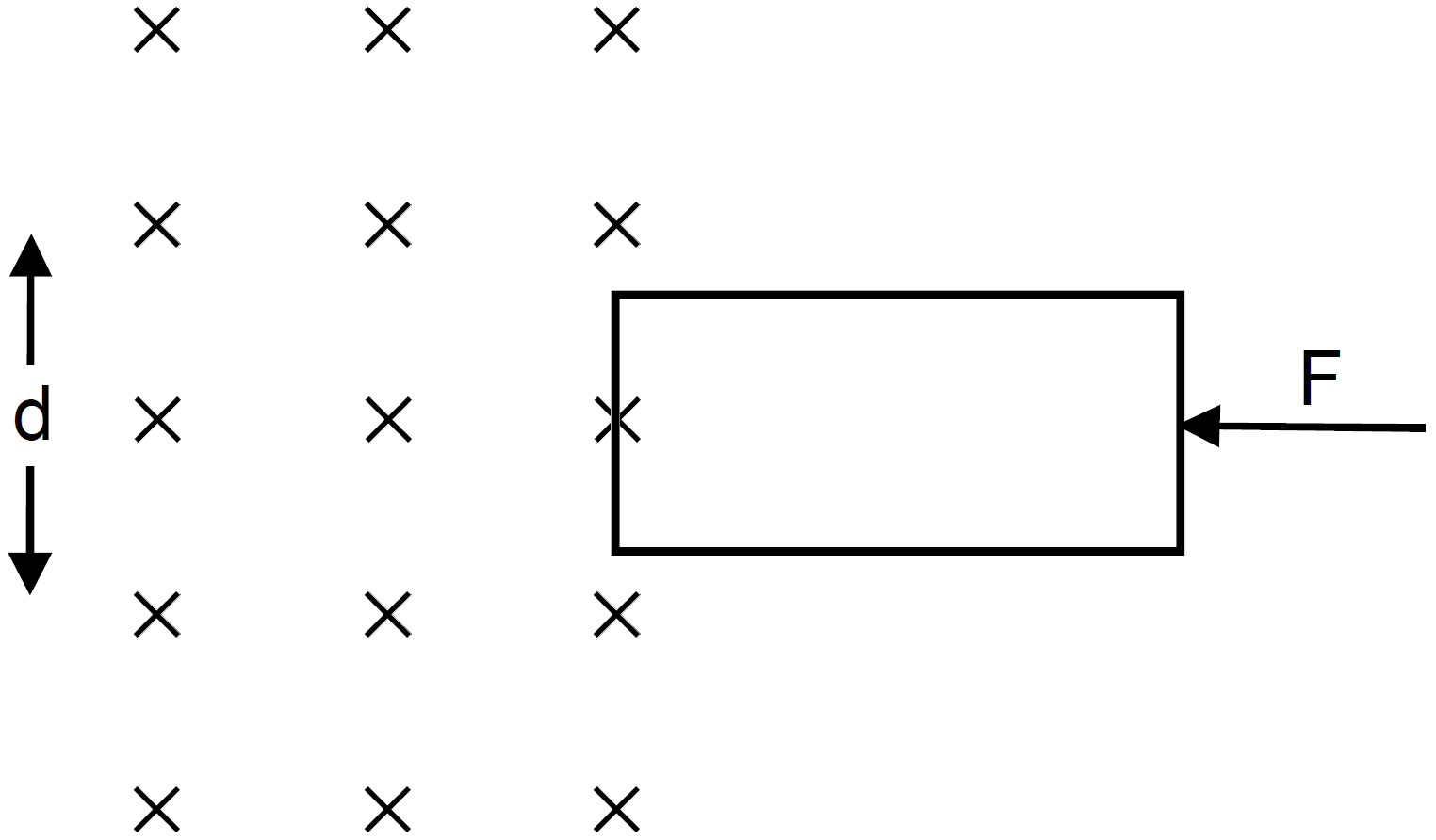
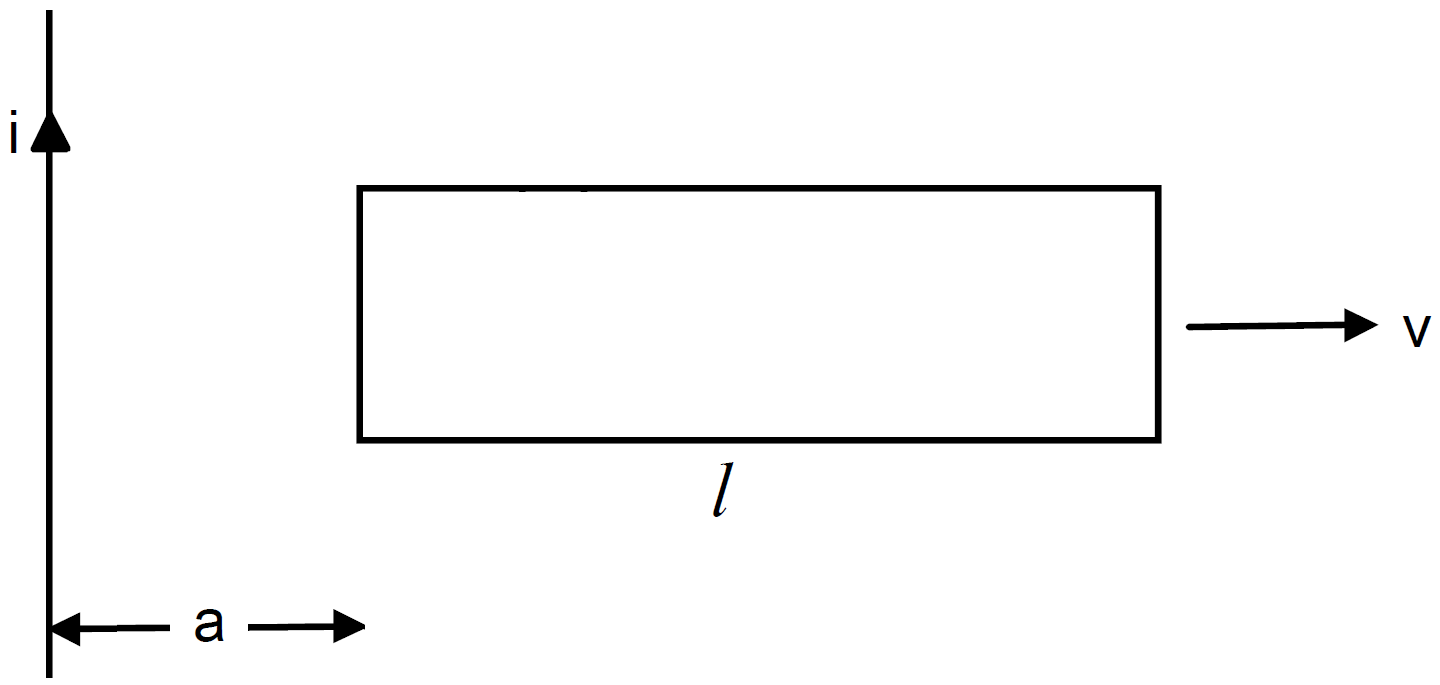
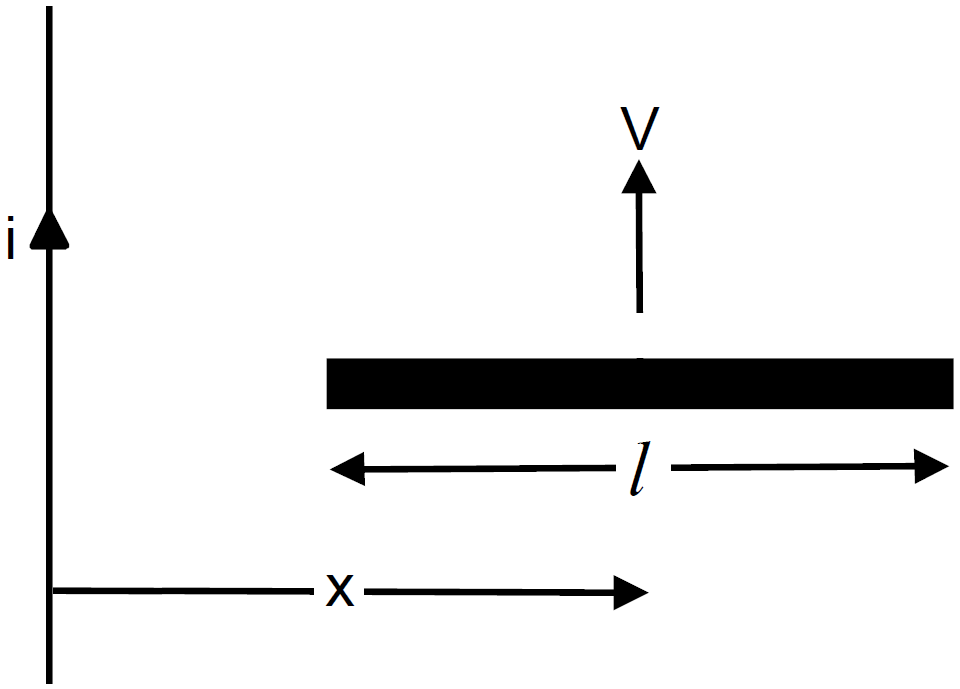
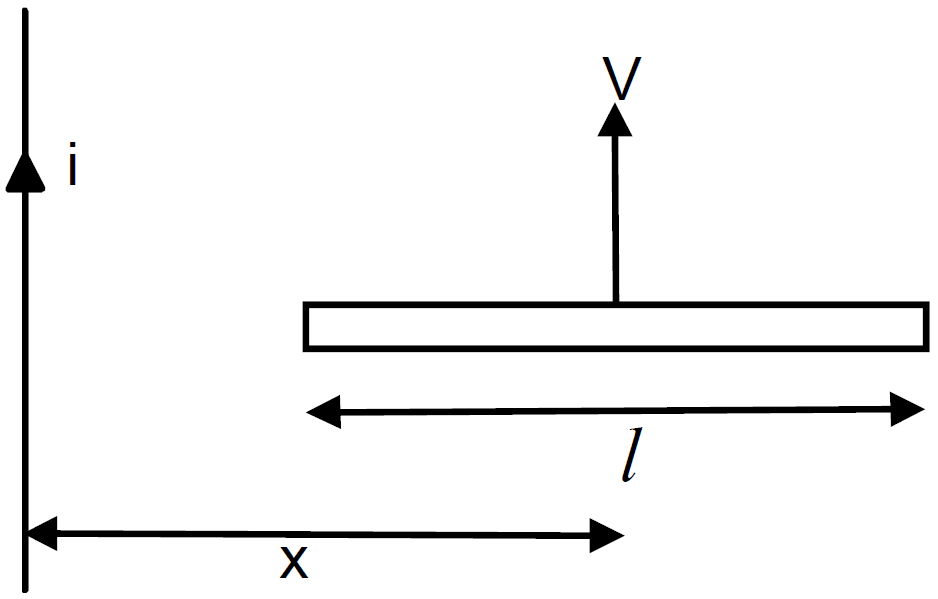
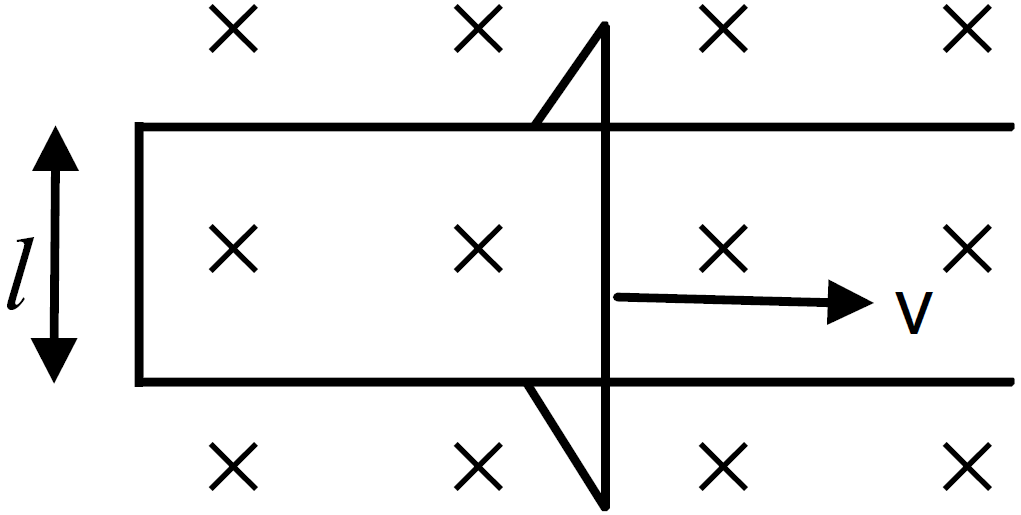
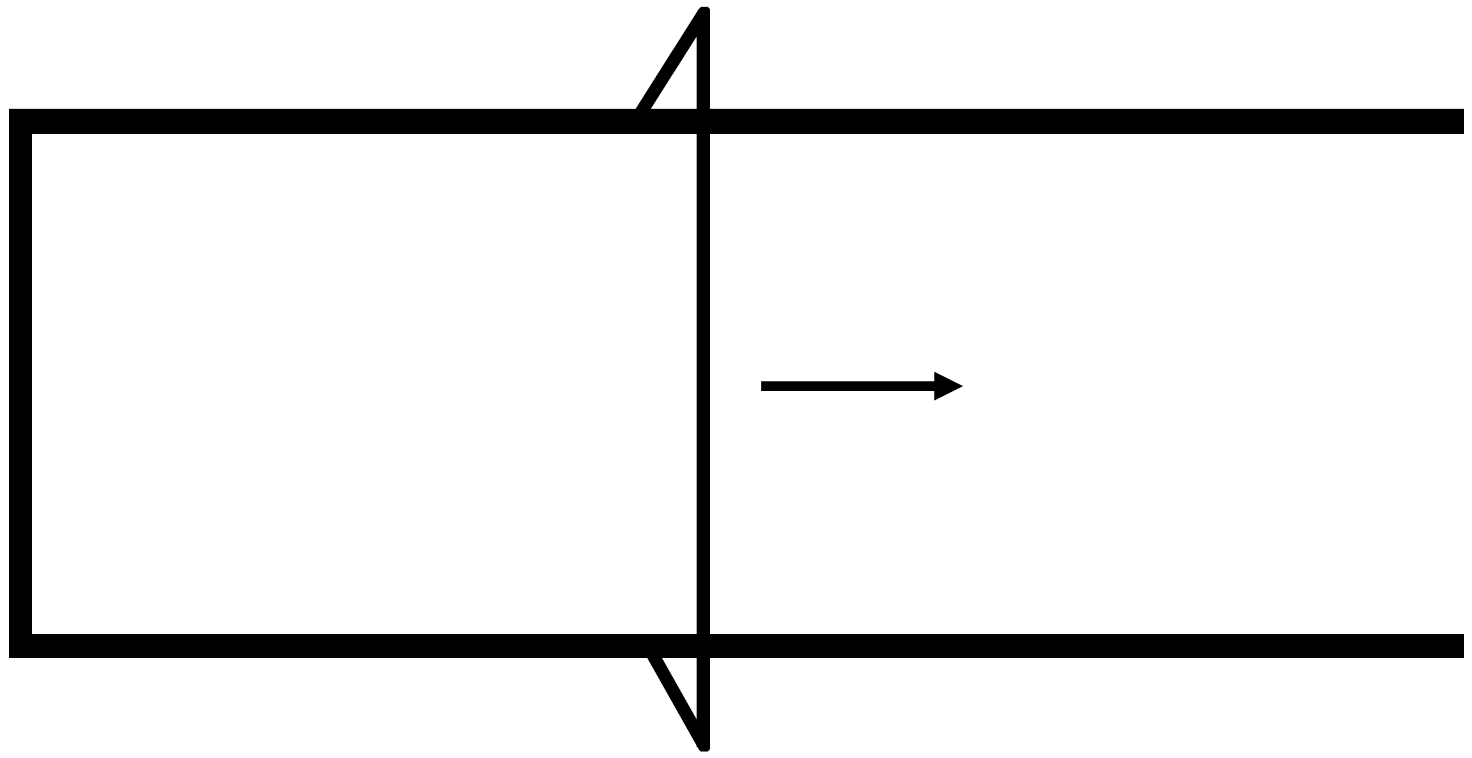
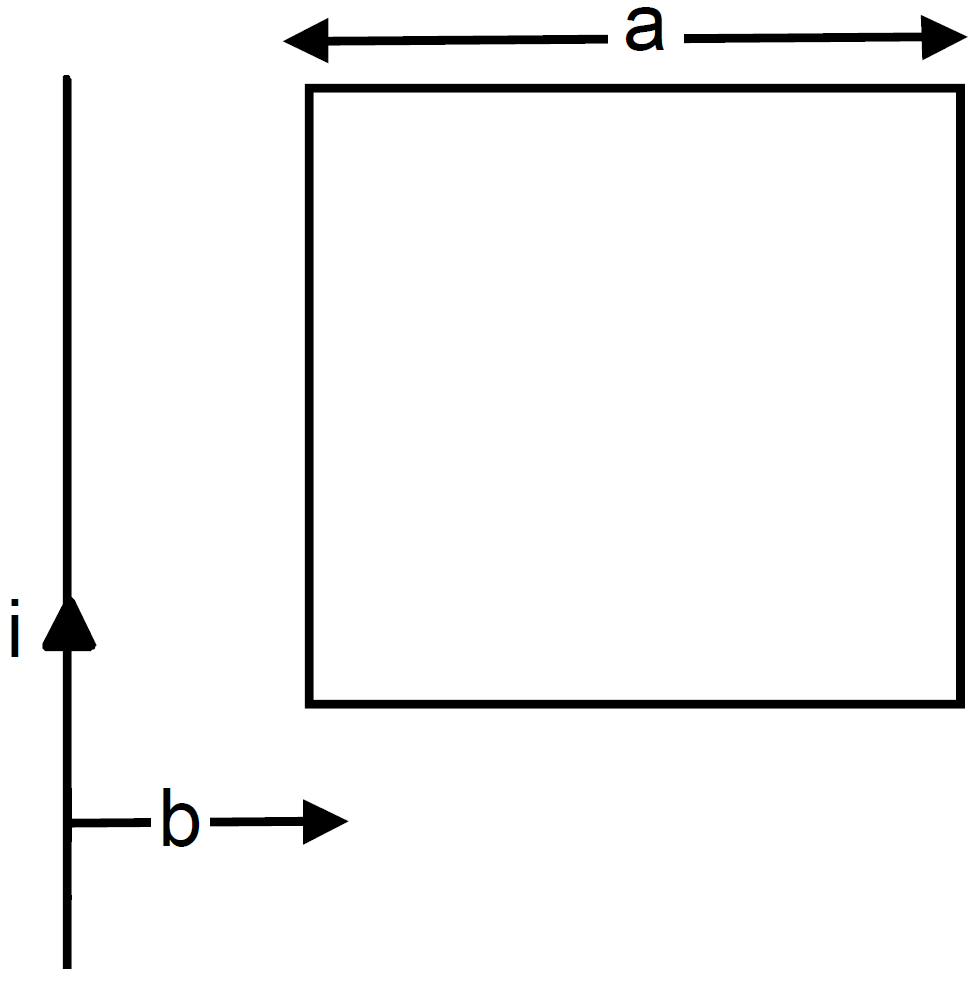
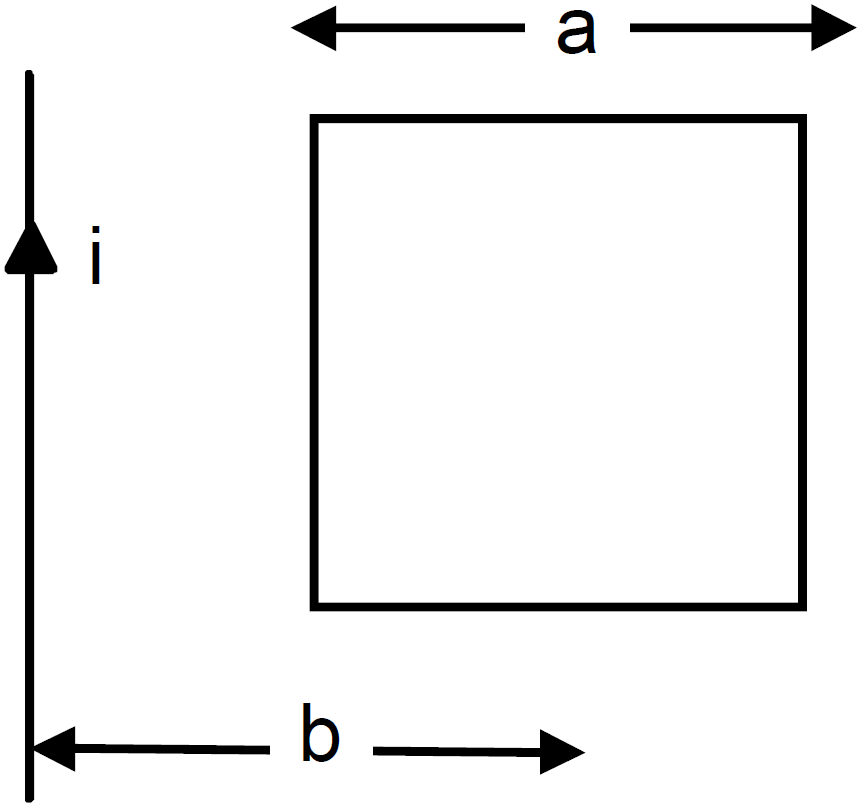
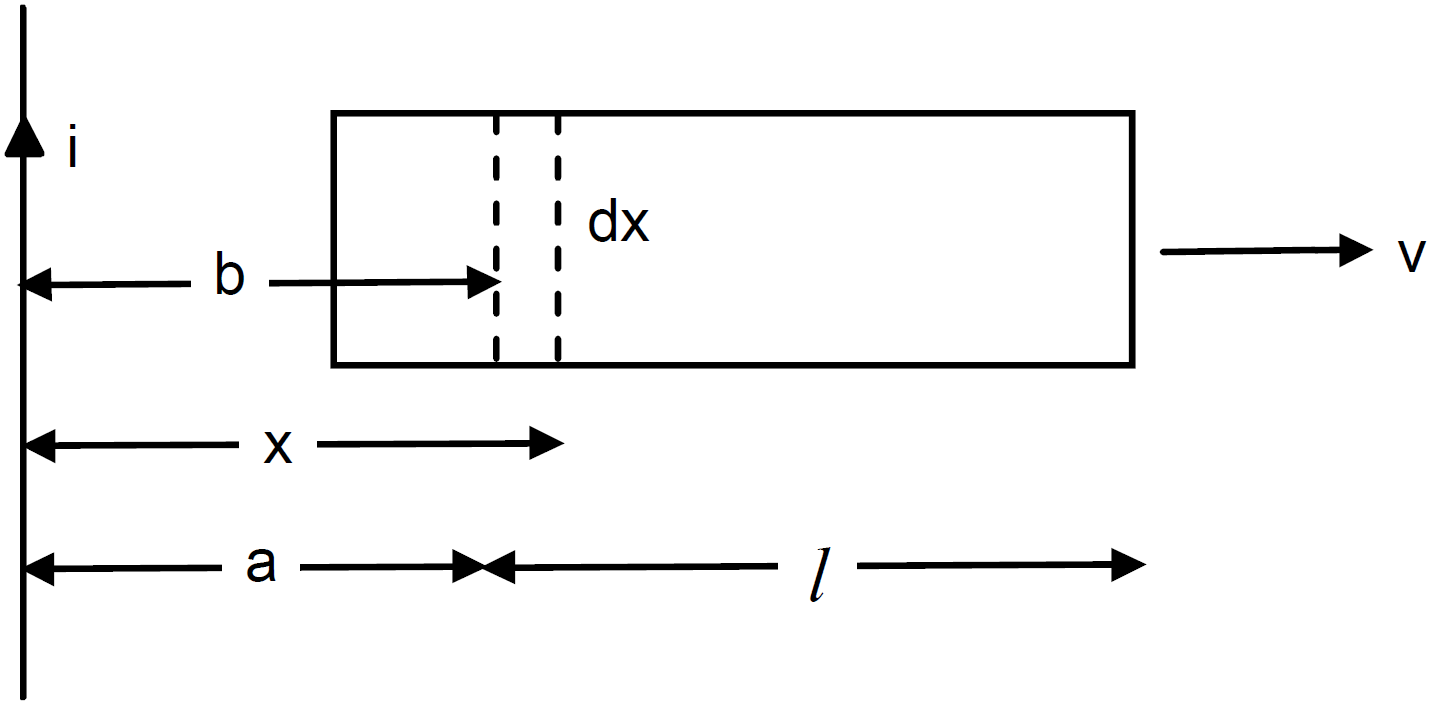 Using Faraday’' law Consider a unit length dx at a distance x $\text{B}=\frac{\mu_0\text{i}}{2\pi\text{x}}$ Area of strip $=\text{b} \ \text{dx}$ $\text{d}\phi=\frac{\mu_0\text{i}}{2\pi\text{x}}\text{dx}$ $\Rightarrow\phi=\int\limits^{\text{a}+1}_\text{a}\frac{\mu_0\text{i}}{2\pi\text{x}}\text{bdx}$ $=\frac{\mu_o\text{i}}{2\pi}\text{b}\int\limits^{\text{a}+1}_\text{a}\Big(\frac{\text{dx}}{\text{x}}\Big)=\frac{\mu_0\text{ib}}{2\pi}\log\Big(\frac{\text{a}+\text{l}}{\text{a}}\Big)$ $\text{Emf}=\frac{\text{d}\phi}{\text{dt}}=\text{dt}\Big[\frac{\mu_0\text{ib}}{2\pi}\text{log}\Big(\frac{\text{a}+\text{l}}{\text{a}}\Big)\Big]$ $=\frac{\mu_0\text{ib}}{2\pi}\frac{\text{a}}{\text{a}+\text{l}}\Big(\frac{\text{va}-(\text{a}+\text{l})\text{v}}{\text{a}^2}\Big)$ $\Big($ Where $\frac{\text{da}}{\text{dt}}=\text{V}\Big)$ $=\frac{\mu_0\text{ib}}{2\pi}\frac{\text{a}}{\text{a}+\text{l}}\frac{\text{vl}}{\text{a}^2}=\frac{\mu_0\text{ibvl}}{2\pi(\text{a}+\text{l})\text{a}}$ The velocity of AB and CD creates the emf. since the emf due to AD and BC are equal and opposite to each other.
 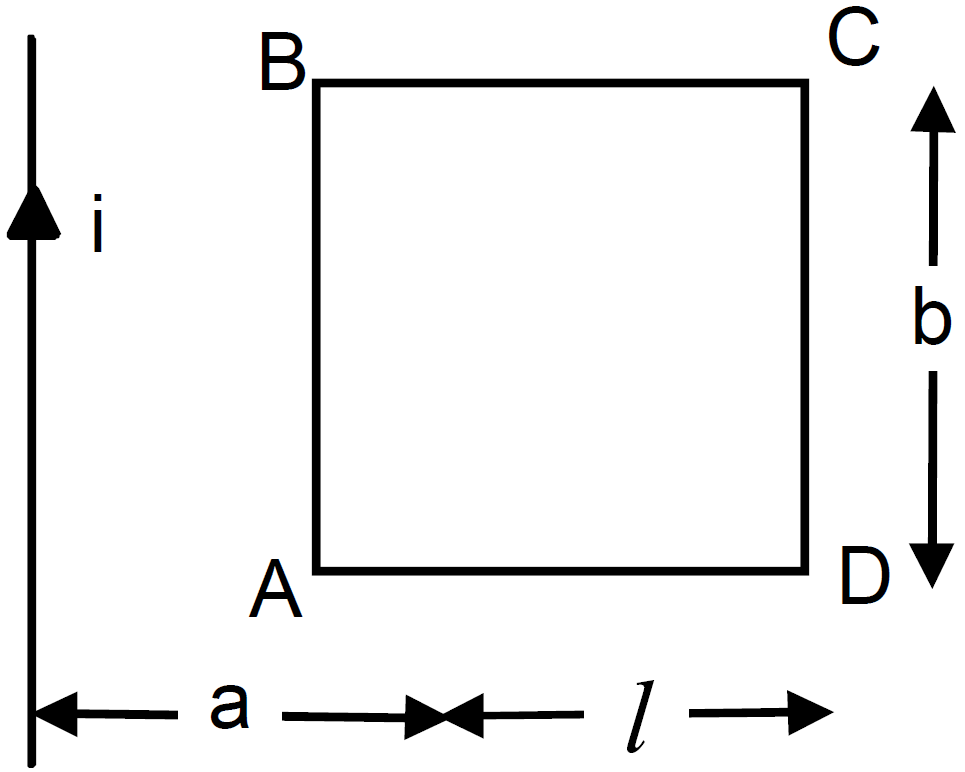 $\text{B}_{\text{AB}}=\frac{\mu_o\text{i}}{2\pi\text{a}} \ \Rightarrow \ \text{E.m.f.} \ \text{AB}=\frac{\mu_0\text{i}}{2\pi\text{a}}\text{bv}$ Length b, velocity v. $\text{B}_{\text{CD}}=\frac{\mu_0\text{i}}{2\pi(\text{a}+\text{l})}$ $\Rightarrow \text{E.m.f.} \ \text{CD}=\frac{\mu_0\text{ibv}}{2\pi(\text{a}+\text{l})}$ Length b, velocity v.Net emf $=\frac{\mu_0\text{i}}{2\pi\text{a}}\text{bv}-\frac{\mu_0\text{ibv}}{2\pi\text{a}(\text{a}+\text{l})}=\frac{\mu_0\text{ibvl}}{2\pi\text{a}(\text{a}+\text{l})}$