A resistor develops $300 \,J$ of thermal energy in $15 \,s$, when a current of $2\, A$ is passed through it. If the current increases to $3 \,A$, the energy developed in $10\,\,s$ is........$J.$
JEE MAIN 2022, Medium


Download our appand get started for free
Experience the future of education. Simply download our apps or reach out to us for more information. Let's shape the future of learning together!No signup needed.*
Similar Questions
- 1If $n,\,e,\,\tau $ and $m$ respectively represent the density, charge relaxation time and mass of the electron, then the resistance of a wire of length $l$ and area of cross-section $A$ will beView Solution
- 2Masses of three wires of copper are in the ratio of $1 : 3 : 5$ and their lengths are in the ratio of $5:3:1.$ The ratio of their electrical resistances areView Solution
- 3View SolutionTo draw maximum current from a combination of cells, how should the cells be grouped
- 4Two wires of same metal have the same length but their cross-sections are in the ratio $3:1$. They are joined in series. The resistance of the thicker wire is $10\,\Omega $. The total resistance of the combination will be ............. $\Omega$View Solution
- 5A bulb rated at ($100\,W$ - $200\,V$) is used on a $100\,V$ line. The current in the bulb isView Solution
- 6View SolutionThe net resistance of a voltmeter should be large to ensure that
- 7Find potential difference across $24\,\Omega $ ............. $\mathrm{volt}$View Solution
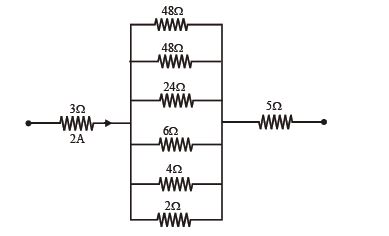
- 8A $60\, watt$ bulb operates on $220\,V$ supply. The current flowing through the bulb isView Solution
- 9In the given figure, the $emf$ of the cell is $2.2\, {V}$ and if internal resistance is $0.6\, \Omega$. Calculate the power dissipated in the whole circuit: (in $W$)View Solution
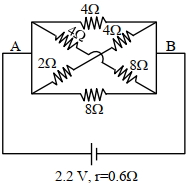
- 10A current of $10\, amp$ is passing through a metallic wire of cross sectional area $4 \times 10^{-6}\, m ^{2}$. If the density of the aluminum conductor is $2.7\, gm / cc$ considering aluminum gives $1$ electrons per atom for conduction find the drift speed of the electrons is ......... $\times 10^{-4} \,m / s$ if molecular weight of aluminum is $27 \,gm$.View Solution