A resonance tube is old and has jagged end. It is still used in the laboratory to determine velocity of sound in air. A tuning fork of frequency $512\,Hz$ produces first resonance when the tube is filled with water to a mark $11\,cm$ below a reference mark, near the open end of the tube. The experiment is repeated with another fork of frequency $256\,Hz$ which produces first resonance when water reaches a mark $27\,cm$ below the reference mark. The velocity of sound in air, obtained in the experiment, is close to .... $ms^{-1}$
JEE MAIN 2019, Diffcult
Download our app for free and get started
$\lambda_{1}=4(11+\mathrm{e}) =\frac{\mathrm{v}}{512}$
$\lambda_{2}=4(27+e)=\frac{V}{256}$
$\frac{11+e}{27+e}=\frac{1}{2}$
$\Rightarrow \quad 22+2 e=27+e$
$\Rightarrow \quad e=5$

Download our appand get started for free
Experience the future of education. Simply download our apps or reach out to us for more information. Let's shape the future of learning together!No signup needed.*
Similar Questions
- 1View SolutionThe number of waves contained in unit length of the medium is called
- 2Consider two sound sources $S_1$ and $s_2$ having same frequency $100\,\,Hz$ and the observer $O$ located between them as shown in the fig. All the three are moving with same velocity in same direction. The beat frequency of the observer is .... $Hz$View Solution

- 3A sound absorber attenuates the sound level by $20\ dB$. The intensity decreases by a factor ofView Solution
- 4View SolutionCoherent sources are characterized by the same
- 5If two waves having amplitudes $2A$ and $A$ and same frequency and velocity, propagate in the same direction in the same phase, the resulting amplitude will beView Solution
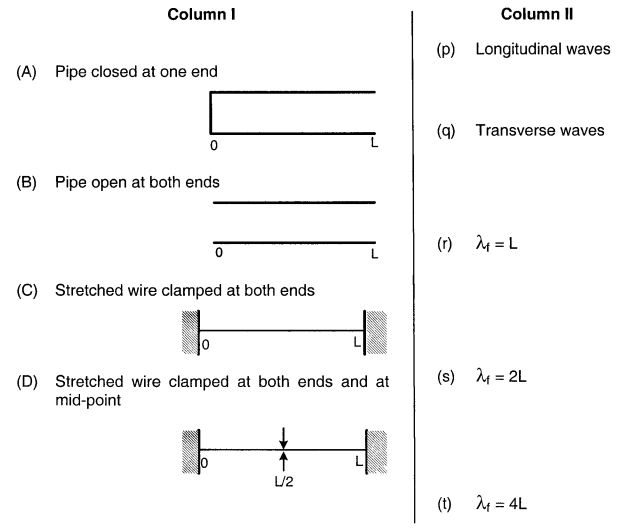
- 6Column $I$ shows four systems, each of the same length $L$, for producing standing waves. The lowest possible natural frequency of a system is called its fundamental frequency, whose wavelength is denoted as $\lambda_{ f }$. Match each system with statements given in Column $II$ describing the nature and wavelength of the standing waves.View Solution
- 7A boat at anchor is rocked by waves whose crests are $100\, m$ apart and velocity is $25\, m/sec$. The boat bounces up once in every: ... $sec$View Solution
- 8Two sources $A$ and $B$ are sounding notes of frequency $660 \,Hz$. $A$ listener moves from $A$ to $B$ with a constant velocity $u$. If the speed of sound is $330 \,m / s$, what must be the value of $u$ so that he hears $8$ beats per second is .......... $m / s$View Solution
- 9An open organ pipe of length $l$ is sounded together with another organ pipe of length $l + x$ in their fundamental tones $(x < < l)$. The beat frequency heard will be (speed of sound is $v$) :View Solution
- 10The ratio of the velocity of sound in hydrogen gas $(\gamma = 7/5)$ to that in helium gas $(\gamma = 5/3)$ at the same temperature will beView Solution