MCQ
A reversible heat engine converts one-fourth of the heat input into work. When the temperature of the sink is reduced by $52\, K$, its efficiency is doubled. The temperature in Kelvin of the source will be ...... .
  • A
    $256$
  • $208$
  • C
    $104$
  • D
    $52$

Answer

Correct option: B.
$208$
b
$\eta=\frac{1}{4}=1-\frac{ T _{2}}{ T _{1}}$

$\frac{ T _{2}}{ T _{1}}=\frac{3}{4}$

$\frac{ T _{2}-52}{ T _{1}}=\frac{1}{2}$

Need a full question paper?

Generate a complete, print-ready paper with questions like this in minutes — across 16+ boards, with answer keys.
Start Generating Free

Similar questions

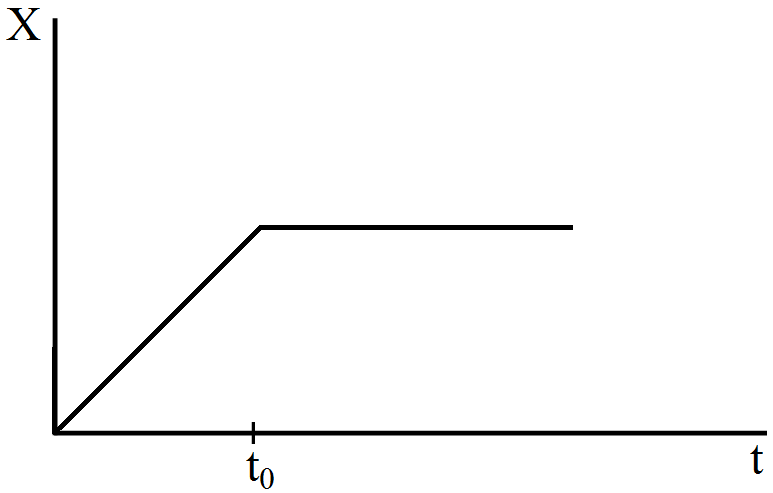
Figure shows the displacement-time graph of a particle moving on the $X-$axis.
A disc is rotating with an angular velocity $\omega _0. $  A constant retrarding torque is applied on it to stop the disc. The angular velocity becomes $(\omega _0/2)$  after $n$ rotations. How many more rotations will it make before coming to rest ?
On celcius scale the temperature of body increases by $40^{\circ} \mathrm{C}$. The increase in temperature on Fahrenheit scale is:
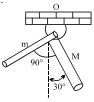
Two uniform rods of equal length but different masses are rigidly joined to form an $L$ -shaped body, which is then pivoted as shown. If in equilibrium the body is in the shown configuration, ratio $M/m$ will be:
According to second law of thermodynamics:
Which one of the following represents displacement time graph of two objects $A$ and $B$ moving with zero relative velocity ?
A projectile is thrown into space so as to have a maximum possible horizontal range of $400$ metres. Taking the point of projection as the origin, the co-ordinates of the point where the velocity of the projectile is minimum are
The fraction of a floating object of volume ${V_0}$ and density ${d_0}$ above the surface of a liquid of density $d$  will be
This question has Statement $1$ and Statement $2.$ Of the four choices given after the Statements, choose the one that best describes the two Statements.
Statement $1:$ In an adiabatic process, change in internal energy of a gas is equal to work done on/by the gas in the process.

Statement $2 :$ The temperature of a gas remains constant in an adiabatic process.

Sound waves travel at $350\,\, m/s$ through a warm air and at $3500\,\, m/s$ through brass. The wavelength of a $700\,\, Hz$ acoustic wave as it enters brass from warm air