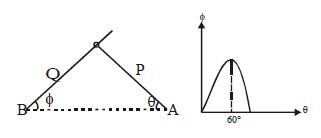
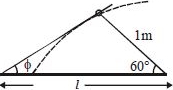
A rod $P$ of length $1\ m$ is hinged at one end $A$ and there is a ring attached to the other end. Another long rod $Q$ is hinged at $B$ and it passes through the ring. The rod $P$ is rotated about an axis which is perpendicular to plane in which both the rods are present and the variation between the angles $\theta$ and $\phi $ are plotted as shown. The distance between the hinges $A$ and $B$ is ....... $m$.
Diffcult


Download our appand get started for free
Experience the future of education. Simply download our apps or reach out to us for more information. Let's shape the future of learning together!No signup needed.*
Similar Questions
- 1View SolutionA motorcyclist of mass m is to negotiate a curve of radius r with a speed v. The minimum value of the coefficient of friction so that this negotiation may take place safely, is
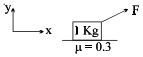
- 2A $\vec F\,\, = \,\,\hat i\, + \,4\hat j\,$ acts on block shown. The force of friction acting on the block is :View Solution
- 3At time $t=0$, a disk of radius $1 m$ starts to roll without slipping on a horizontal plane with an angular acceleration of $\alpha=\frac{2}{3} rad s ^{-2}$. A small stone is stuck to the disk. At $t=0$, it is at the contact point of the disk and the plane. Later, at time $t=\sqrt{\pi} s$, the stone detaches itself and flies off tangentially from the disk. The maximum height (in $m$ ) reached by the stone measured from the plane is $\frac{1}{2}+\frac{x}{10}$. The value of $x$ is. . . . . . .[Take $g=10 m s ^{-2}$.]View Solution
- 4A block of mass $M = 5\,kg$ is resting on a rough horizontal surface for which the coefficient of friction is $0.2$. When a force $F = 40\,\,N$ is applied, the acceleration of the block will be ........ $m/\sec^2$ $(g = 10\,\,m/{\sec^2})$View Solution
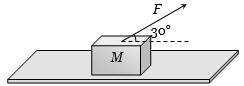
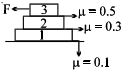
- 5If force $F$ is increasing with time and at $t = 0 , F = 0$ where will slipping first start?View Solution
- 6A gramophone record is revolving with an angular velocity $\omega$. A coin is placed at a distance $r$ from the centre of the record. The static coefficient of friction is $\mu .$ The coin will revolve with the record ifView Solution
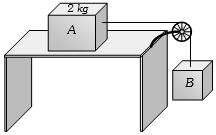
- 7The coefficient of static friction, ${\mu _s},$ between block $A$ of mass $2\, kg$ and the table as shown in the figure is $0.2$. ........ $kg$ would be the maximum mass value of block $B$ so that the two blocks do not move. The string and the pulley are assumed to be smooth and massless. $(g = 10\,m/{s^2})$View Solution
- 8A coin is placed on a disc. The coefficient of friction between the coin and the disc is $\mu$. If the distance of the coin from the center of the disc is $r$, the maximum angular velocity which can be given to the disc, so that the coin does not slip away, is:View Solution
- 9A vehicle is moving with a velocity $v$ on a curved road of width $b$ and radius of curvature $R.$ For counteracting the centrifugal force on the vehicle, the difference in elevation required in between the outer and inner edges of the road isView Solution
- 10A body of mass $1\, kg$ tied to one end of string is revolved in a horizontal circle of radius $0.1\, m$ with a speed of $3$ revolution/sec, assuming the effect of gravity is negligible, then linear velocity, acceleration and tension in the string will beView Solution