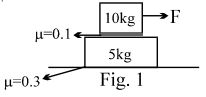
The maximum $"F"$ which will not cause motion of any of the blocks. ...... $N$
Difficult
Download our app for free and get started

Download our appand get started for free
Experience the future of education. Simply download our apps or reach out to us for more information. Let's shape the future of learning together!No signup needed.*
Similar Questions
- 1On the horizontal surface of a truck a block of mass $1 \;kg$ is placed $(\mu=0.6)$ and truck is moving with acceleration $5\; m / sec ^2$ then the frictional force on the block will beView Solution
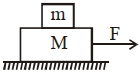
- 2Two blocks $( m =0.5\, kg$ and $M =4.5\, kg$ ) are arranged on a horizontal frictionless table as shown in figure. The coefficient of static friction between the two blocks is $\frac{3}{7} .$ Then the maximum horizontal force that can be applied on the larger block so that the blocks move together is ......... $N.$ (Round off to the Nearest Integer) [Take g as $9.8\, ms ^{-2}$ ]View Solution
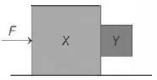
- 3Consider the system shown below. A horizontal force $F$ is applied to a block $X$ of mass $8 \,kg$, such that the block $Y$ of mass $2 \,kg$ adjacent to it does not slip downwards under gravity. There is no friction between the horizontal plane and the base of the block $X$. The coefficient of friction between the surfaces of blocks $X$ and $Y$ is $0.5$. The minimum value of $F$ is ............ $N$ (take, acceleration due to gravity to be $10 \,ms ^{-2}$ )View Solution
- 4A hemispherical bowl of radius $r$ is set rotating about its axis of symmetry in vertical. A small block kept in the bowl rotates with bowl without slipping on its surface. If the surface of the bowl is smooth and the angle made by the radius through the block with the vertical is $\theta$, then find the angular speed at which the ball is rotating.View Solution
- 5A block rests on a rough inclined plane making an angle of ${30^o}$ with the horizontal. The coefficient of static friction between the block and the plane is $0.8$. If the frictional force on the block is $10 \,N$, the mass of the block (in kg) is (take $g = 10\,\,m/{s^2})$View Solution
- 6If ${\mu _s},\,{\mu _k}$ and ${\mu _r}$ are coefficients of static friction, sliding friction and rolling friction, thenView Solution
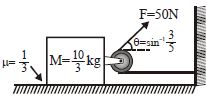
- 7In the given figure the acceleration of $M$ is $(g = 10 \,ms^{-2})$View Solution
- 8View SolutionThe limiting friction between two bodies in contact is independent of
- 9A body of mass $10\,kg$ is moving with an initial speed of $20\,m / s$. The body stops after $5\,s$ due to friction between body and the floor. The value of the coefficient of friction is (Take acceleration due to gravity $g =10\; ms ^{-2}$)View Solution
- 10$A$ block placed on a rough inclined plane of inclination $(\theta =30^o)$ can just be pushed upwards by applying $a$ force $"F"$ as shown. If the angle of inclination of the inclined plane is increased to $(\theta = 60^o)$, the same block can just be prevented from sliding down by application of a force of same magnitude. Thecoefficient of friction between the block and the inclined plane isView Solution
