Question
A rubber string 10 m long is suspended from a rigid support at its one end. Calculate the extension in the string due to its own weight. The density of rubber is $1.5 \times 10^3 \mathrm{~kg} / \mathrm{m}^3$ and Young's modulus for the rubber is $5 \times 10^6 \mathrm{~N} / \mathrm{m}^2$. The breaking stress for a metal is $7.8 \times 10^9 \mathrm{~N} / \mathrm{m}^2$. Calculate the maximum length of the wire made of this metal which may be suspended without breaking. The density of metal $=7.8 \times 10^3 \mathrm{~kg} / \mathrm{m}^3$.
Answer


$\text{l}=10\text{m},\rho=15\times10^3\text{kg}\ \text{m}^3$
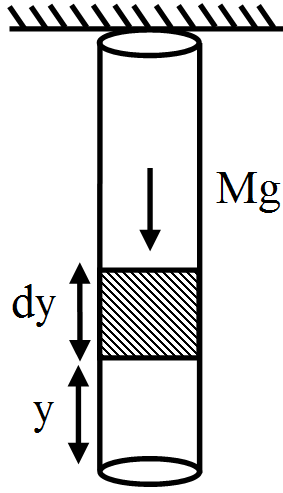
$\text{Y}=5\times10^6\text{N}\text{m}^2$ We know, $\text{Y}=\frac{\text{F.l}}{\text{A}\Delta\text{l}}$ Efficient force = Mg Consider a small length dy at a distance y from free end. The length above this, (l - y) wil experience a force of, $\text{F}_\text{dy}=\frac{\text{M}}{\text{l}}(\text{dy}).\text{gdy}$
$\therefore$ Extension dI $=\frac{\text{F}.\text{l}}{\text{AY}}$
$\Rightarrow\text{dl}=\frac{(\text{l}-\text{y})}{\text{AY}}.\frac{\text{M}}{\text{l}}\text{gdy}$
$=\frac{\text{Mg}}{\text{lAY}}(\text{l}-\text{y})\text{dy}$ Net extension due to its own weight} $=\int\text{dl}$
$=\frac{\text{Mg}}{\text{AYl}}\int(\text{l}-\text{y})$
$=\frac{\text{Mg}}{\text{lAY}}\Big[\text{ly}-\frac{\text{y}^2}{2}\Big]^\text{l}_0=\frac{\text{Mgl}}{2\text{AY}}$ Net extension $=\frac{\text{Mgl}}{2}=\frac{\text{Mgl}^2}{2\text{YV}}=\frac{\rho\text{gl}^2}{2\text{Y}}$ Extcnrion of rubbcer string, $=\frac{1.5\times10^3\times10\times10^2}{2\times5\times10^6}=0.15\text{m}$ Breaking stress for a metal = $7.8 \times 10^9N/ m^2$ Density = $7.8 \times 10^3kg/ m^3$. Stress $=\frac{\text{Force}}{\text{Area}}=\frac{\text{Mg}}{\text{A}}=\frac{\text{Mgl}}{\text{Al}}=\frac{\text{Mgl}}{\text{Volume}}\rho\text{gl}$ If $\rho\text{gl}>$ Breaking stress, the wire will break.
$\therefore\text{l}\leq\frac{7.8\times10^9}{\rho\text{g}},\text{l}\leq\frac{7.8\times10^9}{7.8\times10^3\times10}$ i.e., $\text{l}\leq10^5\text{m}$ Maximum length of wire = $10^5m$.

Need a full question paper?

Generate a complete, print-ready paper with questions like this in minutes — across 16+ boards, with answer keys.

Start Generating Free

Similar questions

Find the charges on the four capacitors of capacitances $1\mu\text{F},2\mu\text{F},3\mu\text{F}$ and $4\mu\text{F}$ shown in the figure.
Explain the molecular nature of matter. What are the factors affecting Brownian motion? Describe them.
A vector has magnitude and direction. Does it have a location in space? Can it vary with time? Will two equal vectors a and b at different locations in space necessarily have identical physical effects? Give examples in support of your answer.
A long cylindrical volume contains a uniformly distributed charge of density $\rho.$ Find the electric field at a point P inside the cylindrical volume at a distance x from its axis (figure).
  1. It is known that density r of air decreases with height y as $\rho_0\text{e}^{-\frac{\text{y}}{\text{y}_0}}$ where $\rho=1.25\text{kg m}^{-3}$ is the density at sea level, and $y_0$ is a constant. This density variation is called the law of atmospheres. Obtain this law assuming that the temperature of atmosphere remains a constant (isothermal conditions). Also assume that the value of g remains constant.
  2. A large He balloon of volume $1425m^3$ is used to lift a payload of $400kg$. Assume that the balloon maintains constant radius as it rises. How high does it rise? [Take $y^0 = 8000m$ and $rHe = 0.18 kgm^{–3}$​​​​​​​​​​​​​​].
Explain the resolution of a vector in a threedimensional coordinate system and prove that
$
|\overrightarrow{A}|=\sqrt{A_x^2+A_y^2+A_z^2}
$
A spherical ball of surface area $20 \mathrm{~cm}^2$ absorbs any radiation that falls on it. It is suspended in a closed box maintained at $57^{\circ} \mathrm{C}$.
a. Find the amount of radiation falling on the ball per second.
b. Find the net rate of heat flow to or from the ball at an instant when its temperature is $200^{\circ} \mathrm{C}$. Stefan constant $=$ $6.0 \times 10^{-8} \mathrm{Wm}^{-2} \mathrm{~K}^{-4}$.
At what temperature is the root mean square speed of an atom in an argon gas cylinder equal to the rms speed of a helium gas atom at$-20°C$? (atomic mass of $Ar = 39.9u,$ of $He = 4.0u$).
What is thermal expansion of gases? Prove that the value of volume coefficient and pressure coefficient are equal.
A circular disc of mass $10kg$ is suspended by a wire attached to its centre. The wire is twisted by rotating the disc and released. The period of torsional oscillations is found to be $1.5s$. The radius of the disc is $15cm$. Determine the torsional spring constant of the wire. (Torsional spring constant $\alpha$ is defined by the relation $\text{J}=-\alpha\theta,$ where J is the restoring couple and $\theta$ the angle of twist).