Question
Explain the molecular nature of matter. What are the factors affecting Brownian motion? Describe them.
Answer

SELF

Need a full question paper?

Generate a complete, print-ready paper with questions like this in minutes — across 16+ boards, with answer keys.

Start Generating Free

Similar questions

A star $2.5$ times the mass of the sun and collapsed to a size of $12km$ rotates with a speed of $1.2$ rev. per second. (Extremely compact stars of this kind are known as neutron stars. Certain stellar objects called pulsars belong to this category). Will an object placed on its equator remain stuck to its surface due to gravity? (mass of the sun = $2 \times 10^{30}kg$).
A certain element emits $\text{K}_\alpha$ X-ray of energy 3.69keV. Use the data from the previous problem to identify the element.
What is meant by limit of elasticity? Write Hooke's law of elasticity. Based on this establish the formula of Young's Modulus of elasticity and give the definition of Young's Modulus of elasticity.
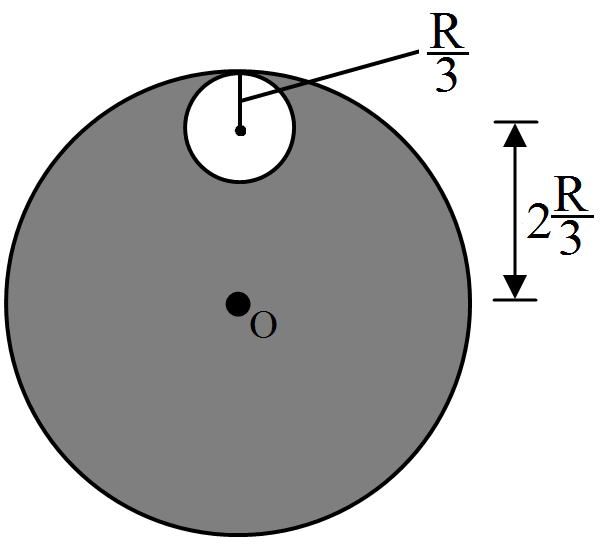
From a circular disc of radius R and mass 9M, a small disc of radius $\frac{\text{R}}{3}$ is removed as shown in Fig. Find the moment of inertia of the remaining disc about an axis perpendicular to the plane of the disc and passing through the point O.
A cricket ball is thrown at a speed of 28m/ s in a direction 30° above the horizontal. Calculate:
  1. The maximum height.
  2. The time taken by the ball to return to the same level.
  3. The horizontal distance from the point of projection to the point where the ball returns to the same level.
How much faster does a cup of coffee cool off from 100°C than from 30°C? Assume the coffee to act as a blackbody and temperature of surrounding is 20°C.
What is a fixed volume thermometer? Explain its principle. How is it better than a mercury thermometer?
Establish an expression for potential energy for the inner points of a spherical object.
Separation of Motion of a system of particles into motion of the centre of mass and motion about the centre of mass: Show $\text{p}=\text{p}'_\text{i}+\text{m}_\text{i}\text{V}$ where $p_i$ is the momentum of the ith particle (of mass $m_i$ ) and $p′_i = m_iv′_i.$ Note: $v′_i$ is the velocity of the ith particle relative to the centre of mass. Also, prove using the definition of the centre of mass.
Find the time period of small oscillations of the following systems.
  1. A metre stick suspended through the $20cm$ mark.
  2. A ring of mass in and radius r suspended through a point on its periphery.
  3. A uniform square plate of edge a suspended through a corner.
  4. A unifrom disc of mass m and radius r suspended through a point $\frac{\text{r}}{2}$ away from the centre.