Question
A vector has magnitude and direction. Does it have a location in space? Can it vary with time? Will two equal vectors a and b at different locations in space necessarily have identical physical effects? Give examples in support of your answer.

Answer

Does it have a location in space? No; Can it vary with time? Yes; Will two equal vectors a and b at different locations in space necessarily have identical physical effects? No Generally speaking, a vector has no definite locations in space. This is because a vector remains invariant when displaced in such a way that its magnitude and direction remain the same. However, a position vector has a definite location in space. A vector can vary with time. For example, the displacement vector of a particle moving with a certain velocity varies with time. Two equal vectors located at different locations in space need not produce the same physical effect. For example, two equal forces acting on an object at different points can cause the body to rotate, but their combination cannot produce an equal turning effect.
Need a full question paper?

Generate a complete, print-ready paper with questions like this in minutes — across 16+ boards, with answer keys.

Start Generating Free

Similar questions

Show that if n equal rain droplets falling through air with equal steady velocity of $10cm s^{-1}$ coalesce, the resultant drop attains a new terminal velocity of $10n^{2/3}cm s^{-1}$​​​​​​​.
The escape speed of a projectile on the earth’s surface is $11.2km s^{-1}$. A body is projected out with thrice this speed. What is the speed of the body far away from the earth? Ignore the presence of the sun and other planets.
Consider a rectangular block of wood moving with a velocity $v_0$ in a gas at temperature T and mass density ρ. Assume the velocity is along x-axis and the area of cross-section of the block perpendicular to v0 is A. Show that the drag force on the block is $4\rho\text{ Av}_0\sqrt{\frac{\text{KT}}{\text{m}}}$ where m is the mass of the gas molecule.
A satellite is in an elliptic orbit around the earth with aphelion of $6R$ and perihelion of 2R where $R = 6400km$ is the radius of the earth. Find eccentricity of the orbit. Find the velocity of the satellite at apogee and perigee. What should be done if this satellite has to be transferred to a circular orbit of radius $6R$?[$G = 6.67 \times 10^{–11}$ SI units and $4M = 6 \times 10^{24}kg$]
Define molar specific heat capacities at constant volume and pressure. Considering thermodynamical process in a cylinder with parameters P, V and T, derive the Mayer's relation.
You are riding in an automatic vehicle of mass 3000 kg . Assume that you are testing the oscillatory characteristics of the suspension system of this vechicle when the entire vehicle is placed on it, the suspended is inclined by 15 cm . Also, the amplitude of oscillation decreases by $50 \%$ in the period of one complete oscillation. Estimate the value of the following
(a) spring constant, and
(b) for the shock absorber system of a spring and $a$ wheel damping constant $b$.
Assume that each wheel carries a mass of 750 kg is.
Given the example of the motion in the following cases:
  1. Where magnitude and direction of the acceleration of the particle changes.
  2. Where the magnitude and direction of acceleration of body remains constant.
  3. Where magnitude of acceleration changes but its direction remains constants.
  4. Where the magnitude of acceleration remains constant but its direction changes.
From a uniform disk of radius R, a circular hole of radius $\frac{\text{R}}{2}$ is cut out. The centre of the hole is at $\frac{\text{R}}{2}$ from the centre of the original disc. Locate the centre of gravity of the resulting flat body.
What are the rules for finding the significant figures? Explain each rule with an example.
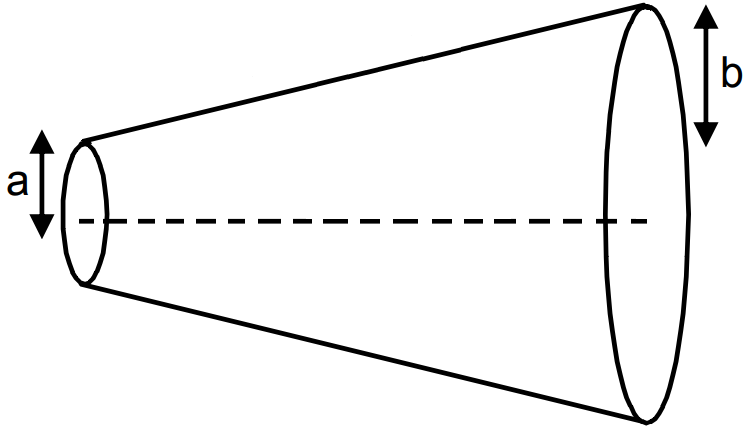
Figure. shows a conductor of length l with a circular cross-section. The radius of the cross-section varies linearly from a to b. The resistivity of the material is ρ. Assuming that b - a << l, find the resistance of the conductor.