Question
A sample of an ideal gas $(\gamma=1.5)$ is compressed adiabatically from a volume of $150cm^3$ to $50cm^3$. The initial pressure and the initial temperature are $150kPa$ and $300K$. Find,
  1. The number of moles of the gas in the sample.
  2. The molar heat capacity at constant volume.
  3. The final pressure and temperature.
  4. The work done by the gas in the process.
  5. The change in internal energy of the gas.
Answer

PV = nRT
Given,
$P = 150KPa = 150 \times 10^3Pa, V = 150cm^3= 150 \times 10^{-6}m^3, T = 300k$
  1. $\text{n}=\frac{\text{PV}}{\text{RT}}=\frac{150\times10^3\times150\times10^{-6}}{8.3\times300}$
$=9.036\times10^{-3}=0.009\ \text{moles}.$
  1. $\frac{\text{C}_\text{p}}{\text{C}_\text{v}}=\gamma$
$\Rightarrow\frac{\gamma\text{R}}{(\gamma-1)\text{C}_\text{v}}=\gamma$ $\Big[\therefore\ \text{C}_\text{p}=\frac{\gamma\text{R}}{\gamma-1}\Big]$
$\Rightarrow\text{C}_\text{v}=\frac{\text{R}}{\gamma-1}=\frac{8.3}{1.5-1}=\frac{8.3}{0.5}$
$=2\text{R}=16.6\text{J/mole}$
  1. Given,
$P_1 = 150KPa = 150 \times 10^3Pa, P_2 = ?$
$V_1 = 150cm^3 = 150 \times 10^{-6}m^3, \gamma=1.5$
$V_2 = 50cm^3= 50 \times 10^{-6}m^3, T_1 = 300k, T_2= ?$
Since the process is adiabatic. Hence,
$-\text{P}_1\text{V}_1^\gamma=\text{P}_2\text{V}_2^\gamma$
$\Rightarrow150\times10^3(150\times10^{-6})^\gamma=\text{P}_2\times(50\times10^{-6})^\gamma$
$\Rightarrow\text{P}_2=150\times10^3\times\Big(\frac{150\times10^{-6}}{50\times10^{-6}}\Big)^{1.5}$
$=150000\times3^{1.5}=779.422\times10^3\text{Pa}\approx780\text{KPa}$
  1. $\triangle\text{Q}=\text{W+}\triangle\text{U}$
$\text{W}=-\triangle\text{U}$ $[\therefore\ \triangle\text{U}=0,\ \text{in adiabatic}]$
$=-\text{nC}_\text{v}\text{dT}=-0.009\times16.6\times(520-300)$
$=-0.009\times16.6\times200=-32.8\text{J}\approx-33\text{J}$
  1. $\triangle\text{U}=\text{nC}_\text{v}\text{dT}=0.009\times16.6\times220\approx33\text{J}$

Need a full question paper?

Generate a complete, print-ready paper with questions like this in minutes — across 16+ boards, with answer keys.

Start Generating Free

Similar questions

What is the density of water at a depth where pressure is $80.0$ atm, given that its density at the surface is $1.03 \times 103kg m^{-3}$?
Write Stefan's law and with the help of it establish a relation between the rate of fall in temperature and rate of emission of radiation.
Calculate the heat required to convert 0.6 kg of ice at $-20^{\circ} \mathrm{C}$, kept in a calorimeter to steam at $100^{\circ} \mathrm{C}$ at atmospheric pressure. Given the specific heat capacity of ice $=2100 \mathrm{~J} \mathrm{~kg}^{-1} \mathrm{~K}^{-1}$, specific heat capacity of water is $4186 \mathrm{~J} \mathrm{~kg}^{-1} \mathrm{~K}^{-1}$, latent heat of ice $=3.35 \times 10^5 \mathrm{~J} \mathrm{~kg}^{-1}$, and latent heat of steam $=2.256 \times 106 \mathrm{~J} \mathrm{~kg}^{-1}$.
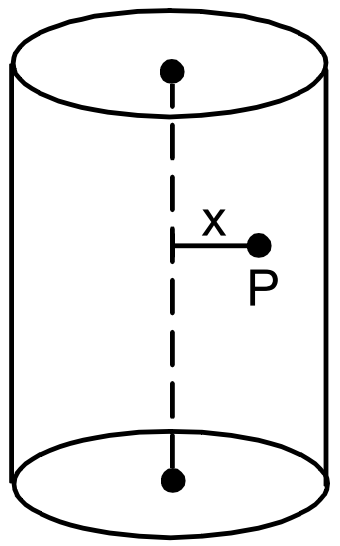
A long cylindrical volume contains a uniformly distributed charge of density $\rho.$ Find the electric field at a point P inside the cylindrical volume at a distance x from its axis (figure).
Calculate the velocity of liquid flowing through a pilot tube.
A car weighs $1800kg$. The distance between its front and back axles is $1.8m$. Its centre of gravity is $1.05m$ behind the front axle. Determine the force exerted by the level ground on each front wheel and each back wheel.
Ten small planes are flying at a speed of 150km/h in total darkness in an air space that is 20 × 20 × 1.5km 3 in volume. You are in one of the planes, flying at random within this space with no way of knowing where the other planes are. On the average about how long a time will elapse between near collision with your plane. Assume for this rough computation that a safety region around the plane can be approximated by a sphere of radius 10m.
A disc of radius R is rotating with an angular speed $\omega_\text{o}$ about a horizontal axis. It is placed on a horizontal table. The coefficient of kinetic friction is $\mu_\text{k}{:}$
  1. What was the velocity of its centre of mass before being brought in contact with the table?
  2. What happens to the linear velocity of a point on its rim when placed in contact with the table?
  3. What happens to the linear speed of the centre of mass when disc is placed in contact with the table?
  4. Which force is responsible for the effects in (b) and (c).
  5. What condition should be satisfied for rolling to begin?
  6. Calculate the time taken for the rolling to begin.
A steel rod of length $2l$, cross sectional area A and mass M is set rotating in a horizontal plane about an axis passing through the centre. If Y is the Young’s modulus for steel, find the extension in the length of the rod. (Assume the rod is uniform.)
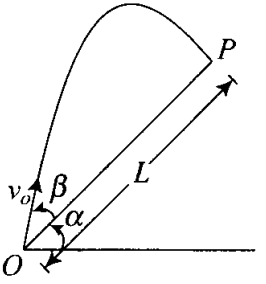
A particle is projected in air at an angle $\beta$ to a surface which itself is inclined at an angle $\alpha$ to the horizontal (Fig.).
  1. Time of flight.
(Hint: This problem can be solved in two different ways:
  1. Point P at which particle hits the plane can be seen as intersection of its trajectory (parobola) and straight line. Remember particle is projected at an angle $(\alpha+\beta)$ w.r.t. horizontal.
  2. We can take x-direction along the plane and y-direction perpendicular to the plane. In that case resolve g (acceleration due to gravity) in two differrent components, $g_x$ along the plane and $g_y$ perpendicular to the plane. Now the problem can be solved as two independent motions in x and y directions respectively with time as a common parameter.)