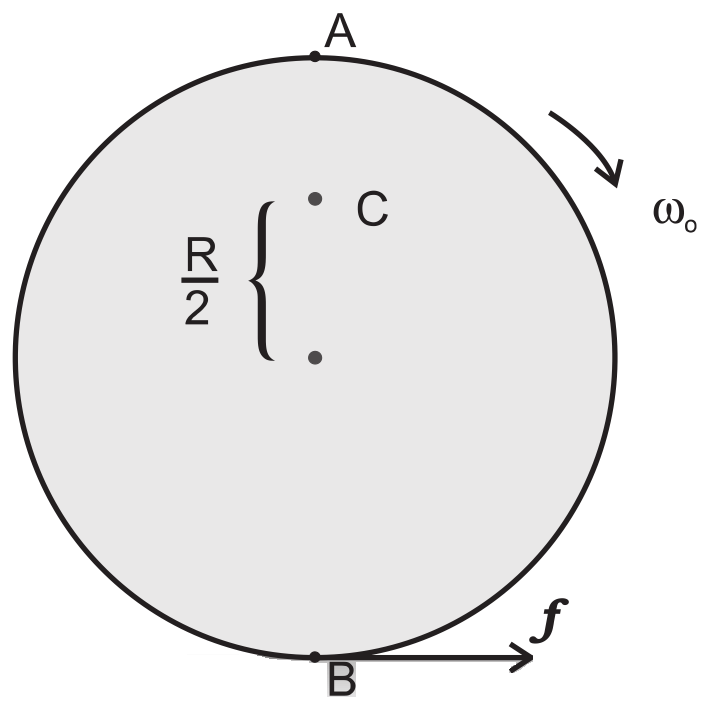
A disc of radius R is rotating with an angular speed $\omega_\text{o}$ about a horizontal axis. It is placed on a horizontal table. The coefficient of kinetic friction is $\mu_\text{k}{:}$
- What was the velocity of its centre of mass before being brought in contact with the table?
- What happens to the linear velocity of a point on its rim when placed in contact with the table?
- What happens to the linear speed of the centre of mass when disc is placed in contact with the table?
- Which force is responsible for the effects in (b) and (c).
- What condition should be satisfied for rolling to begin?
- Calculate the time taken for the rolling to begin.
Download our app for free and get started
- Before the disc is brought in contact with table, it is only rotating about its horizontal axis. So, its centre of mass is at rest i.e. $v_{cm} = 0$.
- (M) When rim is placed in contact with the table then its linear velocity at any point on the rim of disc will reduce due to kinetic friction.
- If rotating disc is placed in contact with the table, its centre of mass acquires some velocity (which was zero before contact) due to kinetic friction. So linear velocity of CM will increase.
- Kinetic friction.
- Rolling will begin when vCM = R(x).
- Acceleration produced in centre of mass due to friction,
Angular acceleration produced by the torque dur to friction.
$\alpha=\frac{\tau}{\text{I}}=\frac{\mu_\text{k}\text{mgR}}{\text{I}}$
$\therefore\ \nu_\text{cm}=\upsilon_\text{cm}+\text{a}_\text{cm}\text{t}$
$\Rightarrow\ \nu_\text{cm}=\mu_\text{k}\text{gt}$
and $\omega=\omega_0+\alpha\text{t}$
$\Rightarrow\omega=\omega_0-\frac{\mu_\text{k}\text{mgR}}{\text{I}}\text{t}$
For rolling without slipping,
$\frac{\nu_\text{cm}}{\text{R}}=\omega_0-\frac{\mu_\text{k}\text{mgR}}{\text{I}}\text{t}$
$\Rightarrow\ \frac{\mu_\text{k}\text{gt}}{\text{R}}=\omega_{\circ}-\frac{\mu_\text{k}\text{mgR}_\text{t}}{\text{I}}$
$\Rightarrow\text{t}=\frac{\text{R}\omega_0}{\mu_\text{k}\text{g}\big(1+\frac{\text{mR}^2}{\text{I}}\big)}$

Download our appand get started for free
Experience the future of education. Simply download our apps or reach out to us for more information. Let's shape the future of learning together!No signup needed.*
Similar Questions
- 1Prove the result that the velocity v of translation of a rolling body (like a ring, disc, cylinder or sphere) at the bottom of an inclined plane of height h given by $\text{v}^2=\frac{2\text{gh}}{\big(1+\frac{\text{K}^2}{\text{R}^2}\big)}$ using dynamical consideration. Note K is the radius of gyration of the body about its symmetry axis, and R is the radius of the body. The body starts from rest at the top of the plane.View Solution
- 2A disc rotating about its axis with angular speed $\omega_0$ is placed lightly (without any translational push) on a perfectly frictionless table. The radius of the disc is R. What are the linear velocities of the points A, B and C on the disc shown in will the disc roll in the direction indicated?View Solution
- 3A uniform rod pivoted at its upper end hangs vertically. It is displaced through an angle of $60°$ and then released. Find the magnitude of the force acting on a particle of mass dm at the tip of the rod when the rod makes an angle of $37°$ with the vertical.View Solution
- 4View SolutionA ball is whirled in a circle by attaching it to a fixed point with a string. Is there an angular rotation of the ball about its centre? If yes, is this angular velocity equal to the angular velocity of the ball about the fixed point?
- 5View SolutionShow that for an isolated system the centre of mass moves with a uniform velocity along a straight line path.
- 6View SolutionA 6.5m long ladder rests against a vertical wall reaching a height of 6.0m. A 60kg man stands half way up the ladder.
- Find the torque of the force exerted by the man on the ladder about the upper end of the ladder.
- Assuming the weight of the ladder to be negligible as compared to the man and assuming the wall to be smooth, find the force exerted by the ground on the ladder.
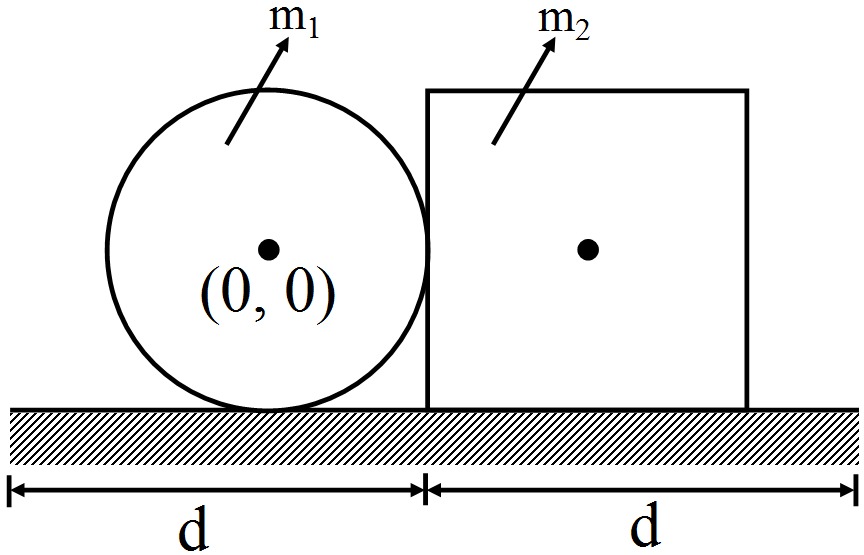
- 7View SolutionA square plate of edge d and a circular disc of diameter d are placed touching each other at the midpoint of an edge of the plate as shown in figure. Locate the centre of mass of the combination, assuming same mass per unit area for the two plates.
- 8View SolutionA sphere of a radius 10cm weighs 1kg, calculate the moment of inertia.
- About the diameter.
- About the tangent.
- 9Two discs of moments of inertia $I_1$ and $I_2$ about their respective axes (normal to the disc and passing through the centre), and rotating with angular speed $\omega_1$ and $\omega_2$ are brought into contact face to face with their axes of rotation coincident.View Solution
- Does the law of conservation of angular momentum apply to the situation? why?
- Find the angular speed of the two-disc system.
- Calculate the loss in kinetic energy of the system in the process.
- Account for this loss.
- 10View Solution
- Obtain an expression for moment of inertia of uniform circular disc about an axis perpendicular to the plane of disc and passing through its centre.
- Three point masses of 1kg, 2kg and 3kg lie at (1, 2), (0, -1) and (2, -3) respectively. Calculate the co-ordinates of centre of mass of the system.