MCQ
A semiconductor is doped with a donor impurity:
- AThe hole concentration increases.
- BThe hole concentration decreases.
- CThe electron concentration increases.
- DThe electron concentration decreases.
Explanation:
When a semiconductor is doped with a donor type such as arsenic or phosphorous, which has five valence electrons, the donor atom replaces the Si or Ge atom. As a result, four out of the five electrons of the donor atom form a covalent bond by sharing an electron with four atoms of silicon. However, the fifth electron is free to move. Also, due to the breaking up of covalent bonds at room temperature, equal number of electrons and holes are produced. Thus, the total number of holes in the n-type semiconductor is less compared to the number of free electrons.
Generate a complete, print-ready paper with questions like this in minutes — across 16+ boards, with answer keys.
Best neutron moderator is
|
(a) Berillium oxide |
(b) Pure water |
(c) Heavy water |
(d) Graphite |
Eddy currents are used in
|
(a) Induction furnace |
(b) Electromagnetic brakes |
|
(c) Speedometers |
(d) All of these |
Water of volume 2 litre in a container is heated with a coil of 1 kW at 27 oC. The lid of the container is open and energy dissipates at rate of 160 J/s. In how much time temperature will rise from 27oC to 77oC [Given specific heat of water is 4.2 kJ/kg]
|
(a) 8 min 20 s |
(b) 6 min 2 s |
(c) 7 min |
(d) 14 min |
The potential difference between points A and B of adjoining figure is
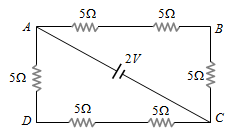
(a) 
|
(b) 
|
(c) |
(d) 2 V |
A plano-convex lens of refractive index 1.5 and radius of curvature 30 cm is silvered at the curved surface. Now this lens has been used to form the image of an object. At what distance from this lens an object be placed in order to have a real image of the size of the object
|
(a) 20 cm |
(b) 30 cm |
(c) 60 cm |
(d) 80 cm |
