MCQ
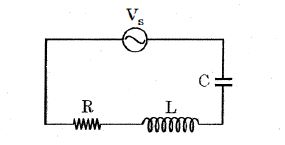
A series $RLC$ circuit is activated by an $ac$ source of voltage $V_S$ volt and variable angular frequency $(\omega )$ as shown in the circuit. $V_{RL}$ and $V_C$ are the potential drops across $RL$ and $C$ respectively. Select the correct statement
  • A
    At low frequency limit, both $V_{RL}$ and $V_C$ are proportional to $\omega $
  • At high frequency limit, $V_{RL}$ approaches $V_S$ but $V_C$ is proportional to $\frac{1}{{{\omega ^2}}}$
  • C
    At high frequency limit, both $V_{RL}$ and $V_C$ are proportional to $\frac{1}{{{\omega ^2}}}$
  • D
    At low frequency limit, $V_{RL}$ is proportional to $\frac{1}{\omega }$ , whereas $V_C$ approaches $V_S$ 
Answer

Correct option: B.
At high frequency limit, $V_{RL}$ approaches $V_S$ but $V_C$ is proportional to $\frac{1}{{{\omega ^2}}}$
b
$\mathrm{V}_{\mathrm{RL}}=\mathrm{i}_{0} \times \sqrt{\omega^{2} \mathrm{L}^{2}+\mathrm{R}^{2}}$

$ - \frac{{{{\rm{V}}_0}}}{{\sqrt {{{\left( {\omega {\rm{L}} - \frac{1}{{\omega {\rm{C}}}}} \right)}^2} + {{\rm{R}}^2}} }} \times \sqrt {{\omega ^2}{{\rm{L}}^2} + {{\rm{R}}^2}} $

$\omega  = 0,\quad {{\rm{V}}_{{\rm{RL}}}} \propto {{\rm{V}}_0} \times \omega {\rm{C}}$

$\mathrm{V}_{\mathrm{c}}=\mathrm{i}_{0} \times \frac{1}{\omega \mathrm{C}}$

$\omega  = \infty \quad {{\rm{V}}_{{\rm{RL}}}} = {{\rm{V}}_0}$

$ = \frac{{{V_0}}}{{\sqrt {{{\left( {{\omega ^2}{\rm{LC}} - 1} \right)}^2} + {\omega ^2}{{\rm{R}}^2}{{\rm{C}}^2}} }}$

$\omega=0$

$\mathrm{V}_{\mathrm{c}}=\frac{\mathrm{V}_{0}}{\mathrm{\omega}} \sqrt{\mathrm{LC}}$

$\omega=\infty$

Need a full question paper?

Generate a complete, print-ready paper with questions like this in minutes — across 16+ boards, with answer keys.

Start Generating Free

Similar questions

Photons of energy 6 eV are incident on a metal surface whose work function is 4 eV. The minimum kinetic energy of the emitted photo-electrons will be
A $500\,\mu F$ capacitor is charged at a steady rate of $100\, \mu C/sec$. The potential difference across the capacitor will be $10\, V$ after an interval of.....$sec$
If ratio of maximum and minimum intensities is $36 : 1$ in an interference pattern then,  ratio of amplitudes of interfering waves is
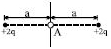
A negative point charge placed at the point $A$ is
Given below are two statements$:$

Statement $I:$ Biot-Savart's law gives us the expression for the magnetic field strength of an infinitesimal current element (IdI) of a current carrying conductor only.

Statement $II :$ Biot-Savart's law is analogous to Coulomb's inverse square law of charge $q$, with the former being related to the field produced by a scalar source, Idl while the latter being produced by a vector source, $q$. In light of above statements choose the most appropriate answer from the options given below:

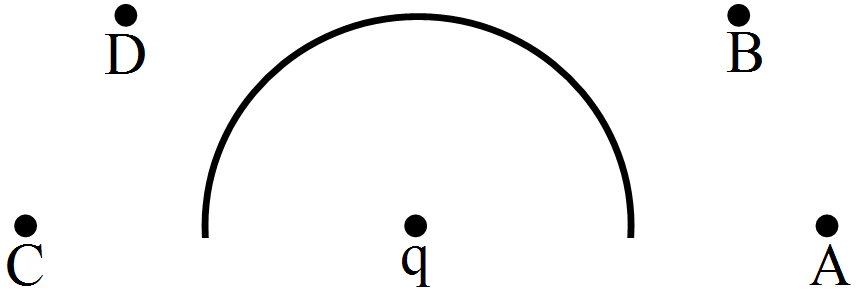
Figure shows a charge q placed at the centre of a hemisphere. A second charge $Q$ is placed at one of the positions $A, B, C$ and $D.$ In which position$($s$)$ of this second charge, the flux of the electric field through the hemisphere remains unchanged?
 
A photocell is illuminated by a small bright source placed $d\; m$ away. When the same source of light is placed $\frac{d}{2}\;m$ away, the number of electrons emitted by photo cathode would
By increasing the temperature, the specific resistance of a conductor and a semiconductor
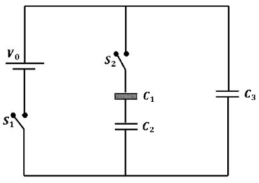
Three identical capacitors $\mathrm{C}_1, \mathrm{C}_2$ and $\mathrm{C}_3$ have a capacitance of $1.0 \mu \mathrm{F}$ each and they are uncharged initially. They are connected in a circuit as shown in the figure and $\mathrm{C}_1$ is then filled completely with a dielectric material of relative permittivity $\varepsilon_{\mathrm{r}}$. The cell electromotive force (emf) $V_0=8 \mathrm{~V}$. First the switch $S_1$ is closed while the switch $S_2$ is kept open. When the capacitor $C_3$ is fully charged, $S_1$ is opened and $S_2$ is closed simultaneously. When all the capacitors reach equilibrium, the charge on $\mathrm{C}_3$ is found to be $5 \mu \mathrm{C}$. The value of $\varepsilon_{\mathrm{r}}=$. . . . 

(image)

A $NPN $ transistor conducts when