Question
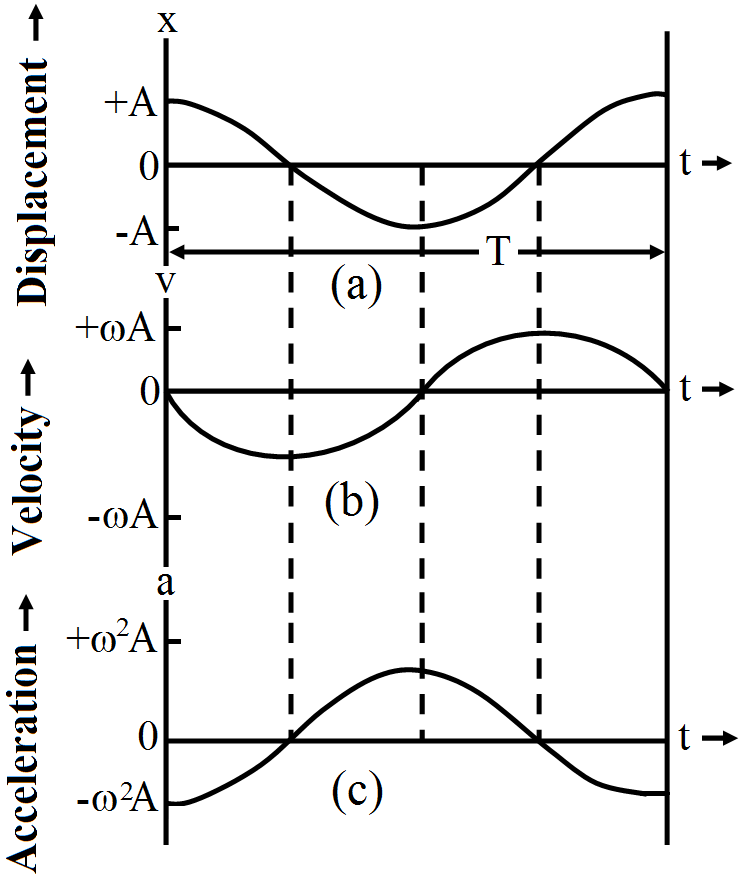
A SHM is expressed by the equation $\text{x}=\text{A}\cos(\omega\text{t}+\phi)$ and the phase angle $\phi=0$ . Draw graphs to show variation of displacement, velocity and acceleration for one complete cycle in SHM.

Answer

Let $\text{x}=\text{A}\cos(\omega\text{t}+\phi)$ and if phase $\phi$ is zero, then $\text{x}=\text{A}\cos\omega\text{t}+\phi$

$\therefore\text{v}=\frac{\text{dx}}{\text{dt}}$ $=-\text{A}\omega\sin\omega\text{t}$

$\text{a}\frac{\text{dv}}{\text{dt}}=-\text{A}\omega^2\cos\omega\text{t}$

$=-\omega\text{x}$

Thus, values of x ,v and a at different times, over one complete oscillation cycle are:

$\text{time}$ $0$ $\frac{\text{T}}{4}$ $\frac{\text{T}}{2}$ $\frac{3\text{T}}{4}$ $\text{T}$
$\omega\text{t}$ $0$ $\frac{\pi}{2}$ $\pi$ $\frac{3\pi}{2}$ $2\pi$
$\text{x}$ $\text{A}$ $0$ $-\text{A}$ $0$ $\text{A}$
$\text{v}$ $0$ $-\text{A}\omega$ $0$ $+\text{A}\omega$ $0$
$\text{a}$ $-\text{A}\omega^2$ $0$ $\text{A}\omega^2$ $0$ $-\text{A}\omega^2$
With the given data we plot x-t.v-t and a-t graphs. The grapha have beem shown in Fig. (a), (b) and (c).

Need a full question paper?

Generate a complete, print-ready paper with questions like this in minutes — across 16+ boards, with answer keys.
Start Generating Free

Similar questions

A cylindrical vessel filled with water upto a height of 2m stands on a horizontal plane. The side wall of the vessel has a plugged circular hole touching the bottom. Find the minimum diameter of the hole so that the vessel begin to move on the floor, if the plug is removed. The coefficient of friction between the bottom of the vessel and the plane is 0.4 and total mass of water plus vessel is 100kg.
Four particles having masses m, 2m, 3m and 4m are placed at the four corners of a square of edge a. Find the gravitational force acting on a particle of mass m placed at the centre.
To simulate car accidents, auto manufacturers study the collisions of moving cars with mounted springs of different spring constants. Consider a typical simulation with a car of mass $1000 kg$ moving with a speed $18.0 km / h$ on a smooth road and colliding with a horizontally mounted spring of spring constant $5.25 \times 10^3 N m ^{-1}$. What is the maximum compression of the spring?

Consider the above Example taking the coefficient of friction, µ, to be 0.5 and calculate the maximum compression of the spring.
A batsman deflects a ball by an angle of 45° without changing its initial speed which is equal to 54km/h. What is the impulse imparted to the ball? (Mass of the ball is 0.15 kg)
A regular polygon of n sides is formed by bending a wire of total length $27\pi\text{r}$ which carries a current i.
  1. Find the magnetic field B at the centre of the polygon.
  2. By letting $\text{n}\rightarrow\infty,$ deduce the expression for the magnetic field at the centre of a circular current.
A gun is mounted on a railroad car. The mass of the car, the gun, the shells and the operator is 50m where m is the mass of one shell. If the velocity of the shell with respect to the gun (in its state before firing) is 200m/s, what is the recoil speed of the car after the second shot? Neglect friction.
Define simple harmonic motion (SHM). Two masses m, and m, are suspended together by a massless spring of spring constant k (see Fig.a). When the masses are in equilibrium, m1 is removed without disturbing the system. Find the angular frequency and amplitude oscillation of m2
Find the wavelength of the radiation emitted by hydrogen in the transitions (a) n = 3 to n= 2, (b) n = 5 to n = 4 and (c) n = 10 to n = 9.
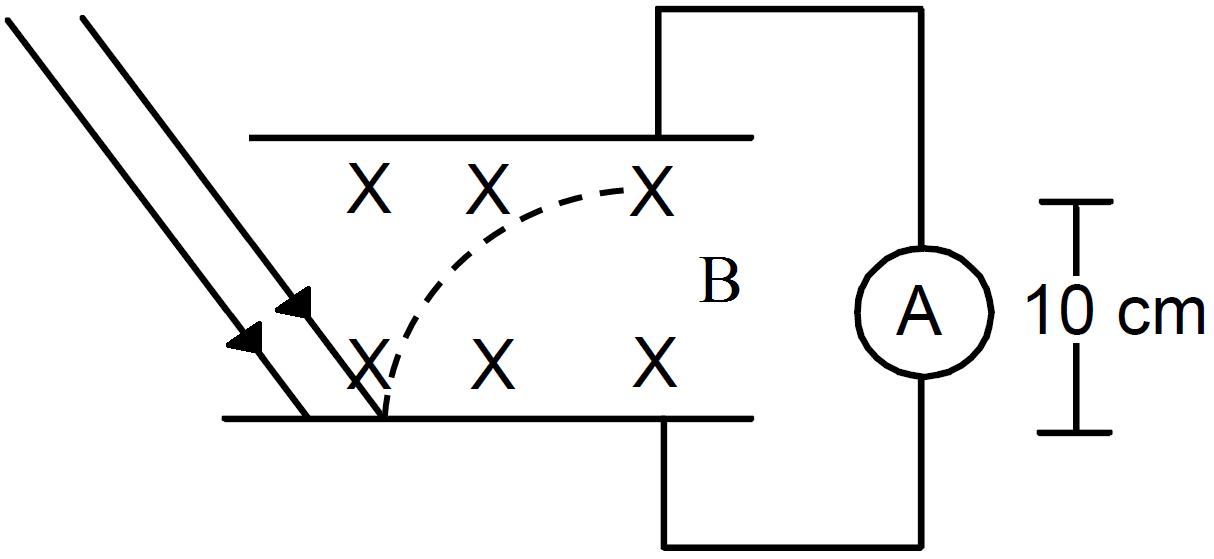
In an experiment on photoelectric effect, the emitter and the collector plates are placed et a separation of 10cm and are connected through en ammeter without any cell A magnetic field B exists parallel to the plates. The work function of the emitter is 2.39eV and the light incident on it has wavelengths between 400nm and 600nm. Find the minimum value of B for which the current registered by the ammeter is zero. Neglect any effect of space charge.

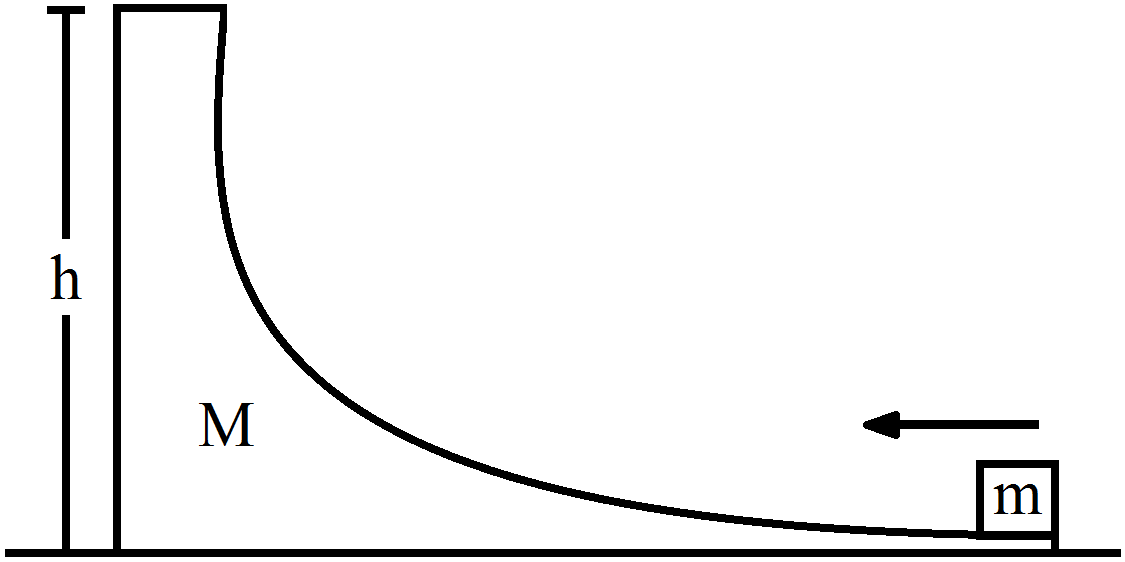
Figure shows a small body of mass m placed over a larger mass M whose surface is horizontal near the smaller mass and gradually curves to become vertical. The smaller mass is pushed on the longer one at a speed v and the system is left to itself. Assume that all the surfaces are frictionless.
  1. Find the speed of the larger block when the smaller block is sliding on the vertical part.
  2. Find the speed of the smaller mass when it breaks off the larger mass at height h.
  3. Find the maximum height (from the ground) that the smaller mass ascends.
  4. Show that the smaller mass will again land on the bigger one. Find the distance traversed by the bigger block during the time when the smaller block was in its flight under gravity.
​​​​​​​