Question
Explain diffraction by a single slit and write down the conditions for central maximum, secondary maxima and minima.
Answer

Image
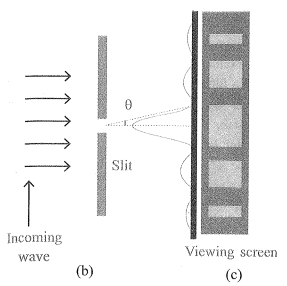
When the double slit in Young's experiment is replaced by a single narrow slit (illuminated by a monochromatic source), a broad pattern with a central bright region is seen.
On both the sides, there are alternate dark and bright regions, the intensity becoming weaker away from the centre. (Fig. (b))
Image
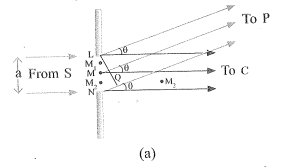
Fig (a) shows a parallel beam of light falling normally, on a single slit LN of width $a$. The diffracted light goes on to meet a screeen. The midpoint of the slit is M .
A straight line through M perpendicular to the slit plane meets the screen at $c$.
We want the intensity at any point P on the screen. As before, straight lines joining P to different points $L, M, N$, etc. can be treated as parallel, making an angle $\theta$ with the normal MC.
Here, the basic idea is to divide the slit into much smaller parts and add their contributions at P with the proper phase difference.
We are treating different parts of the wavefront at the slit as secondary sources. Because the incoming wavefront is parallel to the plane of the slit, these sources are in phase.

Need a full question paper?

Generate a complete, print-ready paper with questions like this in minutes — across 16+ boards, with answer keys.

Start Generating Free

Similar questions

Complete the following table:
Car Model
Driver X
Reaction time 0.20s
Driver Y
Reaction time 0.30s
$A ($deceleration on hard braking $= 6.0m/s^2)$
Speed = 54km/h
Braking distance
a = ...
Total stopping distance
b = ...
Speed = 72km/h
Braking distance
c = ...
Total stopping distance
d = ...
$B ($deceleration on hard braking $= 7.5m/s^2)$
Speed = 54km/h
Breaking distance
e = ...
Total stopping distance
f = ...
Speed 72km/h
Braking distance
g = ...
Total stopping distance
h = ...
A convex or converging lens is thicker at the centre than at the edges. It converges a parallel beam of light on refraction through it. It has a real focus. Convex lens is of three types: (i) Double convex lens (ii) Plano-convex lens (iii) Concavo-convex lens. Concave lens is thinner at the centre than at the edges. It diverges a parallel beam of light on refraction th rough it. It has a virtual focus.
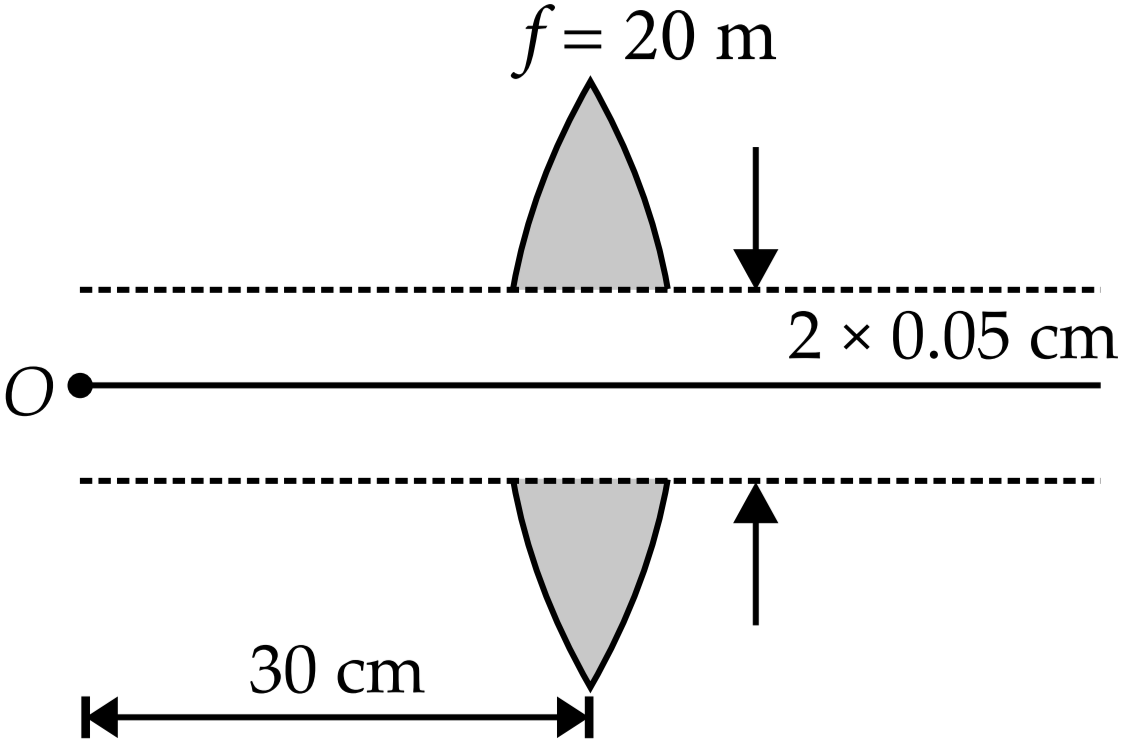
  1. A point object O is placed at a distance of 0.3m from a convex lens (focal length 0.2m) cut into two halves each of which is displaced by 0.0005 mas shown in figure.


What will be the location of the image?
  1. 30cm right of lens.
  2. 60cm right of lens.
  3. 70cm left of lens.
  4. 40cm left of lens.
  1. Two thin lenses are in contact and the focal length of the combination is 80cm. If the focal length of one lens is 20cm, the focal length of the other would be.
  1. 26.7cm
  2. 60cm
  3. 80cm
  4. 20cm
  1. A spherical air bubble is embedded in a piece of glass. For a ray of light passing through the bubble, it behaves tike a.
  1. Converging lens.
  2. Diverging lens.
  3. Piano-converging lens.
  4. Piano-diverging lens.
  1. Lens used in magnifying glass is:
  1. Concave lens.
  2. Convex lens.
  3. Both (a) and (b).
  4. None of the above.
  1. The magnification of an image by a convex lens is positive only when the object is placed.
  1. At its focus F.
  2. Between F and 2F.
  3. At 2F.
  4. Between F and optical centre.
A collision experiment is done on a horizontal table kept in an elevator. Do you expect a change in the results if the elevator is accelerated up or down because of the noninertial character of the frame?
An astronomical telescope is an optical instrument which is used for observing distinct images of heavenly bodies libe stars, planets etc. It consists of two lenses. In normal adjustment of telescope, the final image is formed at infinity. Magnifying power of an astronomical telescope in normal adjustment is defined as the ratio of the angle subtended at the eye by the angle subtended at the eye by the final image to the angle subtended at the eye, by the object directly, when the final image and the object both lie at infinite distance from the eye. It is given by, $\text{m}=\frac{\text{f}_0}{\text{f}_\text{g}}.$ To increase magnifying power of an astronomical telescope in normal adjustment, focal length of objective lens should be large and focal length of eye lens should be small.
  1. An astronomical telescope of magnifying power 7 consists of the two thin lenses 40cm apart, in normal adjustment. The focal lengths of the lenses are
  1. 5cm, 35cm
  2. 7cm, 35cm
  3. 17cm, 35cm
  4. 5cm, 30cm
  1. An astronomical telescope has a magnifying power of 10. In normal adjustment, distance between the objective and eye piece is 22cm. The focal length of objective lens is:
  1. 25cm
  2. 10cm
  3. 15cm
  4. 20cm
  1. In astronomical telescope compare to eye piece, objective lens has:
  1. Negative focal length.
  2. Zero focal length.
  3. Small focal length.
  4. Large focal length.
  1. To see stars, use:
  1. Simple microscope.
  2. Compound microscope.
  3. Endoscope.
  4. Astronomical telescope.
  1. For large magnifying power of astronomical telescope.
  1. $f_0 << f_e$
  2. $f_0 << f_e$
  3. $f_0 << f_e$
  4. None of these.
A car driver going at some speed v suddenly finds a wide wall at a distance r. Should he apply brakes or turn the car in a circle of radius r to avoid hitting the wall?
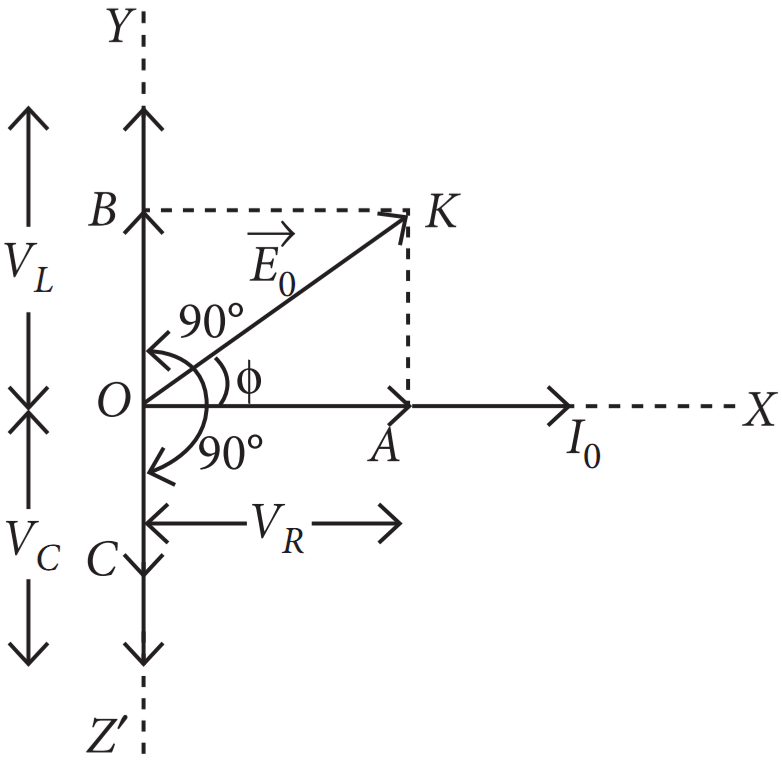
When a pure resistance R, pure inductor L and an ideal capacitor of capacitance C is connected in series to a source of alternating e.m.f., then current at any instant through the three elements has the same amplitude and is represented as $\text{I} = \text{I}_0\sin\omega\text{t}.$ However, voltage across each element has a different phase relationship with the current as shown in graph. The effective resistance of RLC circuit is called impedance (Z) of the circuit and the voltage leads the current by a phase angle $\phi.$

A resistor of $12\Omega,$ a capacitor ofreactance $14\Omega,$ and a pure inductor of inductance 0.1H are joined in series and placed across 200V, 50Hz a.c. supply.
  1. The value of inductive reactance is:
  1. $15\Omega$
  2. $31.4\Omega$
  3. $20\Omega$
  4. $30\Omega$
  1. The value of impedance is:
  1. $20\Omega$
  2. $15\Omega$
  3. $30\Omega$
  4. $21.13\Omega$
  1. What is the value of current in the circuit?
  1. $5A$
  2. $15A$
  3. $10A$
  4. $9.46A$
  1. What is the value of the phase angle between current and voltage?
  1. $53º9'$
  2. $63º9'$
  3. $55º4'$
  4. $50º$
  1. From graph, which one is true from following?
  1. $V_L \geq V_C$
  2. $V_L < V_C$
  3. $V_L < V_C$
  4. $V_L < V_C$
In the year 1939, German scientist Otto Hahn and Strassmann discovered that when an uranium isotope was bombarded with a neutron, it breaks into two intermediate mass fragments. It was observed that, the sum of the masses of new fragments formed were less than the mass of the original nuclei. This difference in the mass appeared as the energy released in the process. Thus, the phenomenon of splitting of a heavy nucleus (usually A > 230) into two or more lighter nuclei by the bombardment of proton, neutron $\alpha$-particle, etc. with liberation of energy is called nuclear fission.
$\ _{92}\text{U}^{235}+\ _0\text{n}^{1}\rightarrow_{92}\text{U}^{236} \rightarrow\ _{56}\text{B}^{114}+\ _{36}\text{Kr}^{89}\ +3\ _{0}\text{n}^{1} + \text{Q}$
$\big[\because \ _{92}\text{U}^{236}= \text{Unstable nucleus}\big]$
  1. Nuclear fission can be explained on the basis of.
  1. Millikan's oil drop method
  2. Liquid drop model
  3. Shell model
  4. Bohr's model.
  1. For sustaining the nuclear fission chain reaction in a sample (of small size) of $_{92}^{235}\text{U}$ it is desirable to slow down fast neutrons by.
  1. Friction
  2. Elastic damping/ scattering
  3. Absorption
  4. None of these.
  1. Which of the following is/ are fission reaction(s)?
  1. $_0^1\text{n}\ +\ _{92}^{235}\text{U}\rightarrow\ _{92}^{235}\text{U}\rightarrow\ _{51}^{133}\text{Sb}+\ _{41}^{99}\text{nb}+\ 4_1^0\text{n}$
  2. $_0^1\text{n}\ +\ _{92}^{235}\text{U}\rightarrow\ _{54}^{1.40}\text{Xe}+\ _{38}^{94}\text{Sr}\ +2_0^1\text{n}$
  3. $_1^2\text{H}\ +\ _1^2\text{H}\rightarrow\ _2^3\text{He}+\ _0^1\text{n}$
  1. Both II and III
  2. Both I and III
  3. Only II
  4. Both I and II
  1. On an average, the number of neutrons and the energy of a neutron released per fission of a uranium atom are respectively.
  1. 2.5 and 2 keV
  2. 3 and 1 keV
  3. 2.5 and 2 MeV
  4. 2 and 2 keV
  1. In any fission process, ratio of mass of daughter nucleus to mass of parent nucleus is.
  1. Less than I
  2. Greater than I
  3. Equal to I
  4. Depends o the mass of parent nucleus.

Interference is based on the superposition principle. According to this principle, at a particular point in the medium, the resultant displacement produced by a number of waves is the vector sum of the displacements produced by each of the waves.
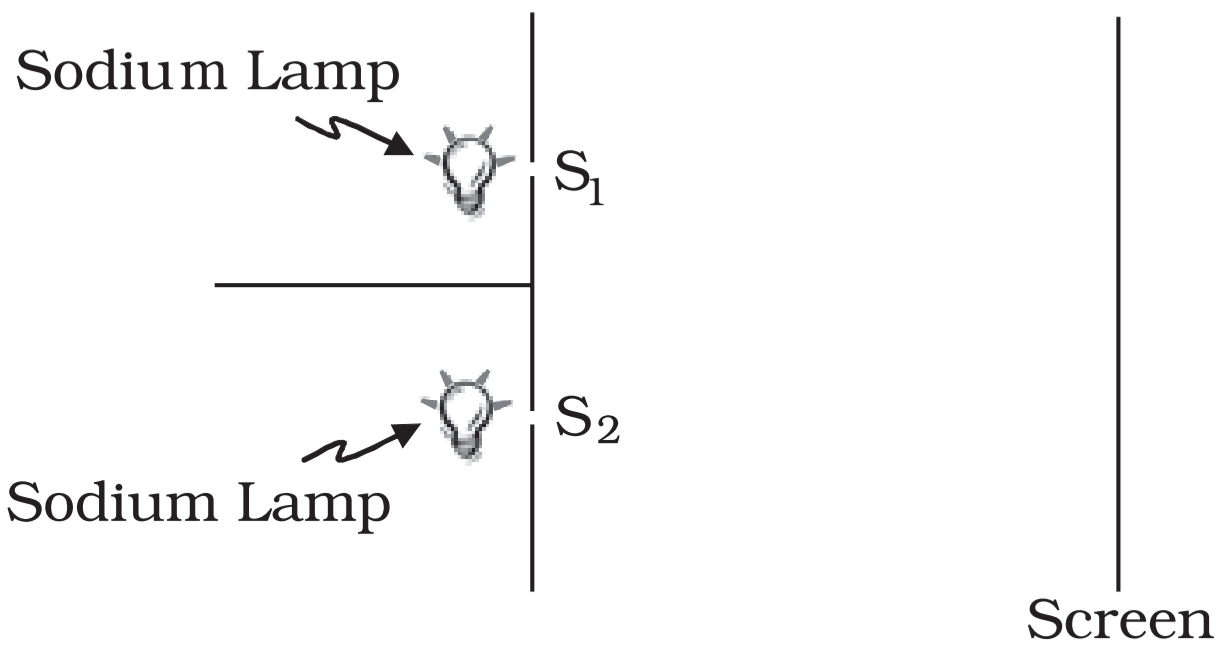
If two sodium lamps illuminate two pinholes $S_1$ and $S_2$, the intensities will add up and no interference fringes will be observed on the screen.
Here the source undergoes abrupt phase change in times of the order of $10^{-10}$ seconds.
  1. Two coherent sources of intensity $\text{10 }\frac{\text{W}}{\text{m}^2}$ and $\text{25 }\frac{\text{W}}{\text{m}^2}$ interfere to form fringes. Find the ratio of maximum intensity to minimum intensity.
  1. $15.54$
  2. $16.78$
  3. $19.72$
  4. $18.39$
  1. Which of the following does not show interference?
  1. Soap bubble.
  2. Excessively thin film.
  3. A thick film.
  4. Wedge shaped film.
  1. ln a Young's double-slit experiment, the slit separation is doubled. To maintain the same fringe spacing on the screen, the screen-to-slit distance D must be changed to:
  1. 2D
  2. 4D
  3. $\frac{\text{D}}{2}$
  4. $\frac{\text{D}}{4}$
  1. The maximum number of possible interference maxima for slit separation equal to twice the wavelength in Young's double-slit experiment, is:
  1. Infinite
  2. Five
  3. Three
  4. Zero
  1. The resultant amplitude of a vibrating particle by the superposition of the two waves.
$\text{y}_1=\text{a}\sin\Big[\omega\text{t}+\frac{\pi}{3}\Big]$ and $\text{y}_2=\text{a}\sin\omega\text{t}$ is:
  1. $\text{a}$
  2. $\sqrt2\text{a}$
  3. $\text{2a}$
  4. $\sqrt3\text{a}$
Suppose you are inside the water in a swimming pool near an edge. A friend is standing on the edge. Do you find your friend taller or shorter than his usual height?
In one of the exercises to strengthen the wrist and fingers, a person squeezes and releases a soft rubber ball. Is the work done on the ball positive, negative or zero during compression? During expansion?