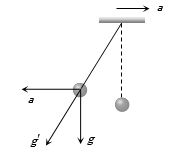
A simple pendulum is suspended from the roof of a trolley which moves in a horizontal direction with an acceleration $a$, then the time period is given by $T = 2\pi \sqrt {\frac{l}{{g'}}} $, where $g'$ is equal to
AIPMT 1991, Medium
Download our app for free and get started
(d)$g' = \sqrt {{g^2} + {a^2}} $

Download our appand get started for free
Experience the future of education. Simply download our apps or reach out to us for more information. Let's shape the future of learning together!No signup needed.*
Similar Questions
- 1The total energy of particle performing $S.H.M.$ depend onView Solution
- 2View SolutionWhat is constant in S.H.M.
- 3A particle executes simple harmonic motion with an amplitude of $4 \mathrm{~cm}$. At the mean position, velocity of the particle is $10 \mathrm{~cm} / \mathrm{s}$. The distance of the particle from the mean position when its speed becomes $5 \mathrm{~cm} / \mathrm{s}$ is $\sqrt{\alpha} \mathrm{cm}$, where $\alpha=$____________.View Solution
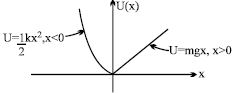
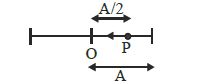
- 4A particle starts from a point $P$ at a distance of $A/2$ from the mean position $O$ and travels towards left as shown in the figure. If the time period of $SHM$ , executed about $O$ is $T$ and amplitude $A$ then the equation of motion of particle isView Solution
- 5View SolutionWhich of the following function represents a simple harmonic oscillation
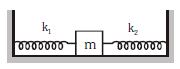
- 6A block of mass $m$ is attached to two springs of spring constants $k_1$ and $k_2$ as shown in figure. The block is displaced by $x$ towards right and released. The velocity of the block when it is at $x/2$ will beView Solution
- 7Two simple harmonic motion, are represented by the equations ${y}_{1}=10 \sin \left(3 \pi {t}+\frac{\pi}{3}\right)$View Solution
$y_{2}=5(\sin 3 \pi t+\sqrt{3} \cos 3 \pi t)$
Ratio of amplitude of ${y}_{1}$ to ${y}_{2}={x}: 1$. The value of ${x}$ is ...... .
- 8The kinetic energy of $SHM$ is $1/n$ time its potential energy. If the amplitude of the $SHM$ be $A$, then what is the displacement of the particle?View Solution
- 9View SolutionTwo oscillating systems; a simple pendulum and a vertical spring-mass-system have same time period of motion on the surface of the Earth. If both are taken to the moon, then-
- 10A particle of mass $m$ moves in the potential energy $U$ shown above. The period of the motion when the particle has total energy $E$ isView Solution