A siren emitting a sound of frequency $800\,\, Hz$ moves away from an observer towards a cliff at a speed of $15 \,\,m s^{-1}$. Then, the frequency of sound that the observer hears in the echo reflected from the cliff is .... $Hz$
(Take velocity of sound in air $= 330\,\, m s^{-1}$)
(Take velocity of sound in air $= 330\,\, m s^{-1}$)
NEET 2016, Medium
Download our app for free and get started
Here, frequency of sound emitted by siren,
$v_{0}=800 \mathrm{Hz}$
Speed of source, $v_{s}=15 \mathrm{m} / \mathrm{s}$
Speed of sound in air, $\mathrm{v}=330 \mathrm{m} / \mathrm{s}$
Apparent frequency of sound at the cliff $=$ Frequency heard by observer $=v$
Using Doppler's effect of sound
$v=\left(\frac{v}{v-v_{S}}\right) v_{0}=\frac{330}{330-15} \times 800$
$=\frac{330}{315} \times 800=838.09 \mathrm{Hz} \approx 838 \mathrm{Hz}$

Download our appand get started for free
Experience the future of education. Simply download our apps or reach out to us for more information. Let's shape the future of learning together!No signup needed.*
Similar Questions
- 1The phase difference between two points separated by $0.8 m$ in a wave of frequency is $120 Hz$ is $\frac{\pi }{2}.$ The velocity of wave is ..... $m/s$View Solution
- 2How many times more intense is $90\,\, dB$ sound than $40\,\, dB$ sound?View Solution
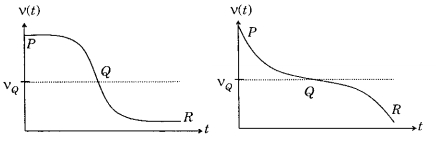
- 3Two loudspeakers $M$ and $N$ are located $20 \mathrm{~m}$ apart and emit sound at frequencies $118 \mathrm{~Hz}$ and $121 \mathrm{~Hz}$, respectively. $A$ car is initially at a point $P, 1800 \mathrm{~m}$ away from the midpoint $Q$ of the line $M N$ and moves towards $Q$ constantly at $60 \mathrm{~km} / \mathrm{hr}$ along the perpendicular bisector of $M N$. It crosses $Q$ and eventually reaches a point $R, 1800(m$ away from $Q$. Let $v(t)$ represent the beat frequency measured by a person sitting in tlie car at time $t$. Let $v_P, v_Q$ and $v_R$ be the beat frequencies measured at locations $P . Q$ and $R$, respectively. The speed of sound in air is $330 \mathrm{~m} \mathrm{~s}^{-1}$. Which of the following statement($s$) is(are) true regarding the sound heard by the person?View Solution
($A$) $v_P+v_R=2 v_Q$
($B$) The rate of change in beat frequency is maximum when the car passes through $Q$
($C$) The plot below represents schematically the variation of beat frequency with time
(image)
($D$) The plot below represents schematically the variation of beat frequency with time
(image)
- 4Two trains $A$ and $B$ are moving with speeds $20 \mathrm{~m} / \mathrm{s}$ and $30 \mathrm{~m} / \mathrm{s}$ respectively in the same direction on the same straight track, with $B$ ahead of $A$. The engines are at the front ends. The engine of train $A$ blows a long whistle.View Solution
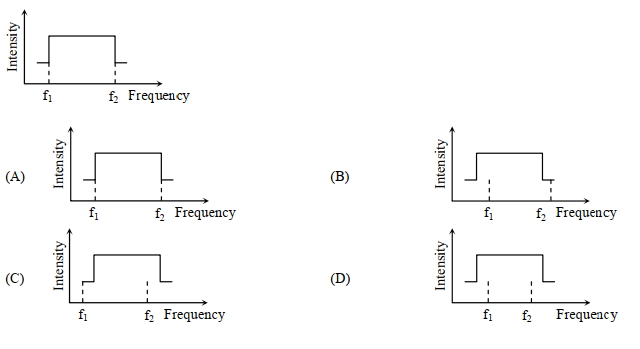
Assume that the sound of the whistle is composed of components varying in frequency from $f_1=800 \mathrm{~Hz}$ to $f_2=1120 \mathrm{~Hz}$, as shown in the figure. The spread in the frequency (highest frequency - lowest frequency) is thus $320 \mathrm{~Hz}$. The speed of sound in still air is $340 \mathrm{~m} / \mathrm{s}$.
$1.$ The speed of sound of the whistle is
$(A)$ $340 \mathrm{~m} / \mathrm{s}$ for passengers in $A$ and $310 \mathrm{~m} / \mathrm{s}$ for passengers in $B$
$(B)$ $360 \mathrm{~m} / \mathrm{s}$ for passengers in $A$ and $310 \mathrm{~m} / \mathrm{s}$ for passengers in $B$
$(C)$ $310 \mathrm{~m} / \mathrm{s}$ for passengers in $A$ and $360 \mathrm{~m} / \mathrm{s}$ for passengers in $B$
$(D)$ $340 \mathrm{~m} / \mathrm{s}$ for passengers in both the trains
$2.$ The distribution of the sound intensity of the whistle as observed by the passengers in train $\mathrm{A}$ is best represented by
$Image$
$3.$ The spread of frequency as observed by the passengers in train $B$ is
$(A)$ $310 \mathrm{~Hz}$ $(B)$ $330 \mathrm{~Hz}$ $(C)$ $350 \mathrm{~Hz}$ $(D)$ $290 \mathrm{~Hz}$
Give the answer question $1,2$ and $3.$
- 5A man, standing between two cliffs, claps his hands and starts hearing a series of echoes at intervals of one second. If the speed of sound in air is $340 ms^{-1}$, the distance between the cliffs is .... $m$View Solution
- 6A plane progressive wave is represented by the equation $y = 0.1\sin \left( {200\pi t - \frac{{20\pi x}}{{17}}} \right)$ where y is displacement in $m$, $ t$ in second and $x$ is distance from a fixed origin in meter. The frequency, wavelength and speed of the wave respectively areView Solution
- 7In Quincke’s tube a detector detects minimum intensity. Now one of the tube is displaced by $5 \,\,cm$. During displacement detector detects maximum intensity $10$ times, then finally a minimum intensity (when displacement is complete). The wavelength of sound is .... $cm$View Solution
- 8The two interfering waves have intensities in the ratio $9 : 4$. The ratio of intensities of maxima and minima in the interference pattern will beView Solution
- 9A wave in a string has an amplitude of $2\,\, cm.$ The wave travels in the $+ve$ direction of $x-$ axis with a speed of $128\,\, m/s$ and it is noted that $5$ complete waves fit in $4\,\, m$ length of the string. The equation describing the wave isView Solution
- 10Standing waves are produced in a $10 \;m$ long stretched string. If the string vibrates in $5$ segments and the wave velocity is $20\; m/s$, the frequency is ... $Hz$View Solution