$A$ particle inside the rough surface of $a$ rotating cone about its axis is at rest relative to it at $a$ height of $1m$ above its vertex. Friction coefficient is $\mu = 0.5$, if half angle of cone is $45^o$, the maximum angular velocity of revolution of cone can be :
Difficult
Download our app for free and get started

Download our appand get started for free
Experience the future of education. Simply download our apps or reach out to us for more information. Let's shape the future of learning together!No signup needed.*
Similar Questions
- 1A bullet of mass $4\,g$ is fired horizontally with a speed of $300\,m/s$ into $0.8\,kg$ block of wood at rest on a table. If the coefficient of friction between the block and the table is $0.3,$ how far will the block slide approximately?View Solution
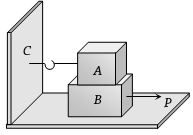
- 2Block $A$ weighing $100$ kg rests on a block $B$ and is tied with a horizontal string to the wall at $C$. Block $B$ weighs $200 \,kg$. The coefficient of friction between $A$ and $B$ is $0.25$ and between $B$ and the surface is $1/3$. The horizontal force $P$ necessary to move the block $B$ should be ........ $N$ $(g = 10\,m/{s^2})$View Solution
- 3A body of mass $10\, kg$ is lying on a rough plane inclined at an angle of $30^o$ to the horizontal and the coefficient of friction is $0.5$. the minimum force required to pull the body up the plane is ........ $N$View Solution
- 4A body starts from rest on a long inclined plane of slope $45^o$ . The coefficient of friction between the body and the plane varies as $\mu = 0.3\,x$ . where $x$ is distance travelled down the plane. The body will have maximum speed ( for $g = 10\,m/s^2$ ) when $x=$ ........ $m$View Solution
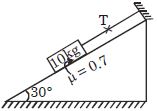
- 5The tension $T$ in the string shown in figure isView Solution
- 6A uniform wooden stick of mass $1.6 \mathrm{~kg}$ and length $l$ rests in an inclined manner on a smooth, vertical wall of height $h( < l)$ such that a small portion of the stick extends beyond the wall. The reaction force of the wall on the stick is perpendicular to the stick. The stick makes an angle of $30^{\circ}$ with the wall and the bottom of the stick is on a rough focr. The reaction of the wall on the stick is equal in magnitude to the reaction of the floor on the st $ck$. The ratio $h / l$ and the frictional force $f$ at the bottom of the stick are $\left(g=10 \mathrm{~m} \mathrm{~s}^{-2}\right)$View Solution
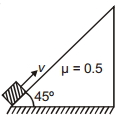
- 7A block of mass $1 \,kg$ is projected from the lowest point up along the inclined plane. If $g=10 \,ms ^{-2}$, the retardation experienced by the block is ............. $ms ^ {-2}$View Solution
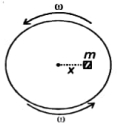
- 8A block of mass $m$ is kept on horizontal turn table at $x$ distance from the centre. If coefficient of friction between block and surface of turn table is $\mu$, then maximum angular speed of the table so that block does not slipView Solution
- 9A block of mass $1 \,kg$ is projected from the lowest point up along the inclined plane. If $g=10 \,ms ^{-2}$, the retardation experienced by the block is ............. $ms ^ {-2}$View Solution
- 10The normal reaction $'{N}^{\prime}$ for a vehicle of $800\, {kg}$ mass, negotiating a turn on a $30^{\circ}$ banked road at maximum possible speed without skidding is $...\,\times 10^{3}\, {kg} {m} / {s}^{2}$ [Given $\left.\cos 30^{\circ}=0.87, \mu_{{s}}=0.2\right]$View Solution