A small object is placed at the centre of the bottom of a cylindrical vessel of radius 3cm and height 4cm filled completely with water. Consider the ray leaving the vessel through a corner. Suppose this ray and the ray along the axis of the vessel are used to trace the image. Find the apparent depth of the image and the ratio of real depth to the apparent depth under the assumptions taken. Refractive index of water = 1.33
Download our app for free and get started
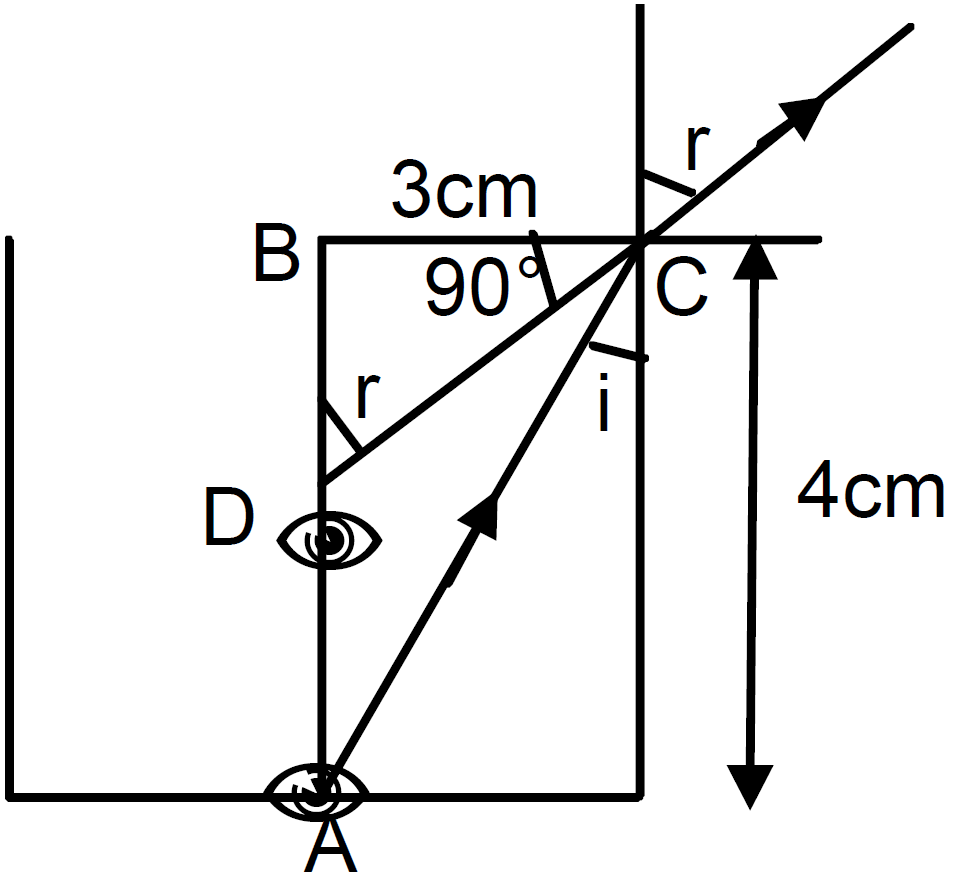
According to the figure, $\frac{\text{x}}{3}=\cot\text{r} \ ...(1)$
Again, $\frac{\sin\text{i}}{\sin\text{r}}=\frac{1}{1.33}=\frac{3}{4}$
$\Rightarrow\sin\text{r}=\frac{4}{3}\sin\text{i}=\frac{4}{3}\times\frac{3}{5}=\frac{4}{5} \ \Big(\text{because}\sin\text{i}=\frac{\text{BC}}{\text{AC}}=\frac{3}{5}\Big)$
$\Rightarrow\cot\text{r}=\frac{3}{4} \ ...(2)$
From (1) and (2)
$\Rightarrow\frac{\text{x}}{3}=\frac{3}{4}$
$\Rightarrow\text{x}=\frac{9}{4}=2.25\text{cm}.$
$\therefore \ $ Ratio of real and apparent depth = 4 : (2.25) = 1.78

Download our appand get started for free
Experience the future of education. Simply download our apps or reach out to us for more information. Let's shape the future of learning together!No signup needed.*
Similar Questions
- 1View Solution
- Draw the ray diagram of an astronomical telescope when the final image is formed at infinity. Write the expression for the resolving power of the telescope.
- An astronomical telescope has an objective lens of focal length 20m and eyepiece of focal length 1cm.
- Find the angular magnification of the telescope.
- If this telescope is used to view the Moon, find the diameter of the image formed by the objective lens. Given the diameter of the Moon is $3.5 \times 10^6m$ and radius of lunar orbit is $3.8 \times 10^8m.$
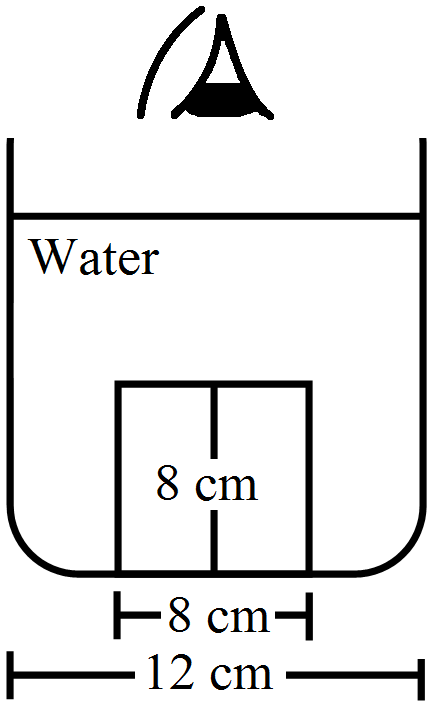
- 2A cylindrical vessel of diameter 12cm contains $800\pi\text{cm}^3$ of water. A cylindrical glass piece of diameter 8.0 cm and height 8.0cm is placed in the vessel. If the bottom of the vessel under the glass piece is seen by the paraxial rays, locate its image. The index of refraction of glass is 1.50 and that of water is 1.33.View Solution
- 3A thin lens made of a material of refractive index $\mu_2$ has a medium of refractive index $\mu_1$ on one side and a medium of refractive index $\mu_3$ on the other side. The lens is biconvex and the two radii of curvature have equal magnitude R. A beam of light travelling parallel to the principal axis is incident on the lens. Where will the image be formed if the beam is incident from:View Solution
- The medium $\mu_1$
- From the medium $\mu_3?$
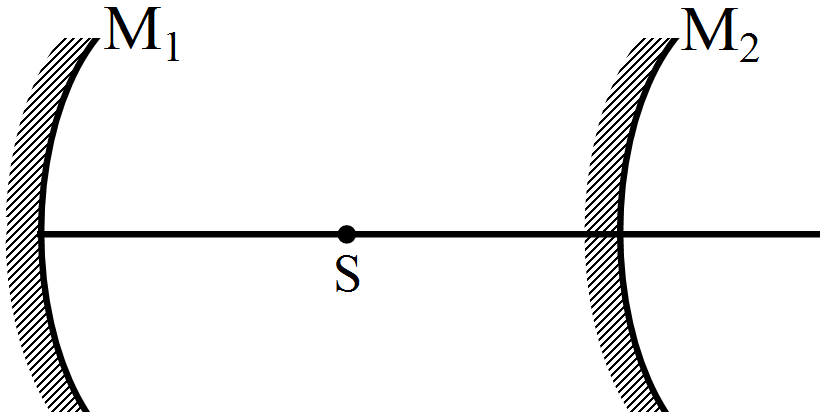
- 4A converging mirror $\mathrm{M}_1$, a point source S and a diverging mirror $\mathrm{M}_2$ are arranged as shown in figure. The source is placed at a distance of 30 cm from $\mathrm{M}_1$. The focal length of each of the mirrors is 20 cm . Consider only the images formed by a maximum of two reflections. It is found that one image is formed on the source itself.View Solution
- Find the distance between the two mirrors.
- Find the location of the image formed by the single reflection from $\mathrm{M}_2$.
- 5View Solution
- Draw a labelled ray diagram to show the formation of image in an astronomical telescope for a distant object.
- Write three distinct advantages of a reflecting type telescope over a refracting type telescope.
- A convex lens of focal length 10 cm is placed coaxially 5 cm away from a concave lens of focal length 10 cm. If an object is placed 30 cm in front of the convex lens, find the position of the final image formed by the combined system.
- 6View SolutionA gun of mass M fires a bullet of mass m with a horizontal speed V. The gun is fitted with a concave mirror of focal length f facing tpwards the receding bullet. Find the speed of separation of the bullet and the image just after the gun was fired.
- 7View SolutionAn optical instrument used for angular magnification has a 25D objective and a 20D eyepiece. The tube length is 25cm when the eye is least strained.
- Whether it is a microscope or a telescope?
- What is the angular magnification produced?
- 8View SolutionA normal eye has retina 2cm behind the eye-lens. What is the power of the eye-lens when the eye is
- Fully relaxed,
- Most strained?
- 9View Solution
- Derive the mathematical relation between refractive indices $n_1$ and $n_2 $ of two radii and radius of curvature R for refraction at a convex spherical surface. Consider the object to be a point since lying on the principle axis in rarer medium of refractive index $n_1$ and a real image formed in the denser medium of refractive index $n_{2}$.Hence, derive lens maker's formula.
- Light from a point source in air falls on a convex spherical glass surface of refractive index 1.5 and radius of curvature 20 cm. The distance of light source from the glass surface is 100 cm. At what position is the image formed?
- 10View SolutionA man with normal near point (25 cm) reads a book with small print using a magnifying glass: a thin convex lens of focal length 5 cm.
- What is the closest and the farthest distance at which he should keep the lens from the page so that he can read the book when viewing through the magnifying glass?
- What is the maximum and the minimum angular magnification (magnifying power) possible using the above simple microscope?