A normal eye has retina 2cm behind the eye-lens. What is the power of the eye-lens when the eye is
- Fully relaxed,
- Most strained?
Download our app for free and get started
Since, the retina is 2cm behind the eye-lensv = 2cm
$\text{v}=2\text{cm}=0.02\text{m}$
$\Rightarrow\frac{1}{\text{f}}=\frac{1}{\text{v}}-\frac{1}{\text{u}}=\frac{1}{0.02}-\frac{1}{\infty}=50\text{D}$
So, in this condition power of the eye-lens is 50D
$\text{v}=+2\text{cm}=+0.02\text{m}$
$\Rightarrow\frac{1}{\text{u}}=\frac{1}{\text{v}}-\frac{1}{\text{u}}=\frac{1}{0.02}-\frac{1}{-0.25}=50+4=54\text{D}$
In this condition power of the eye lens is 54D.
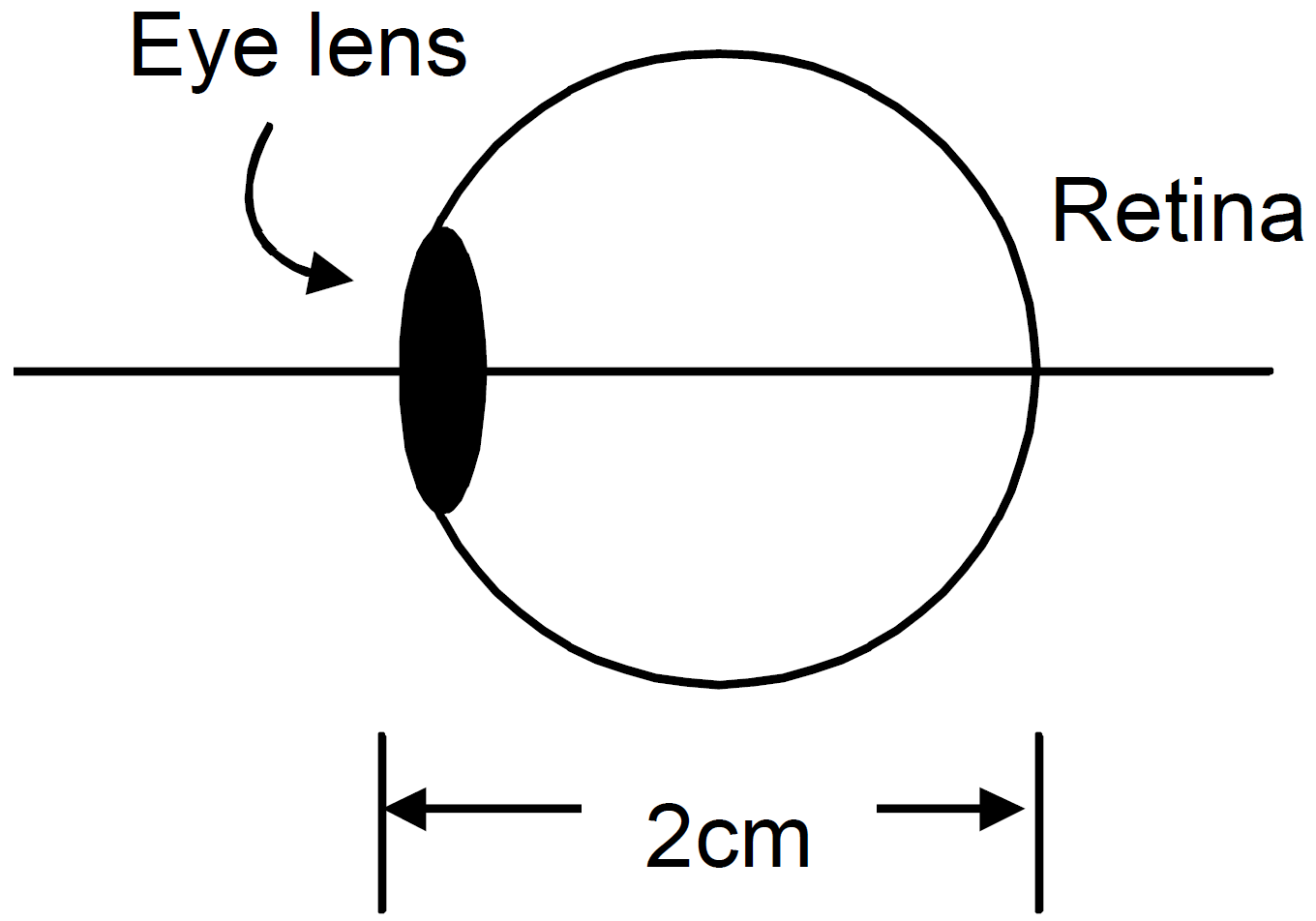
- When the eye-lens is fully relaxed
$\text{v}=2\text{cm}=0.02\text{m}$
$\Rightarrow\frac{1}{\text{f}}=\frac{1}{\text{v}}-\frac{1}{\text{u}}=\frac{1}{0.02}-\frac{1}{\infty}=50\text{D}$
So, in this condition power of the eye-lens is 50D
- When the eye-lens is most strained,
$\text{v}=+2\text{cm}=+0.02\text{m}$
$\Rightarrow\frac{1}{\text{u}}=\frac{1}{\text{v}}-\frac{1}{\text{u}}=\frac{1}{0.02}-\frac{1}{-0.25}=50+4=54\text{D}$
In this condition power of the eye lens is 54D.

Download our appand get started for free
Experience the future of education. Simply download our apps or reach out to us for more information. Let's shape the future of learning together!No signup needed.*
Similar Questions
- 1View SolutionAn eye can distinguish between two points of an object if they are separated by more than 0.22mm when the object is placed at 25cm from the eye. The object is now seen by a compound microscope having a 20D objective and 10D eyepiece separated by a distance of 20cm. The final image is formed at 25cm from the eye. What is the minimum separation between two points of the object which can now be distinguished?
- 2Derive the lens formula, $\frac{1}{\text{f}} = \frac{1}{\text{v}} - \frac{1}{\text{u}}$ for a concave lens, using the necessary ray diagram.View Solution
Two lenses of powers 10 D and – 5 D are placed in contact.- Calculate the power of the new lens.
- Where should an object be held from the lens, so as to obtain a virtual image of magnification 2?
- 3View SolutionLenses are constructed by a material of refractive index 1.50. The magnitude of the radii of curvature are 20cm and 30cm. Find the focal lengths of the possible lenses with the above specifications.
- 4View SolutionWill the focal length of a lens for red light be more, same or less than that for blue light?
- 5View SolutionA lady uses +1.5D glasses to have normal vision from 25cm onwards. She uses a 20D lens as a simple microscope to see an object. Find the maximum magnifying power if she uses then microscope
- Together with her glass
- Without the glass. Do the answers suggest that an object can be more clearly seen through a microscope without using the correcting glasses?
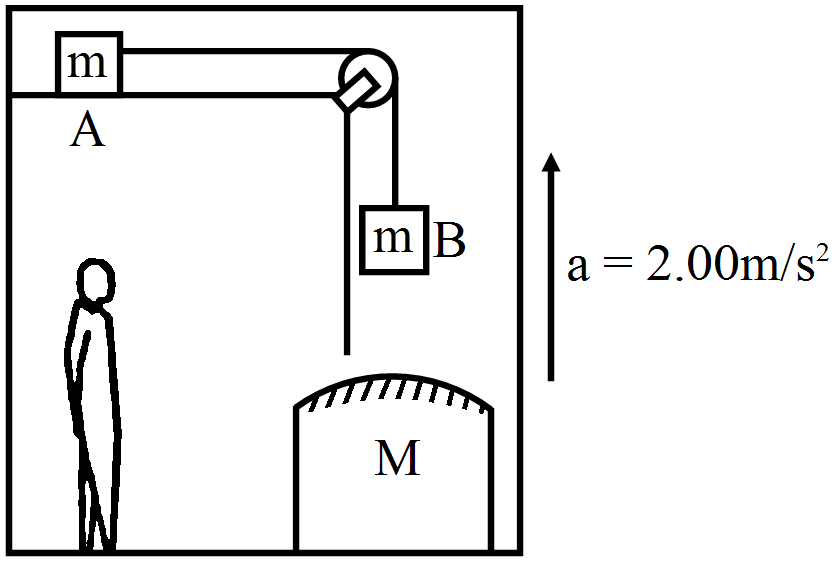
- 6Consider the situation shown in figure. The elevator is going up with an acceleration of $2.00m/s^2$ and the focal length of the mirror is 12.0cm. All the surfaces are smooth and the pulley is light. The mass-pulley system is released from rest (with respect to the elevator) at t = 0 when the distance of B from the mirror is 42.0cm. Find the distance between the image of the block B and the mirror at $t = 0.200s$. Take $g = 10m/s^2$.View Solution
- 7View Solution
- With the help of a suitable ray diagram, derive the mirror formula for a concave mirror.
- The near point of a hypermetropic person is 50 cm from the eye. What is the power of the lens required to enable the person to read clearly a book held at 25 cm from the eye?
- 8View SolutionDraw a ray diagram to show the formation of real image of the same size as that of the object placed in front of a converging lens. Using this ray diagram establish the relation between u, v and f for this lens.
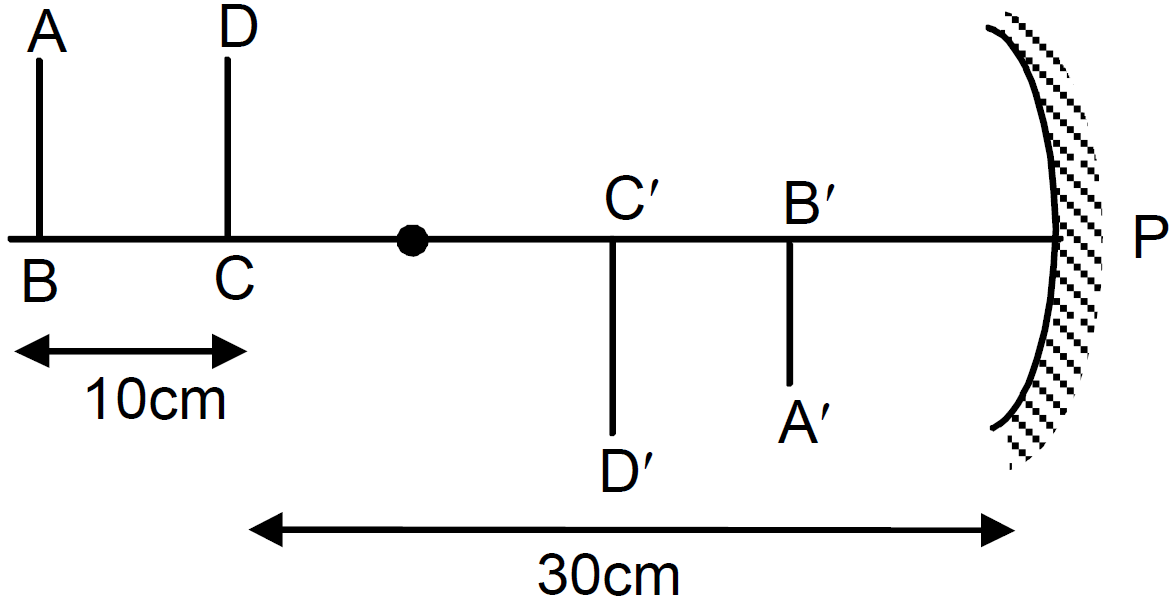
- 9View SolutionA U-shaped wire is placed before a concave mirror having radius of curvature 20cm. Find the total length of the image.
- 10View SolutionA compound microscope consists of an objective of focal length 1cm and an eyepiece of focal length 5cm. An object is placed at a distance of 0.5cm from the objective. What should be the separation between the lenses so that the microscope projects an inverted real image of the object on a screen 30cm behind the eyepiece?