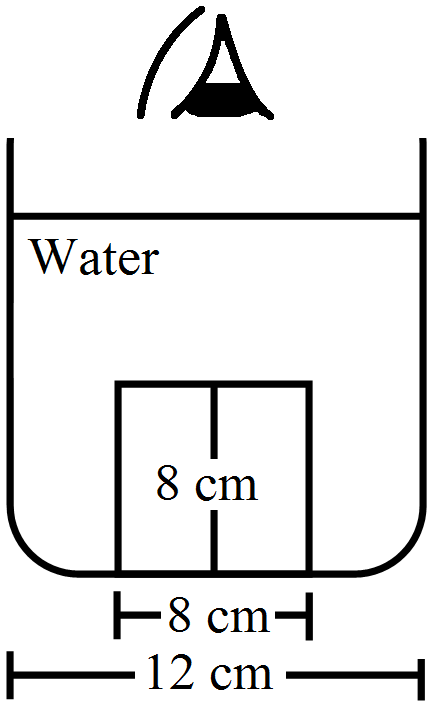
A cylindrical vessel of diameter 12cm contains $800\pi\text{cm}^3$ of water. A cylindrical glass piece of diameter 8.0 cm and height 8.0cm is placed in the vessel. If the bottom of the vessel under the glass piece is seen by the paraxial rays, locate its image. The index of refraction of glass is 1.50 and that of water is 1.33.
Download our app for free and get started
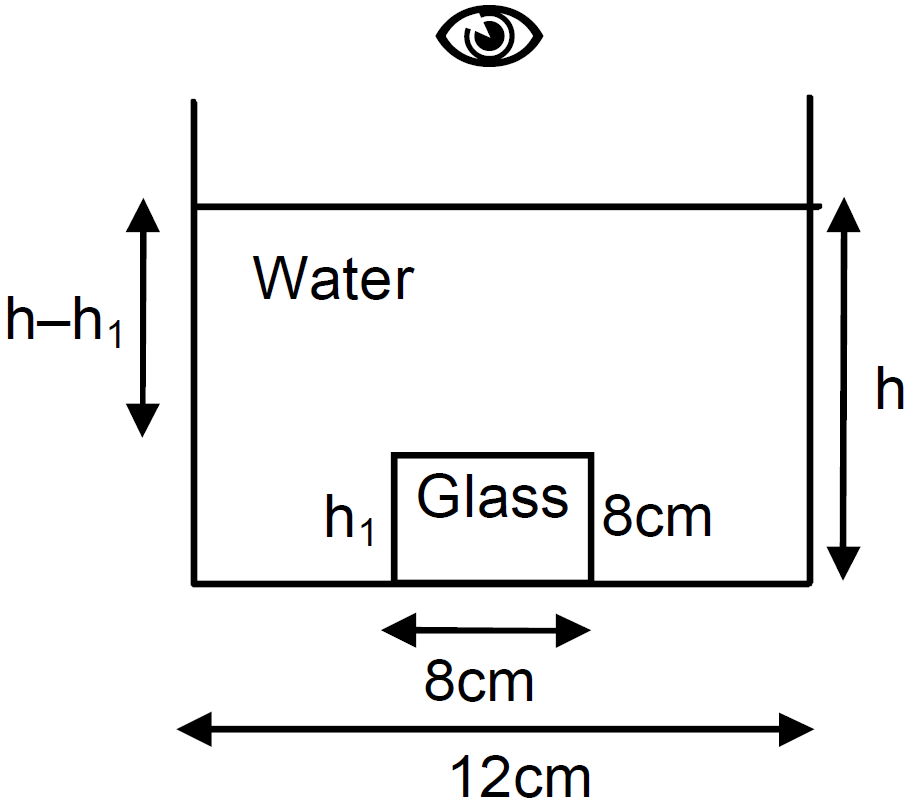
Given $r = 6 cm, r_1 = 4cm, h_1 = 8cm$
Let, h = final height of water column.
The volume of the cylindrical water column after the glass piece is put will be,
$\pi\text{r}^2\text{h}=800\pi+\pi\text{r}_1{^2\text{h}_1}$
or $\text{r}^2\text{h}=800+\text{r}_1{^2\text{h}_1}$
or $6^2\text{h}=800+4^2\times8$
$\text{h}=\frac{800+128}{36}=\frac{928}{36}$
$=25.7\text{cm}$
There are two shifts due to glass block as well as water.
So, $\Delta\text{t}_1=\Big(1-\frac{1}{\mu_0}\Big)\text{t}_0=\bigg(1-\frac{1}{\frac{3}{2}}\bigg)8=2.26\text{cm}$
And, $\Delta\text{t}_2=\Big(1-\frac{1}{\mu_{\text{w}}}\Big)\text{t}_{\text{w}}=\bigg(1-\frac{1}{\frac{4}{3}}\bigg)(25.7-8)=4.44\text{cm}$
Total shift = (2.66 + 4.44)cm = 7.1cm above the bottom.

Download our appand get started for free
Experience the future of education. Simply download our apps or reach out to us for more information. Let's shape the future of learning together!No signup needed.*
Similar Questions
- 1View SolutionA lady uses +1.5D glasses to have normal vision from 25cm onwards. She uses a 20D lens as a simple microscope to see an object. Find the maximum magnifying power if she uses then microscope
- Together with her glass
- Without the glass. Do the answers suggest that an object can be more clearly seen through a microscope without using the correcting glasses?
- 2A thin lens made of a material of refractive index $\mu_2$ has a medium of refractive index $\mu_1$ on one side and a medium of refractive index $\mu_3$ on the other side. The lens is biconvex and the two radii of curvature have equal magnitude R. A beam of light travelling parallel to the principal axis is incident on the lens. Where will the image be formed if the beam is incident from:View Solution
- The medium $\mu_1$
- From the medium $\mu_3?$
- 3View SolutionA small object is placed at the centre of the bottom of a cylindrical vessel of radius 3cm and height 4cm filled completely with water. Consider the ray leaving the vessel through a corner. Suppose this ray and the ray along the axis of the vessel are used to trace the image. Find the apparent depth of the image and the ratio of real depth to the apparent depth under the assumptions taken. Refractive index of water = 1.33
- 4View SolutionIn many experimental set-ups the source and screen are fixed at a distance say D and the lens is movable. Show that there are two positions for the lens for which an image is formed on the screen. Find the distance between these points and the ratio of the image sizes for these two points.
- 5View Solution
- With the help of a suitable ray diagram, derive the mirror formula for a concave mirror.
- The near point of a hypermetropic person is 50 cm from the eye. What is the power of the lens required to enable the person to read clearly a book held at 25 cm from the eye?
- 6View SolutionA convex lens has a focal length of 10cm. Find the location and nature of the image if a point object is placed on the principal axis at a distance of:
- 9.8cm
- 10.2cm from the lens.
- 7View SolutionA compound microscope has a magnifying power of 100 when the image is formed at infinity. The objective has a focal length of 0.5cm and the tube length is 6.5cm. Find the focal length of the eyepiece.
- 8View Solution
- Obtain lens makers formula using the expression
Here the ray of light propagating from a rare medium of refractive index $(n_1)$ to a denser medium of refractive index $(n_2)$ is incident on the convex side of spherical refracting surface of radius of curvature R.- Draw a ray diagram to show the image formation by a concave mirror when the object is kept between its focus and the pole. Using this diagram, derive the magnification formula for the image formed.
- 9View SolutionAt what angle should a ray of light be incident on the face of a prism of refracting angle 60° so that it just suffers total internal reflection at the other face? The refractive index of the material of the prism is 1.524.
- 10View Solution
- Draw a ray diagram showing the image formation by a compound microscope. Hence obtain expression for total magnification when the image is formed at infinity.
- Distinguish between myopia and hypermetropia. Show diagrammatically how these defects can be corrected.