A uniform disc of radius R and mass M is mounted on an axis supported in fixed frictionless bearing. A light chord is wrapped around the rim of the wheel and suppose that we hang a body of mass m from the chord. Find the angular acceleration of the disc and tangential acceleration of point on the rim.
Download our app for free and get started
The situation is shown in the fig.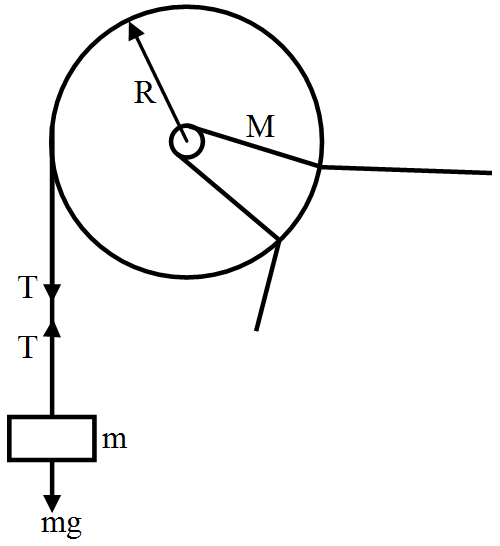
Let f be the tension in the chord. Now, $\text{mg}-\text{T}=\text{ma},\dots(1)$ where a is the tangential acceleradon of a point
on the rim of the disc We know that $\tau=\text{l}\alpha.$ But the resultant torque on the disc = TR and
the rotational inertia $\text{l}=\frac{1}{2}\text{MR}^2$ $\therefore\text{TR}=\frac{1}{2}\text{MR}^2\Big(\frac{\text{a}}{\text{R}}\Big)(\because\alpha=\frac{\text{a}}{\text{R}})$ or $2\text{TR}=\text{Ma}$ or $\text{a}=\frac{2\text{T}}{\text{M}}\dots(2)$ From equations (r) and (ir), we get $\text{mg}-\Big(\frac{\text{Ma}}{2}\Big)=\text{ma}$ or $\text{a}=\Big(\frac{2\text{m}}{\text{M+2M}}\Big)\text{g}\dots(3)$ Again,$\text{mg}-\text{T}=\text{m}\times\Big(\frac{2\text{T}}{\text{M}}\Big)$ or $\text{T}=\Big(\frac{\text{mM}}{\text{M}+2\text{m}}\Big)\text{g}\dots(4)$
Let f be the tension in the chord. Now, $\text{mg}-\text{T}=\text{ma},\dots(1)$ where a is the tangential acceleradon of a point
on the rim of the disc We know that $\tau=\text{l}\alpha.$ But the resultant torque on the disc = TR and
the rotational inertia $\text{l}=\frac{1}{2}\text{MR}^2$ $\therefore\text{TR}=\frac{1}{2}\text{MR}^2\Big(\frac{\text{a}}{\text{R}}\Big)(\because\alpha=\frac{\text{a}}{\text{R}})$ or $2\text{TR}=\text{Ma}$ or $\text{a}=\frac{2\text{T}}{\text{M}}\dots(2)$ From equations (r) and (ir), we get $\text{mg}-\Big(\frac{\text{Ma}}{2}\Big)=\text{ma}$ or $\text{a}=\Big(\frac{2\text{m}}{\text{M+2M}}\Big)\text{g}\dots(3)$ Again,$\text{mg}-\text{T}=\text{m}\times\Big(\frac{2\text{T}}{\text{M}}\Big)$ or $\text{T}=\Big(\frac{\text{mM}}{\text{M}+2\text{m}}\Big)\text{g}\dots(4)$

Download our appand get started for free
Experience the future of education. Simply download our apps or reach out to us for more information. Let's shape the future of learning together!No signup needed.*
Similar Questions
- 1Locate the centre of mass of a system of particles of mass $m_1 = 1kg, m_2 = 2kg$ and $m_3 = 3kg$, situated at the corners of an equilateral triangle of side 1.0 metre.View Solution
- 2A hoop of radius $2m$ weighs $100kg$. It rolls along a horizontal floor so that its centre of mass has a speed of $20cm/s$. How much work has to be done to stop it?View Solution
- 3Particles of masses $1g, 2g, 3g, ........, 100g$ are kept at the marks $1cm, 2cm, 3cm, ........, 100cm$ respectively on a metre scale. Find the moment of inertia of the system of particles about a perpendicular bisector of the metre scale.View Solution
- 4Two cylindrical hollow drums of radii R and 2R, and of a common height h, are rotating with angular velocities $\omega$ (anti-clockwise) and $\omega$ (clockwise), respectively. Their axes, fixed are parallel and in a horizontal plane separated by $(3\text{R}+\delta).$ They are now brought in contact $(\delta\rightarrow0){:}$View Solution
- Show the frictional forces just after contact.
- Identify forces and torques external to the system just after contact.
- What would be the ratio of final angular velocities when friction ceases?
- 5View SolutionA uniform disc of radius R is put over another uniform disc of radius 2R of the same thickness and density. The peripheries of the two discs touch each other. Locate the centre of mass of the system.
- 6Two discs of moments of inertia $I_1$ and $I_2$ about their respective axes (normal to the disc and passing through the centre), and rotating with angular speeds $\omega_1$ and $\omega_2$ are brought into contact face to face with their axes of rotation coincident.View Solution
- What is the angular speed of the two-disc system?
- Show that the kinetic energy of the combined system is less than the sum of the initial kinetic energies of the two discs. How do you account for this loss in energy? Take $\omega_1\neq\omega_2$
- 7View SolutionFig. shows two blocks of masses 5kg and 2kg placed on a frictionless surface and connected by a spring. An external kick gives a velocity 14 m/ s to the heavier block in the direction of lighter one. Deduce (i) the velocity gained by the centre of mass and (ii) the separate velocities of the two blocks in the centre of mass coordinates just after the kick.
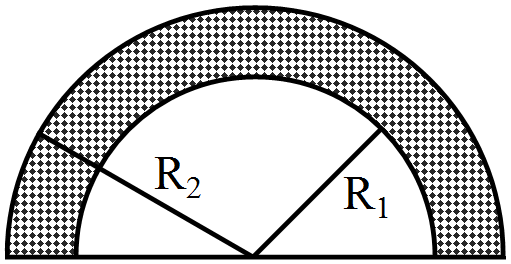
- 8Find the centre of mass of a uniform plate having semicircular inner and outer boundaries of radii $R_1$ and $R_2$.View Solution
- 9A $2kg$ body and a $3kg$ body are moving along the x-axis. At a particular instant, the $2kg$ body is $1m$ from the origin and has a velocity of $3ms^{-1}$ and the $3kg$ body is $2m$ from the origin and has velocity of $-1 ms^{-1}$. Find the position and velocity of the centre of mass and also find the total momentum.View Solution
- 10Separation of Motion of a system of particles into motion of the centre of mass and motion about the centre of mass: Show $\text{K}=\text{K}'+\frac{1}{2}\text{M}\text{V}^2$ where K' is the total kinetic energy of the system of particles, K′ is the total kinetic energy of the system when the particle velocities are taken with respect to the centre of mass and $\frac{\text{MV}^2}{2}$ is the kinetic energy of the translation of the system as a whole (i.e. of the centre of mass motion of the system). The result has been used in $\sec7.14$View Solution