Question
Write Hooke's law. On what does the value of co-efficient of elasticity depend? Draw a graph between stress and strain with in the elastic limit.###Write Hooke's law. How to determine the coefficient of elasticity of a material of wire in the laboratory? Explain. Make necessary diagram also Compare the Young's Modulus of elasticity of different material.
Answer

SELF

Need a full question paper?

Generate a complete, print-ready paper with questions like this in minutes — across 16+ boards, with answer keys.

Start Generating Free

Similar questions

An object starts from rest and covers a total distance X in the following manner: It first has a uniform acceleration $a_1$ for some time $t_1$, moves with the speed acquired at the end of $t_1$ for some distance and is then given a uniform retardation $a_2$ so that it is again at rest at the end of the journey. Show that the journey is covered in least time if the body is accelerated for a time of $\Big[\frac{2\text{X a}_2}{\text{a}_1(\text{a}_1+\text{a}_2)}\Big]^{\frac{1}{2}}$ and this minimum time is $\Bigg[2\text{X}\Big(\frac{1}{\text{a}_1}+\frac{1}{\text{a}_2}\Big)\Bigg]^{\frac{1}{2}}.$
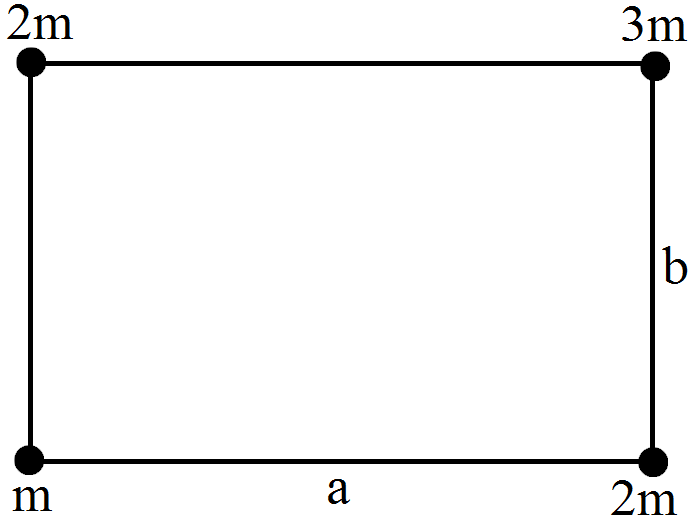
Four bodies have been arranged at the corners of a rectangle shown in figure. Find the centre of mass of the system.
Two friends A and B (each weighing $40kg$) are sitting on a frictionless platform some distance d apart. A rolls a ball of mass $4kg$ on the platform towards B which B catches. Then B rolls the ball towards A and A catches it. The ball keeps on moving back and forth between A and B. The ball has a fixed speed of 5m/s on the platform.
  1. Find the speed of A after he rolls the ball for the first time.
  2. Find the speed of A after he catches the ball for the first time.
  3. Find the speeds of A and B after the ball has made 5 round trips and is held by A.
  4. How many times can A roll the ball?
  5. Where is the centre of mass of the system ''A + B + ball'' at the end of the $n^{th}$ trip?
An organ pipe of length L open at both ends is found to vibrate in its first harmonic when sounded with a tuning fork of 480Hz. What should be the length of a pipe closed at one end, so that it also vibrates in its first harmonic with the same tuning fork?
Define velocity and acceleration. Draw a velocity time graph for uniformly accelerated motion and prove that the area between the curve of this graph and the time axis is equal to the displacement of the moving object
Establish the following vector inequalities geometrically or otherwise: $|\text{a}+\text{b}|\le|\text{a}|+|\text{b}|$ When does the equality sign above apply?
A drunkard walking in a narrow lane takes 5 steps forward and 3 steps backward, followed again by 5 steps forward and 3 steps backward, and so on. Each step is 1m long and requires 1s. Plot the x-t graph of his motion. Determine graphically and otherwise how long the drunkard takes to fall in a pit 13m away from the start.
A small piece of cesium metal ($\phi$ = 1 ·9 eV) is kept at a distance of $20cm$ from a large metal plate having a charge density of $1.0 \times 10^{-9}C/m^2$ on the surface facing the cesium piece. A monochromatic light of wavelength $400nm$ is incident on the cesium piece. Find the minimum and the maximum kinetic energy of the photoelectrons reaching the large metal plate. Neglect any change in electric field due to the small piece of cesium present.
We would like to make a vessel whose volume does not change with temperature (take a hint from the problem above). We can use brass and iron $\big(\beta_\text{ubrass}=6\times10^{-5}/\text{K and }\beta_\text{uiron}=3.55\times10^{-5}\text{K}\big)$ to create a volume of $100cc$. How do you think you can achieve this.
Derive the formula for centripetal acceleration of a particle moving with constant speed on a plane circular path. Or Derive the formula of acceleration for a particle moving with uniform speed on a circular path and tell its direction.