MCQ
A soap bubble in vacuum has a radius of $3 \,cm$ and another soap bubble in vacuum has a radius of $4 \,cm$. If the two bubbles coalesce under isothermal condition, then the radius of the new bubble is ....... $cm$
  • A
    $2.3$
  • B
    $4.5$
  • $5 $
  • D
    $7$

Answer

Correct option: C.
$5 $
c
(c) $r = \sqrt {r_1^2 + r_2^2} = \sqrt {9 + 16} = 5\;cm$

Need a full question paper?

Generate a complete, print-ready paper with questions like this in minutes — across 16+ boards, with answer keys.
Start Generating Free

Similar questions

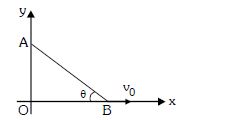
The end $B$ of the rod $AB$ which makes angle $\theta$ with the floor is being pulled with, a constant velocity $v_0$ as shown. The length of the rod is $l.$ At the instant when $\theta = 37^o $ then
Four bodies $P, Q, R$ and $S$ are projected with equal velocities having angles of projection $15^o , 30^o , 45^o $  and $60^o $ with the horizontal respectively. The body having shortest range is
A body is moving forwards and backward. Change in frequency observed of source is 2%. What is velocity of the body? (Speed of sound is 300 m/s)
During an adiabatic process, the pressure of a gas is proportional to the cube of its absolute temperature. The value of $\frac{\text{C}_{\text{p}}}{\text{C}_\text{v}}$ for that gas is:
A particle revolves round a circular path. The acceleration of the particle is
Two pendulums begin to swing simultaneously. If the ratio of the frequency of oscillations of the two is $7 : 8$, then the ratio of lengths of the two pendulums will be
Water rises to a height of $10\,cm$ in a certain capillary tube. An another identical tube when dipped in mercury the level of mercury is depressed by $3.42\,cm$. Density of mercury is $13.6\, g/cc$. The angle of contact for water in contact with glass is $0^o$ and mercury in contact with glass is $135^o$. The ratio of surface tension of water to that of $Hg$ is :-
A sphere cannot roll on:
  1. A smooth horizontal surface.
  2. A smooth inclined surface.
  3. A rough horizontal surface.
  4. A rough inclined surface.
At what temperature the molecules of nitrogen will have the same $r.m.s.$ velocity as the molecules of oxygen at $127°C$  ....... $^oC$
A body starts from rest and moves with uniform acceleration for $3\ s.$ It then decelerates uniformly for $2\ s.$ and stops. If the deceleration is $3 \ ms^{-2}$ the maximum velocity of the body is$. . . ms^{-1}$