MCQ
A solid conducting sphere of radius $R_1$ is surrounded by another concentric hollow conducting sphere of radius $R_2.$ The capacitance of this assembly is proportional to
  • A
    $\frac{R_2-R_1}{R_1 R_2}$
  • B
    $\frac{ R _2+ R _1}{ R _1 R _2}$
  • C
    $\frac{ R _1 R _2}{ R _1+ R _2}$
  • $\frac{R_1 R_2}{R_2-R_1}$

Answer

Correct option: D.
$\frac{R_1 R_2}{R_2-R_1}$

Need a full question paper?

Generate a complete, print-ready paper with questions like this in minutes — across 16+ boards, with answer keys.

Start Generating Free

Similar questions

The n rows each containing $m$ cells in series are joined in parallel. Maximum current is taken from this combination across an external resistance of $3\Omega$ resistance. If the total number of cells used are $24$ and internal resistance of each cell is $0.5\Omega$ then
A person brings a mass of $1\ kg$ from infinity to a point $A$. Initially the mass was at rest but it moves at a speed of $2ms^{-1}$ as it reaches $A.$ The work done by the person on the mass is $-3J.$ The potential at $A$ is:
The black shapes in the figure are closed surfaces. The electric field lines are in red. For which case the net flux through the surfaces is non-zero?
The correct order of ionizing capacity of α, β and γ - rays is(a) α >  γ > β(b) α > β > γ(c) α < β <γ(d) α > β > γ
       
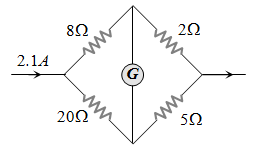
In the given figure, when galvanometer shows no deflection, the current $($in ampere$)$ flowing through $5 \Omega$  resistance will be
If the forward voltage in a semiconductor diode is doubled, the width of the depletion layer will(a) Become half(b) Become one-fourth(c) Remain unchanged(d) Become double
       
A charged particle moves through a magnetic field perpendicular to its direction. Then:
Two cells when connected in series are balanced on 8m on a potentiometer. If the cells are connected with polarities of one of the cell is reversed, they balance on 2m. The ratio of e.m.f.'s of the two cells is(a) 3 : 5(b) 5 : 3(c) 3 : 4(d) 4 : 3
       
A circular disc $A$ of radius $r$ is made from an iron plate of thickness $(t)$ and another circular disc $B$ of radius $4r$ is made from an iron plate of thickness $\frac{\text{t}}{4}.$ The relation between the moments of inertia $I_A$ and $I_B$ is:
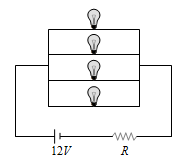
Four identical electrical lamps are labelled $1.5V, 0.5A$ which describes the condition necessary for them to operate at normal brightness. A $12V$ battery of negligible internal resistance is connected to lamps as shown, then