MCQ
A solid cube and a solid sphere of identical material and equal masses are heated to the same temperature and left to cool in the same surroundings. Then,
  • A
    the cube will cool faster because of its sharp edges
  • the cube will cool faster because it has a larger surface area
  • C
    the sphere will cool faster because it is smooth
  • D
    the sphere will cool faster because it has a larger surface area

Answer

Correct option: B.
the cube will cool faster because it has a larger surface area
b
(b)

Area of cube is more than that of a sphere for same mass and density.

Cube also have sharp edges that radiates more effectively than a flat surface.

So, rate of cooling for cube is much rapid than sphere. Effect of sharp edges is prominent only at very high

temperatures. So, option $(b)$ is correct.

Need a full question paper?

Generate a complete, print-ready paper with questions like this in minutes — across 16+ boards, with answer keys.

Start Generating Free

Similar questions

Magnification of a compound microscope is $30$. Focal length of eye-piece is $5\, cm$ and the image is formed at a distance of distinct vision of $25\, cm$. The magnification of the objective lens is
Which of the following is not correct regarding the radio telescope
$A$ bal $A$ collides elastically with another identical ball $B$ initially at rest $A$ is moving with velocity of $10m/ s$ at an angle of $60^o$ from the line joining their centres. Select correct alternative :
An oscillator is nothing but an amplifier with
$A$ proton and an $\alpha$-particle are accelerated through a potential difference of $100 V$. The ratio of the wavelength associated with the proton to that associated with an $\alpha$-particle is
If in hydrogen atom, radius of ${n^{th}}$ Bohr orbit is ${r_n},$ frequency of revolution of electron in ${n^{th}}$ orbit is ${f_n}$ choose the correct option
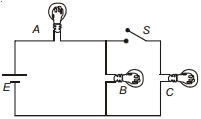
Three identical bulbs are connected as shown in figure. When switch $S$ is closed, the power consumed in bulb $B$ is $P$. What will be the power consumed by the same bulb when switch $S$ is opened?
The displacement of a particle executing $SHM$ is given by $y=0.25 \sin 200 t$ $cm$. The maximum speed of the particle is $.........cm s^{-1}$
In a series $LCR$ current the voltage across resistance, capacitance and inductance is $10\, V$ each. If the inductor is short circuited, the voltage across the capacitor will be:-
If $Q= \frac{X^n}{Y^m}$ and $\Delta X$ is absolute error in the measurement of $X,$ $\Delta Y$ is absolute error in the measurement of $Y,$ then absolute error $\Delta Q$ in $Q$ is