Question
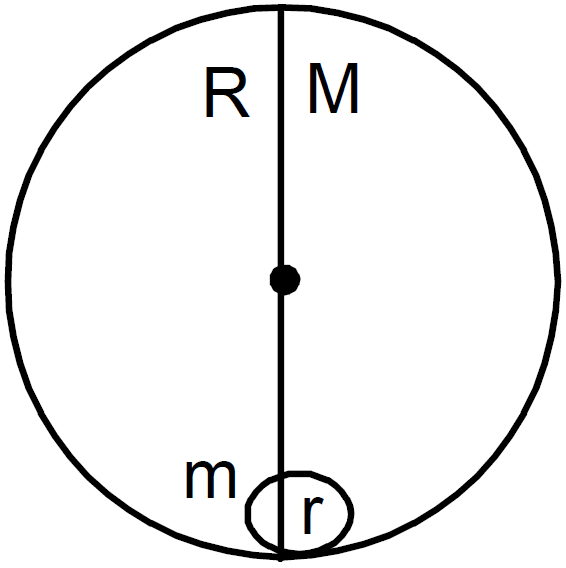
A solid sphere of mass m and radius r is placed inside a hollow thin spherical shell of mass M and radius R as shown in A particle of mass m' is placed on the line joining the two centres at a distance x from the point of contact of the sphere and the shell. Find the magnitude of the resultant gravitational force on this particle due to the sphere and the shell if,
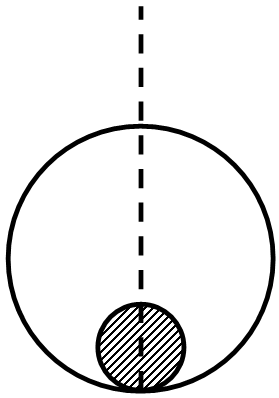
  1. r < x < 2r.
  2. 2r < x < 2R.
  3. x > 2R.

Answer

  1. m' is placed at a distance x from ‘O’.
If r < x, 2r, Let’s consider a thin shell of man

$\text{dm}=\frac{\text{m}}{\big(\frac{4}{3}\big)\pi\text{r}^2}\times\frac{4}{3}\pi\text{x}^3=\frac{\text{mx}^3}{\text{r}^3}$

Thus $\int\text{dm}=\frac{\text{mx}^3}{\text{r}^3}$

Then gravitational force $\text{F}=\frac{\text{Gmdm}}{\text{x}^2}=\frac{\frac{\text{Gmx}^3}{\text{r}^3}}{\text{x}^2}=\frac{\text{Gmx}}{\text{r}^3}$
  1. x < 2R, then F is due to only the sphere.
$\text{F}=\frac{\text{Gmm'}}{(\text{x}-\text{r})^2}$
  1. If x > 2R, then Gravitational force is due to both sphere & shell, then due to shell,
$\text{F}=\frac{\text{GMm'}}{(\text{x}-\text{R})^2}$

due to the sphere $=\frac{\text{Gmm'}}{(\text{x}-\text{r})^2}$

So, Resultant force $=\frac{\text{Gmm'}}{(\text{x}-\text{r})^2}+\frac{\text{GMm'}}{(\text{x}-\text{R})^2}$

Need a full question paper?

Generate a complete, print-ready paper with questions like this in minutes — across 16+ boards, with answer keys.

Start Generating Free

Similar questions

A brass wire $1.8m$ long at $27°C$ is held taut with little tension between two rigid supports. If the wire is cooled to a temperature of  $–39^\circ C$, what is the tension developed in the wire, if its diameter is $2.0mm$? Co-efficient of linear expansion of brass = $2.0 \times 10^{–5} K^{–1}$; Young’s modulus of brass = $0.91 × 10¹¹Pa$.
Electrons emitted with negligible speed from an electron gun are accelerated through a potential difference V along the x-axis. These electrons emerge from a narrow hole into a uniform magnetic field B directed along this axis. However, some of the electrons emerging from the hole make slightly divergent angles, as shown in the figure. Show that these paraxial electrons are refocussed on the x-axis at a distance $\sqrt{\frac{8\pi^2\text{mV}}{\text{eB}^2}}.$
How many wavelengths are emitted by atomic hydrogen in visible range $(380nm-780nm)$? In the range $50nm$ to $100nm$?
Obtain an expression for the escape velocity of an object of mass m from the surface of a planet of mass M and radius R. For planet earth, escape velocity is known to have a value of 11.2km/s. How fast will an object be moving when at infinity if it is launched with a speed of 22.4km/s from the surface of the earth?
Consider a long steel bar under a tensile stress due to forces F acting at the edges along the length of the bar. Consider a plane making an angle $\Delta$ with the length. What are the tensile and shearing stresses on this plane?
  1. For what angle is the tensile stress a maximum?
  2. For what angle is the shearing stress a maximum?
A parallel beam of white light is incident normally on a water film $1.0 \times 10^{-4}cm$ thick. Find the wavelength in the visible range $(400nm - 700nm)$ which are strongly transmitted by the film. Refractive index of water = $1.33$.
A point particle of mass $0.1kg$ is executing S.H.M. of amplitude of $0.1m$. When the particle passes through the mean position, its kinetic energy is $8 \times 10^{-3}$ joule. Obtain the equation of motion of this particle if the initial phase of oscillation is $45^\circ$
The motion of a particle executing simple harmonic motion is described by the displacement function, $x ( t )= A$ $\cos \left(\omega_t+\omega\right)$.
If the initial $(t=0)$ position of the particle is 1 cm and its initial velocity is $\omega cm / s$, what are its amplitude and initial phase angle? The angular frequency of the particle is $\pi s ^{-1}$. If instead of the cosine function, we choose the sine function to describe the $SHM : x = B \sin (\omega t+a)$, what are the amplitude and initial phase of the particle with the above initial conditions.
A disc of radius R is rotating with an angular speed $\omega_\text{o}$ about a horizontal axis. It is placed on a horizontal table. The coefficient of kinetic friction is $\mu_\text{k}{:}$
  1. What was the velocity of its centre of mass before being brought in contact with the table?
  2. What happens to the linear velocity of a point on its rim when placed in contact with the table?
  3. What happens to the linear speed of the centre of mass when disc is placed in contact with the table?
  4. Which force is responsible for the effects in (b) and (c).
  5. What condition should be satisfied for rolling to begin?
  6. Calculate the time taken for the rolling to begin.
Consider an ideal gas with following distribution of speeds.
Speed m/s
200
400
600
800
1000
% of molecules
10
20
40
20
10
If all the molecules with speed 1000m/s escape from the system, calculate new $V_{rms}$ and hence T.