A source, approaching with speed $u$ towards the open end of a stationary pipe of length $L$, is emitting a sound of frequency $f_5$. The farther end of the pipe is closed. The speed of sound in air is $v$ and $f_0$ is the fundamental frequency of the pipe. For which of the following combination(s) of $u$ and $f_5$, will the sound reaching the pipe lead to a resonance?
$(A)$ $u=0.8 v$ and $f_5=f_0$
$(B)$ $u=0.8 v$ and $f_5=2 f_0$
$(C)$ $u=0.8 v$ and $f_5=0.5 f_0$
$(D)$ $u=0.5 v$ and $f_5=1.5 f_0$
IIT 2021, Advanced
Download our app for free and get started
$f=f\left(\frac{v}{v-u}\right)$
$(A)$ $f=f_0\left(\frac{v}{v-0.8 v}\right)=5 f_0$
$(B)$ $f =2 f _0\left(\frac{ v }{ v -0.8 v }\right)=10 f _0$
$(C)$ $f =0.5 f _0\left(\frac{ v }{ v -0.8 v }\right)=2.5 f _0$
$(D)$ $f =1.5 f _0\left(\frac{ v }{ v -0.5 v }\right)=3 f _0$
All odd harmonics are available in closed pipe therefore correct Ans $(A,D)$

Download our appand get started for free
Experience the future of education. Simply download our apps or reach out to us for more information. Let's shape the future of learning together!No signup needed.*
Similar Questions
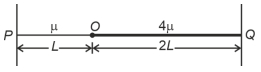
- 1Two uniform strings of mass per unit length $\mu$ and $4 \mu$, and length $L$ and $2 L$, respectively, are joined at point $O$, and tied at two fixed ends $P$ and $Q$, as shown in the figure. The strings are under a uniform tension $T$. If we define the frequency $v_0=\frac{1}{2 L} \sqrt{\frac{T}{\mu}}$, which of the following statement($s$) is(are) correct?View Solution
$(A)$ With a node at $O$, the minimum frequency of vibration of the composite string is $v_0$
$(B)$ With an antinode at $O$, the minimum frequency of vibration of the composite string is $2 v_0$
$(C)$ When the composite string vibrates at the minimum frequency with a node at $O$, it has $6$ nodes, including the end nodes
$(D)$ No vibrational mode with an antinode at $O$ is possible for the composite string
- 2The standing wave in a medium is expressed as $y=0.2 \sin (0.8 x) \cos (3000 t) \,m$. The distance between any two consecutive points of minimum or maximum displacement isView Solution
- 3The frequency of a tunning fork is $384$ per second and velocity of sound in air is $352 m/s$. How far the sound has traversed while fork completes $36$ vibration .... $m$View Solution
- 4A wavelength $0.60 cm$ is produced in air and it travels at a speed of $300 ms^{-1}$. It will be anView Solution
- 5If in an experiment for determination of velocity of sound by resonance tube method using a tuning fork of $512 Hz$, first resonance was observed at $30.7 cm$ and second was obtained at $63.2 cm$, then maximum possible error in velocity of sound is .....$cm/sec$ (consider actual speed of sound in air is $332 m/s$)View Solution
- 6Select the correct statement about the reflection and refraction of a wave at the interface between the medium $1$ and $2$ theView Solution
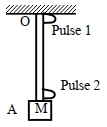
- 7A block $\mathrm{M}$ hangs vertically at the bottom end of a uniform rope of constant mass per unit length. The top end of the rope is attached to a fixed rigid support at $O$. A transverse wave pulse (Pulse $1$ ) of wavelength $\lambda_0$ is produced at point $O$ on the rope. The pulse takes time $T_{O A}$ to reach point $A$. If the wave pulse of wavelength $\lambda_0$ is produced at point $A$ (Pulse $2$) without disturbing the position of $M$ it takes time $T_{A 0}$ to reach point $O$. Which of the following options is/are correct?View Solution
(image)
[$A$] The time $\mathrm{T}_{A 0}=\mathrm{T}_{\mathrm{OA}}$
[$B$] The velocities of the two pulses (Pulse $1$ and Pulse $2$) are the same at the midpoint of rope.
[$C$] The wavelength of Pulse $1$ becomes longer when it reaches point $A$.
[$D$] The velocity of any pulse along the rope is independent of its frequency and wavelength.
- 8In a resonance tube, the first resonance is obtained when the level of water in the tube is at $16\,cm$ from the open end. Neglecting end correction, the next resonance will be obtained when the level of water from the open end is .... $cm$View Solution
- 9Sound waves have the following frequencies that are audible to human beings .... $c/s$View Solution
- 10View SolutionTwo sound waves of slightly different frequencies propagating in the same direction produce beats due to