Question
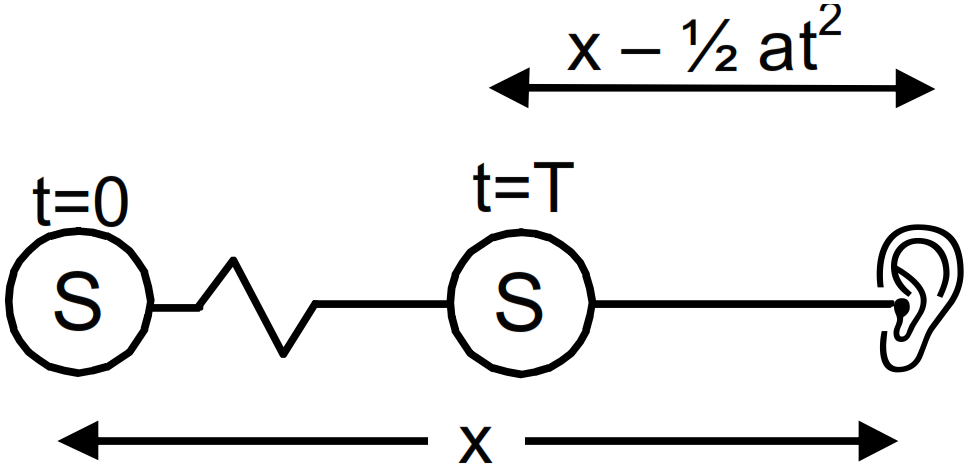
A source emitting a sound of frequency v is placed at a large distance from an observer. The source starts moving towards the observer with a uniform acceleration a. Find the frequency heard by the observer corresponding to the wave emitted just after the source starts. The speed of sound in the medium is u.
Answer

Let the distance between the source and the observer is ‘x’ (initially) So, time taken for the first pulse to reach the observer is $\text{t}_1=\frac{\text{x}}{\text{v}}$ And the second pulse starts after T $\Big($where, $\text{T}=\frac{1}{\text{v}}\Big)$ And it should travel a distance $\Big(\text{x}-\frac{1}{2}\text{a}\text{T}^2\Big).$
So, $\text{t}_2=\text{T}+\frac{\frac{\text{x}-1}{2}\text{a}\text{T}^2}{\text{v}}$$\text{t}_2-\text{t}_1=\text{T}+\frac{\frac{\text{x}-1}{2}\text{aT}^2}{\text{v}}=\frac{\text{x}}{\text{v}}=\text{T}-\frac{1}{2}\frac{\text{aT}^2}{\text{v}}$
Putting = $\text{T}=\frac{1}{\text{v}}.$ we get$\text{t}_2-\text{t}_1=\frac{2\text{uv}-\text{a}}{2\text{vv}^2}$
So, frequency heard $=\frac{2\text{vv}^2}{2\text{uv}-\text{a}}$ $\Big($because, $\text{f}=\frac{1}{\text{t}_2-\text{t}_1}\Big)$

Need a full question paper?

Generate a complete, print-ready paper with questions like this in minutes — across 16+ boards, with answer keys.

Start Generating Free

Similar questions

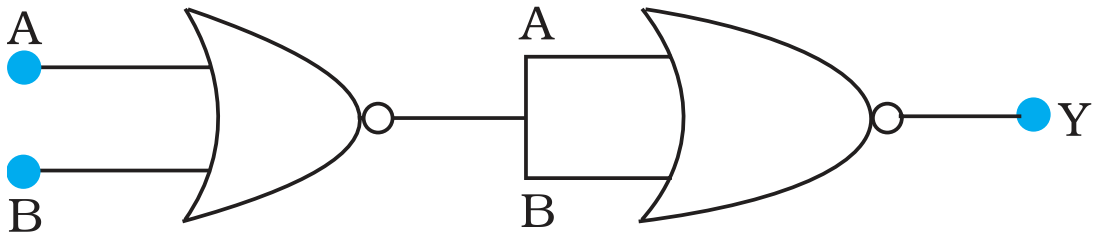
Write the truth table for circuit given in Fig. 14.47 below consisting of NOR gates and identify the logic operation (OR, AND, NOT) which this circuit is performing.
(Hint: A = 0, B = 1 then A and B inputs of second NOR gate will be 0 and hence Y=1. Similarly work out the values of Y for other combinations of A and B. Compare with the truth table of OR, AND, NOT gates and find the correct one.)
An electron and a positron moving at small speeds collide and annihilate each other. Find the energy of the resulting gamma photon.
A 12.9 eV beam of electrons is used to bombard gaseous hydrogen at room temperature. Upto which energy level the hydrogen atoms would be excited?
Calculate the wavelength of the first member of Paschen series and first member of Balmer series.
For a CE-transistor amplifier, the audio signal voltage across the collector resistance of 2 k$\Omega$ is 2 V. suppose the current amplification factor if the transistor is 100, find the input signal voltage and base current if the base resistance is 1 k$\Omega$.
The total energy of an electron in the first excited state of the hydrogen atom is about –3.4 eV.
  1. What is the kinetic energy of the electron in this state?
  2. What is the potential energy of the electron in this state?
  3. Which of the answers above would change if the choice of the zero of potential energy is changed?
The photon emitted during the de-excitation from the first excited level to the ground state of hydrogen atom is used to irradiate a photocathode of a photocell, in which stopping potential of 5 V is used. Calculate the work function of the cathode used.
A ball of superconducting material is dipped in liquid nitrogen and placed near a bar magnet.
  1. In which direction will it move?
  2. What will be the direction of it’s magnetic moment?
  1. In the following diagram, which bulb out of $B_1$ and $B_2$ will glow and why?
  1. Draw a diagram of an illuminated $p-n$ junction solar cell.
  2. Explain briefly the three processes due to which generation of emf takes place in a solar cell.
Mention the important considerations required while fabricating a p-n junction diode to be used as a Light Emitting Diode (LED). What should be the order of band gap of an LED if it is required to emit light in the visible range?
A spherical shell made of plastic, contains a charge Q distributed uniformly over its surface. What is the electric field inside the shell? If the shell is hammered to deshape it without altering the charge, will the field inside be changed? What happens if the shell is made of a metal?