Question
A spherical shell made of plastic, contains a charge Q distributed uniformly over its surface. What is the electric field inside the shell? If the shell is hammered to deshape it without altering the charge, will the field inside be changed? What happens if the shell is made of a metal?
Answer

As the shell is made of plastic, it is non-conducting. But as the charge is distributed uniformly over the surface of the shell, the sum of all the electric field vectors at the centre due to this kind of distribution is zero. But when the plastic shell is deformed, the distribution of charge on it becomes non-uniform. In other words, the sum of all the electric field vectors is non-zero now or the electric field exists at the centre now.
In case of a deformed conductor, the field inside is always zero.

Need a full question paper?

Generate a complete, print-ready paper with questions like this in minutes — across 16+ boards, with answer keys.

Start Generating Free

Similar questions


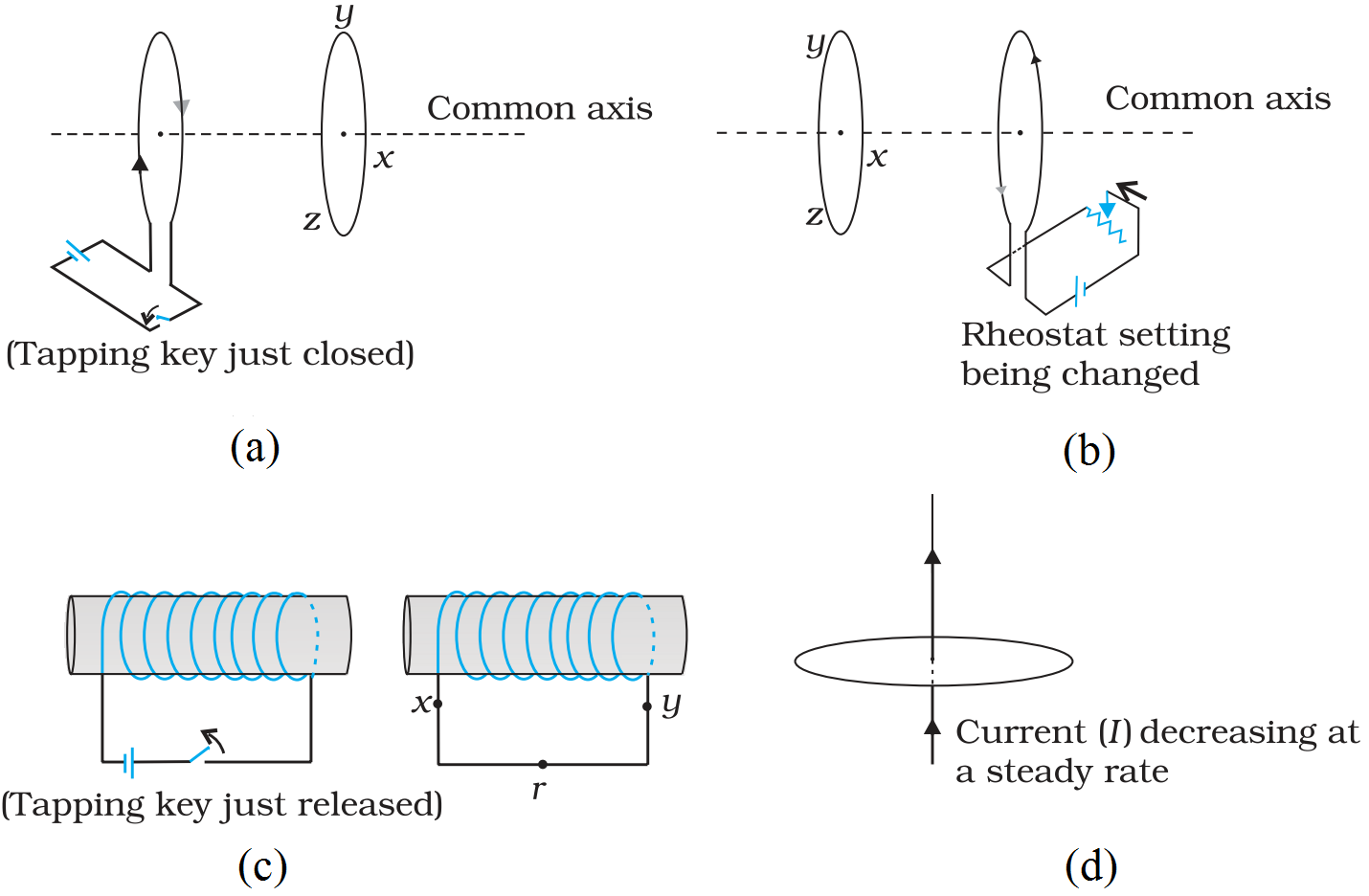
Predict the direction of induced current in the situations described in the following figs.
Can we have magnetic hysteresis in paramagnetic or diamagnetic substances?
We have valence electrons and conduction electrons in a semiconductor. Do we also have 'valence holes' and 'conduction holes'?
A beam of monochromatic radiation is incident on a photosensitive surface. Answer the following questions giving reasons.
i. Do the emitted photoelectrons have the same kinetic energy?
ii. Does the kinetic energy of the emitted electrons depend on the intensity of incident radiation?
iii. On what factors does the number of emitted photoelectrons depend?
How many time constants will elapse before the power delivered by a battery drops to half of its maximum value in an RC circuit?
Obtain the equation of electric current for an AC circuit having only inductor.
A person has near point at 100cm. What power of lens is needed to read at 20cm if he/ she uses.
  1. Contact lens,
  2. Spectacles having glasses 2.0cm separated from the eyes?
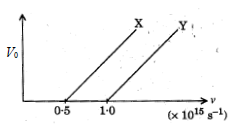
The following graph shows the variation of stopping potential $V_0$ with the frequency $v$ of the incident radiation for two photosensitive metals $X$ and $Y$ :
  1. Which of the metals has larger threshold wavelength? Give reason.
  2. Explain, giving reason, which metal gives out electrons, having larger kinetic energy, for the same wavelength of the incident radiation.
  3. If the distance between the light source and metal $X$ is halved, how will the kinetic energy of electrons emitted from it change? Give reason.
The stopping potential in a photoelectric experiment is linearly related to the inverse of the wavelength $\Big(\frac{1}{\lambda}\Big)$ of the light falling on the cathode. The potential difference applied across an $X-$ray tube is linearly related to the inverse of the cutoff wavelength $\Big(\frac{1}{\lambda}\Big)$ of the $X-$ray emitted. Show that the slopes of the lines in the two cases are equal and find its value.
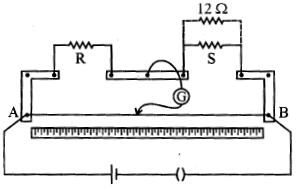
In a meter bridge, the null point is found at a distance of 40 cm from A. If a resistance of 12 Ω is connected in parallel with S, the null point occurs at 50.0 cm from. Determine the values of R and S.