MCQ
A source $S_1$ is producing, $10^{15}$ photons per second of wavelength $5000 \;\mathring A.$ Another source $S_2$ is producing $1.02 \times 10^{15}$ photons per second of wavelength $5100\;\mathring A$. Then, $($ power of $S_2)/$  $($ power of $S_1)$ is equal to
  • $1$
  • B
    $1.02$
  • C
    $1.04$
  • D
    $0.98$

Answer

Correct option: A.
$1$
a
For a source $S_{1}$

Wavelength, $\lambda_{1}=5000 \,\,{\mathop {\text{A}}\limits^o }$

Number of photons emitted per second, $N_{1}=10^{15}$

Energy of each photon, $E_{1}=\frac{h c}{\lambda_{1}}$

Power of source $S_{1}, P_{1}=E_{1} N_{1}=\frac{N_{1} h c}{\lambda_{1}}$

For a source $S_{2}$

Wavelength, $\lambda_{2}=5100\,\,{\mathop {\text{A}}\limits^o }$

Number of photons emitted per second,

$N_{2}=1.02 \times 10^{15}$

Energy of each photon, $E_{2}=\frac{h c}{\lambda_{2}}$

Power of source $S_{2},\,\,P_{2}=N_{2} E_{2}=\frac{N_{2} h c}{\lambda_{2}}$

$\therefore \,\,\frac{{{\text{ Power of}}\,{\text{ }}{S_2}}}{{{\text{ Power of }}\,{S_1}}} = \frac{{{P_2}}}{{{P_1}}}$ $ = \frac{{\frac{{{N_2}hc}}{{{\lambda _2}}}}}{{\frac{{{N_1}hc}}{{{\lambda _1}}}}} = \frac{{{N_2}{\lambda _1}}}{{{N_1}{\lambda _2}}}$

$ = \frac{{(1.02 \times {{10}^{15}}{\text{ photons/s) }} \times (5000{\mkern 1mu} {\mkern 1mu} \mathop {\text{A}}\limits^o )}}{{({{10}^{15}}{\text{ photons/s) }} \times (5100{\mkern 1mu} {\mkern 1mu} \mathop {\text{A}}\limits^o )}}$ $ = \frac{{51}}{{51}} = 1$
Need a full question paper?

Generate a complete, print-ready paper with questions like this in minutes — across 16+ boards, with answer keys.

Start Generating Free

Similar questions

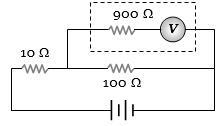
The potential difference across the $100\,\Omega$ resistance in the following circuit is measured by a voltmeter of $900 \,\Omega$ resistance. The percentage error made in reading the potential difference is
An iron rod of heat capacity $C$ is heated to temperature $8T_0$ . It is then put in a cylindrical vessel of adiabatic walls having two moles of air which can be treated as diatomic ideal gas at temperature $T_0$ and closed by a movable piston which is also adiabatic. The atmospheric pressure is $P_0$ .  The cylinder with the piston combined have heat capacity $2C$ . Find the equilibrium temperature . (Assume temperature of air to be uniform and equal to vessel at all times) .
The ratio of the radius of the earth to that of the moon is $10$. The ratio of acceleration due to gravity on the earth and on the moon is $6$. The ratio of the escape velocity from the earth's surface to that from the moon is
If three helium nuclei combine to form a carbon nucleus then the energy released in this reaction is $\times 10^{-2} \mathrm{MeV}$. (Given $1 \mathrm{u}=931 \mathrm{MeV} / \mathrm{c}^2$, atomic mass of helium $=4.002603 \mathrm{u}$ )
A man is carrying a block of a certain substance (of density $1000 \,kg{m^{ - 3}}$) weighing $1 \,kg$ in his left hand and a bucket filled with water and weighing $10 \,kg$ in his right hand. He drops the block into the bucket. How much load does he carry in his right hand now  ........... $kg$
Fraunhofer lines of the solar system is an example of
When milk is churned, cream gets separated due to
A juggler throws balls vertically upwards with same initial velocity in air. When the first ball reaches its highest position, he throws the next ball. Assuming the juggler throws $n$ balls per second, the maximum height the balls can reach is
A plane wave is represented by $x = 1.2\sin (314\,t + 12.56y)$Where $x$ and $y$ are distances measured along in $x$ and $y$ direction in meters and $t$ is time in seconds. This wave has
A particle of charge per unit mass $\alpha$ is released from origin with a velocity $\bar{v}=v_0 \vec{i}$ in a uniform magnetic field $\bar{B}=-B_0 \hat{k}$. If the particle passes through $(0, y, 0)$ then $y$ is equal to