A sphere of density $\rho $ , specific heat capacity $c$ and radius $r$ is hung by a thermally insulating thread in an enclosure which is kept at a lower temperature than the sphere. The temperature of the sphere starts to drop at a rate which depends upon the temperature difference between the sphere and the enclosure and the nature of the surface of sphere and is proportional to
Medium


Download our appand get started for free
Experience the future of education. Simply download our apps or reach out to us for more information. Let's shape the future of learning together!No signup needed.*
Similar Questions
- 1The initial temperature of a body is $80°C$ . If its temperature falls to $64°C$ in $5$ minutes and in $10$ minutes to $52°C$ then the temperature of surrounding will be ...... $^oC$View Solution
- 2Temperature of a black body increases from ${327^o}C\,{\rm{to}}\,{\rm{92}}{{\rm{7}}^{\rm{o}}}C$, the initial energy possessed is $ 2KJ$ , what is its final energy ..... $KJ$View Solution
- 3A black body at a temperature of $1640 K$ has the wavelength corresponding to maximum emission equal to $1.75$ $\mu $. Assuming the moon to be a perfectly black body, the temperature of the moon, if the wavelength corresponding to maximum emission is $ 14.35$ $\mu $ is ...... $K$View Solution
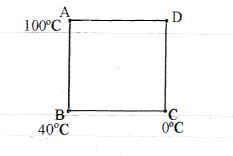
- 4Four conducting rods are joined to make a square. All rods are identical and ends $A, B$ and $C$ are maintained at given temperatures. choose $INCORRECT$ statement for given arrangement in steady state. (value of $\frac {KA}{L}$ is $1\frac{J}{{{S^o}C}}$ , symbols , have their usual meaning)View Solution
- 5View SolutionWhen red glass is heated in dark room it will seem
- 6View SolutionHeat travels through vacuum by
- 7View SolutionA block of metal is heated to a temperature much higher than the room temperature and allowed to cool in a room free from air currents. Which of the following curves correctly represents the rate of cooling
- 8The following three objects $(1)$ a metal tray, $(2)$ a block of wood and $(3)$ a woolen cap are left in a closed room overnight. Next day, the temperature of each is recorded as $T_1, T_2$ and $T_3$, respectively. The likely situation isView Solution
- 9Two rods one made of copper and other made of steel of the same length and same cross sectional area are joined together. The thermal conductivity of copper and steel are $385\,J\,s ^{-1}\,K ^{-1}\,m ^{-1}$ and $50\,J\,s ^{-1}\,K ^{-1}\,m ^{-1}$ respectively. The free ends of copper and steel are held at $100^{\circ}\,C$ and $0^{\circ}\,C$ respectively. The temperature at the junction is, nearly $.......^{\circ}\,C$View Solution
- 10View SolutionSnow is more heat insulating than ice, because