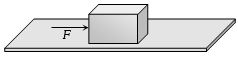
A sphere of mass $m$ is set in motion with initial velocity $v_o$ on a surface on which $kx^n$ is the frictional force with $k$ and $n$ as the constants and $x$ as the distance from the point of start. Find the distance in which sphere will stop
Diffcult


Download our appand get started for free
Experience the future of education. Simply download our apps or reach out to us for more information. Let's shape the future of learning together!No signup needed.*
Similar Questions
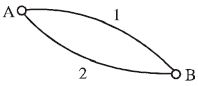
- 1A small body slips, subject to the force of friction, from point $A$ to point $B$ along two curved surfaces of equal radius, first along route $1,$ then along route $2$. Friction does not depend on the speed and the coefficient of friction on both routes is the same. In which case will the body’s speed at $B$ be greater?View Solution
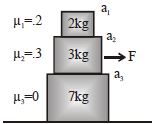
- 2Find the acceleration of $a_1, a_2$ and $a_3$. If $10\,N$ force $F$ is applied on $3\,kg$ block :-View Solution
- 3View SolutionWhich one of the following is not used to reduce friction
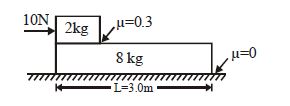
- 4Determine the time in which the smaller block reaches other end of bigger block in the figure. $(g = 10\ m s^{-2})$ .......... $\sec$View Solution
- 5A body of $5 \,kg$ weight kept on a rough inclined plane of angle $30^{\circ}$ starts sliding with a constant velocity. Then the coefficient of friction is (assume $g=10 \,ms ^{-2}$ )View Solution
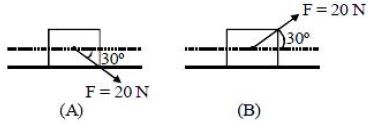
- 6A block of mass $5\, kg$ is $(i)$ pushed in case $(A)$ and $(ii)$ pulled in case $(B)$, by a force $F = 20\, N$, making an angle of $30^o$ with the horizontal, as shown in the figures. The coefficient of friction between the block and floor is $\mu = 0.2$. The difference between the accelerations of the block, in case $(B)$ and case $(A)$ will be $....... ms^{-2}$ .$(g = 10\, ms^{-2})$View Solution
- 7A car is moving along a straight horizontal road with a speed ${v_0}$. If the coefficient of friction between the tyres and the road is $\mu $, the shortest distance in which the car can be stopped isView Solution
- 8A small block of mass $m$ is projected horizontally with speed $u$ where friction coefficient between block and plane is given by $\mu = cx$, where $x$ is displacement of the block on plane. Find maximum distance covered by the blockView Solution
- 9The retarding acceleration of $7.35\, ms^{-2}$ due to frictional force stops the car of mass $400\, kg$ travelling on a road. The coefficient of friction between the tyre of the car and the road isView Solution
- 10A block of mass $2 \,kg$ is kept on the floor. The coefficient of static friction is $0.4$. If a force F of $2.5$ Newtons is applied on the block as shown in the figure, the frictional force between the block and the floor will be ........ $N$View Solution