Question
A spherical ball of salt is dissolving in water in such a manner that the rate of decrease of the volume at any instant is propotional to the surface. Prove that the radius is decreasing at a constant rate.

Answer

We have, rate of decrease of the volume of spherical ball of salt at any instant is surface. Let the radius of the spherical ball of the salt be r.
$\therefore$ Volume of the ball $(\text{V})=\frac{4}{3}\pi\text{r}^3$
and surface area $(\text{S})=4\pi\text{r}^2$
$\because\ \frac{\text{dV}}{\text{dT}}\propto\text{S}$
$\Rightarrow\ \frac{\text{d}}{\text{dt}}\Big(\frac{4}{3}\pi\text{r}^3\Big)\propto4\pi\text{r}^2$
$\Rightarrow\ \frac{4}{3}\pi3\text{r}^2\frac{\text{dr}}{\text{dt}}\propto4\pi\text{r}^2$
$\Rightarrow\ \frac{\text{dr}}{\text{dt}}\propto\frac{4\pi\text{r}^2}{4\pi\text{r}^2}$
$\Rightarrow\ \frac{\text{dr}}{\text{dt}}=\text{k.1}$ [where, k is the proportionality constant]
$\Rightarrow\ \frac{\text{dr}}{\text{dt}}=\text{k}$
Hence, the radius of ball is decreasing at a constant rate.

Need a full question paper?

Generate a complete, print-ready paper with questions like this in minutes — across 16+ boards, with answer keys.

Start Generating Free

Similar questions

In an office three employees Vinay, Sonia and Iqbal process incoming copies of a certain form. Vinay process $50\%$ of the forms, Sonia processes $20\%$ and Iqbal the remaining $30\%$ of the forms. Vinay has an error rate of $0.06,$ Sonia has an error rate of $0.04$ and Iqbal has an error rate of $0.03.$ Based on the above information, answer the following questions.

  1. The conditional probability that an error is committed in processing given that Sonia processed the form is:
  1. $0.0210$
  2. $0.04$
  3. $0.47$
  4. $0.06$
  1. The probability that Sonia processed the form and committed an error is:
  1. $0.005$
  2. $0.006$
  3. $0.008$
  4. $0.68$
  1. The total probability of committing an error in processing the form is:
  1. $0$
  2. $0.047$
  3. $0.234$
  4. $1$
  1. The manager of the company wants to do a quality check. During inspection he selects a form at random from the days output of processed forms. If the form selected at random has an error, the probability that the form is $\ce{NOT}$ processed by Vinay is:
  1. $1$
  2. $\frac{30}{47}$
  3. $\frac{20}{47}$
  4. $\frac{17}{47}$
  1. Let $A$ be the event of committing an error in processing the form and let $E_1, E_2$ and $E_3$ be the events that Vinay, Sonia and Iqbal processed the form. The value of $\sum\limits^3_\text{i=1}\ \text{P}(\text{E}_\text{i}\ |\ \text{A})$ is:
  1. $0$
  2. $0.03$
  3. $0.06$
  4. $1$
Between students of class $XII$ of two schools $A$ and $B$ basketball match is organised. For which, a team from each school is chosen, say $T_1$ be the team of school $A$ and $T_2$ be the team of school $B.$ These teams have to play two games against each other. It is assumed that the outcomes of the two games are independent. The probability of $T_1$ winning, rawmg an osrng a game against $T_2$ are $\frac{1}{2},\ \frac{3}{10}$ and $\frac{1}{5}$ respecnvely. Each team gets $2$ points for a win, $1$ point for a draw and $0$ point for a loss in a game. Let $X$ and $Y$ denote the total points scored by team $A$ and
$B$ respectively, after two games. Based on the above information, answer the following questions.
  1. $P(T_2$ winning a match against $T_1)$ is equal to:
  1. $\frac{1}{5}$
  2. $\frac{1}{6}$
  3. $\frac{1}{3}$
  4. None of these
  1. $P(T_2$ drawing a match against $T_1)$ is equal to:
  1. $\frac{1}{2}$
  2. $\frac{1}{3}$
  3. $\frac{1}{6}$
  4. $\frac{3}{10}$
  1. $P(X > Y)$ is equal to:
  1. $\frac{1}{4}$
  2. $\frac{5}{12}$
  3. $\frac{1}{20}$
  4. $\frac{11}{20}$
  1. $P(X = Y)$ is equal to:
  1. $\frac{11}{100}$
  2. $\frac{1}{3}$
  3. $\frac{29}{100}$
  4. $\frac{1}{2}$
  1. $P(X + Y = 8)$ is equal to:
  1. $0$
  2. $\frac{5}{12}$
  3. $\frac{13}{36}$
  4. $\frac{7}{12}$
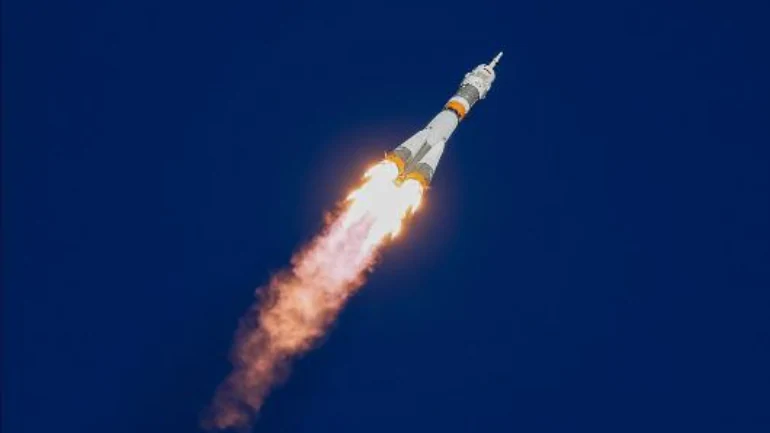
The equation of motion of a rocket are: x = 2t, y = -4t, z = 41, where the time 't' is given in seconds, and the distance measured is in kilometres. Based on the above information, answer the following questions.

  1. What is the path of the rocket?
  1. Straight line.
  2. Circle.
  3. Parabola.
  4. None of these.
  1. Which of the following points lie on the path of the rocket?
  1. (0, 1, 2)
  2. (1, -2, 2)
  3. (2, -2, 2)
  4. None of these
  1. At what distance will the rocket be from the starting point (0, 0, 0) in 10 seconds?
  1. 40km
  2. 60km
  3. 30km
  4. 80km
  1. If the position of rocket at certain instant of time is (3, -6, 6), then what will be the height of the rocket from the ground, which is along the xy-plane?
  1. 3km
  2. 2km
  3. 4km
  4. 6km
  1. At certain instant of time, if the rocket is above sea level, where equation of surface of sea is given by 3x - y + 4z = 2 and position of rocket at that instant of time is (1, -2, 2), then the image of position of rocket in the sea is:
  1. $\Big(\frac{20}{13},\frac{15}{13},\frac{18}{13}\Big)$
  2. $\Big(\frac{-20}{13},\frac{-15}{13},\frac{-18}{13}\Big)$
  3. $\Big(\frac{20}{13},\frac{-15}{13},\frac{18}{13}\Big)$
  4. None of these
Let $\text{A}=\begin{bmatrix}1&0\\2&1\end{bmatrix},$ and $U_1, U_2$ are e first and second columns respectively of a $2 \times 2$ matrix $U.$ Also, let the column matrices $U_1$ and $U_2$ satisfying $\text{AU}_1=\begin{bmatrix}1\\0\end{bmatrix}$ and $\text{AU}_2=\begin{bmatrix}2\\3\end{bmatrix}.$ Based on the above information, answer the following questions.
  1. The matrix $U_1 + U_2$​​​​​​​ is equal to:
  1. $\begin{bmatrix}1\\-1\end{bmatrix}$
  2. $\begin{bmatrix}2\\-2\end{bmatrix}$
  3. $\begin{bmatrix}3\\-3\end{bmatrix}$
  4. $\begin{bmatrix}4\\-4\end{bmatrix}$
  1. The value of $|U|$ is:
  1. $2$
  2. $-2$
  3. $3$
  4. $-3$
  1. If $\text{X}=\begin{bmatrix}3&2\end{bmatrix}\text{U}\begin{bmatrix}3\\2\end{bmatrix},$ then the value of $|X| =$
  1. $3$
  2. $-3$
  3. $-5$
  4. $5$
  1. The minor of element at the position $a_{22}$ in $U$ is:
  1. $1$
  2. $2$
  3. $-2$
  4. $-1$
  1. If $\text{U}=[\text{a}_\text{ij}]_{2\times2},$ then the value of $a_{11}A_{11 }+ a_{12}A_{12},$ where $A_{ij}$ denotes the cofactor of $a_{ij},$ is:
  1. $1$
  2. $2$
  3. $-3$
  4. $3$
Consider the mapping $f: A \rightarrow B$ is defined by $f(x) = x - 1$ such that $f$ is a bijection.
Based on the above information, answer the following questions.
  1. Domain of $f$ is:
  1. $R - {2}$
  2. $R$
  3. $R - {1, 2}$
  4. $R - {0}$
  1. Range of $f$ is:
  1. $R$
  2. $R - {2}$
  3. $R - {0}$
  4. $R - {1, 2}$
  1. If $g: R - {2} \rightarrow R - {1}$ is defined by $g(x) = 2f(x) - 1,$ then $g(x)$ in terms of $x$ is:
  1. $\frac{\text{x}+2}{\text{x}}$
  2. $\frac{\text{x}+1}{\text{x}-2}$
  3. $\frac{\text{x}-2}{\text{x}}$
  4. $\frac{\text{x}}{\text{x}-2}$
  1. The function $g$ defined above, is:
  1. One$-$one
  2. Many$-$one
  3. into
  4. None of these
  1. A function $f(x)$ is said to be one$-$one iff.
  1. $\ce{f(x_1) = f(x_2) \Rightarrow -x_{1 }= x_2}$
  2. $\ce{f(-x_1) = f(-x_2) \Rightarrow -x_1 = x_2}$
  3. $\ce{f(x_1) = f(x_2) \Rightarrow x_1 = x_2}$
  4. None of these
A function f(x) is said to be continuous in an open interval (a, b), if it is continuous at every point in this interval.
A function f(x) is said to be continuous in the closed interval [a, b), if f(x) is continuous in (a, b) and $\lim\limits_{\text{x}\rightarrow0}\text{f}(\text{a}+\text{h})=\text{f}(\text{a})$ and $\lim\limits_{\text{x}\rightarrow0}\text{f}(\text{b}-\text{h})=\text{f}(\text{b})$
If function $\text{f}(\text{x})=\begin{cases}\frac{\sin(\text{a}+1)\text{x}+\sin\text{x}}{\text{x}}&,\text{x}<0\\\text{c}&,\text{x}=0\\\frac{\sqrt{\text{x}+\text{bx}^2}-\sqrt{\text{x}}}{\text{bx}^{\frac{3}{2}}}&,\text{x}>0\end{cases}$ is continuous at x = 0, then answer the following questions.
  1. The value of a is:
  1. $-\frac{3}{2}$
  2. $0$
  3. $\frac{1}{2}$
  4. $-\frac{1}{2}$
  1. The value of b is:
  1. 1
  2. -1
  3. 0
  4. Any real number.
  1. The value of c is:
  1. $1$
  2. $\frac{1}{2}$
  3. $-1$
  4. $-\frac{1}{2}$
  1. The value of a + c is:
  1. 1
  2. 0
  3. -1
  4. -2
  1. The value of c - a is:
  1. 1
  2. 0
  3. -1
  4. 2
Show that $\text{f(x)}=\tan^{-1}(\sin\text{x}+\cos\text{x})$ is an increasing function in $\Big(0,\frac{\pi}{4}\Big).$
The relation between the height of the plant ( $\mathrm{y}$ in $\mathrm{cm}$ ) with respect to exposure to sunlight is governed by the following equation $\mathrm{y}=4 \mathrm{x}-\frac{1}{2} \mathrm{x}^2$ where $\mathrm{x}$ is the number of days exposed to sunlight.

Image

(i) Find the rate of growth of the plant with respect to sunlight.

(ii) What is the number of days it will take for the plant to grow to the maximum height?

(iii) Verify that height of the plant is maximum after four days by second derivative test and find the maximum height of plant.

OR

What will be the height of the plant after 2 days?
Let f : A → B and g : B → C be two functions defined on non-empty sets A, B, C, then gof : A → C be is called the composition of f and g defined as, $\text{gof}(\text{x})=\text{g}\{\text{f(x)}\}\forall\text{ x }\epsilon\text{ A}.$
Consider the functions $\text{f}(\text{x})=\begin{cases}\sin\text{x},&\text{x}\geq0\\1-\cos\text{x},&\text{x}\leq0\end{cases},\text{g}(\text{x})=\text{e}^\text{x}$ and then answer the following questions.
  1. The function gof(x) is defined as:
  1. $\text{gof}(\text{x})=\begin{cases}\text{e}^\text{x}&,\text{x}\geq0\\1-\text{e}^{\cos\text{x}}&,\text{x}\leq0\end{cases}$
  2. $\text{gof}(\text{x})=\begin{cases}\text{e}^{\sin\text{x}}&,\text{x}\leq0\\\text{e}^{1-\cos\text{x}}&,\text{x}\geq0\end{cases}$
  3. $\text{gof}(\text{x})=\begin{cases}\text{e}^{\sin\text{x}}&,\text{x}\leq0\\1-\text{e}^{\cos\text{x}}&,\text{x}\geq0\end{cases}$
  4. $\text{gof}(\text{x})=\begin{cases}\text{e}^{\sin\text{x}}&,\text{x}\geq0\\\text{e}^{1-\cos\text{x}}&,\text{x}\leq0\end{cases}$
  1. $\frac{\text{d}}{\text{dx}}\{\text{gof}(\text{x})\}=$
  1. $[\text{gof}(\text{x})]'=\begin{cases}\cos\text{x}\cdot\text{e}^{\sin\text{x}}&,\text{x}\geq0\\\text{e}^{1-\cos\text{x}}\cdot\sin\text{x}&,\text{x}\leq0\end{cases}$
  2. $[\text{gof}(\text{x})]'=\begin{cases}\cos\text{x}\cdot\text{e}^{\sin\text{x}}&,\text{x}\geq0\\-\sin\text{x}\cdot\text{e}^{1-\cos\text{x}}&,\text{x}\leq0\end{cases}$
  3. $[\text{gof}(\text{x})]'=\begin{cases}\cos\text{x}\cdot\text{e}^{\sin\text{x}}&,\text{x}\geq0\\\sin\text{x}\cdot({1-\cos\text{x}})&,\text{x}\leq0\end{cases}$
  4. $[\text{gof}(\text{x})]'=\begin{cases}\cos\text{x}\cdot\text{e}^{\sin\text{x}}&,\text{x}\geq0\$1-{\sin\text{x}})\cdot\text{e}^{1-\cos\text{x}}&,\text{x}\leq0\end{cases}$
  1. R.H.D. of $gof(x)$ at$ x = 0$ is:
  1. $0$
  2. $1$
  3. $-1$
  4. $2$
  1. L.H.D. of $gof(x) $ at $x = 0$ is:
  1. $0$
  2. $1$
  3. $-1$
  4. $2$
  1. The value of f'(x) at $\text{x}=\frac{\pi}{4}$ is:
  1. $\frac{1}{9}$
  2. $\frac{1}{\sqrt2}$
  3. $\frac{1}{2}$
  4. Not defined.
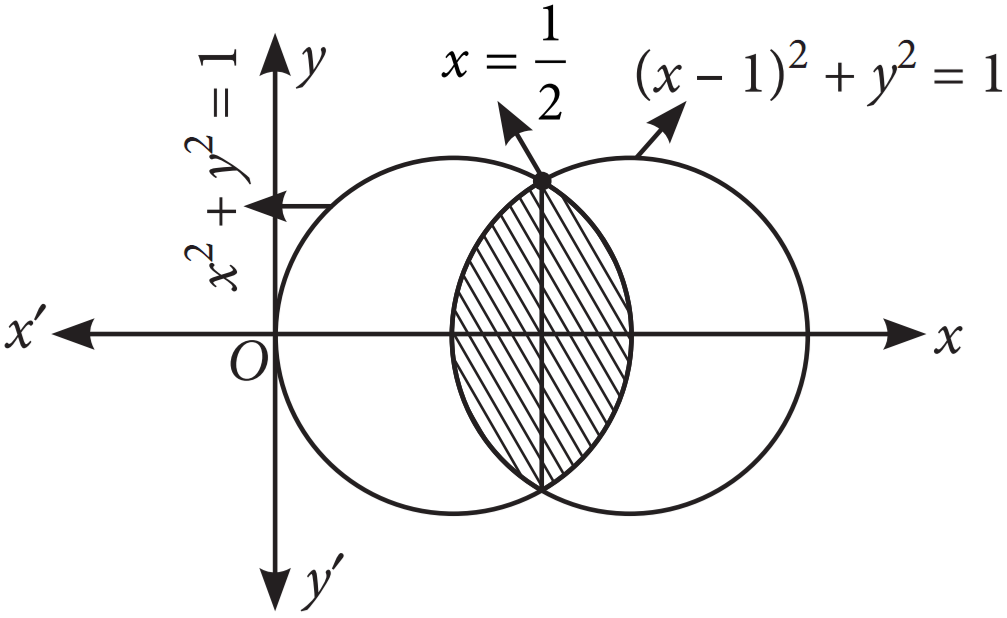
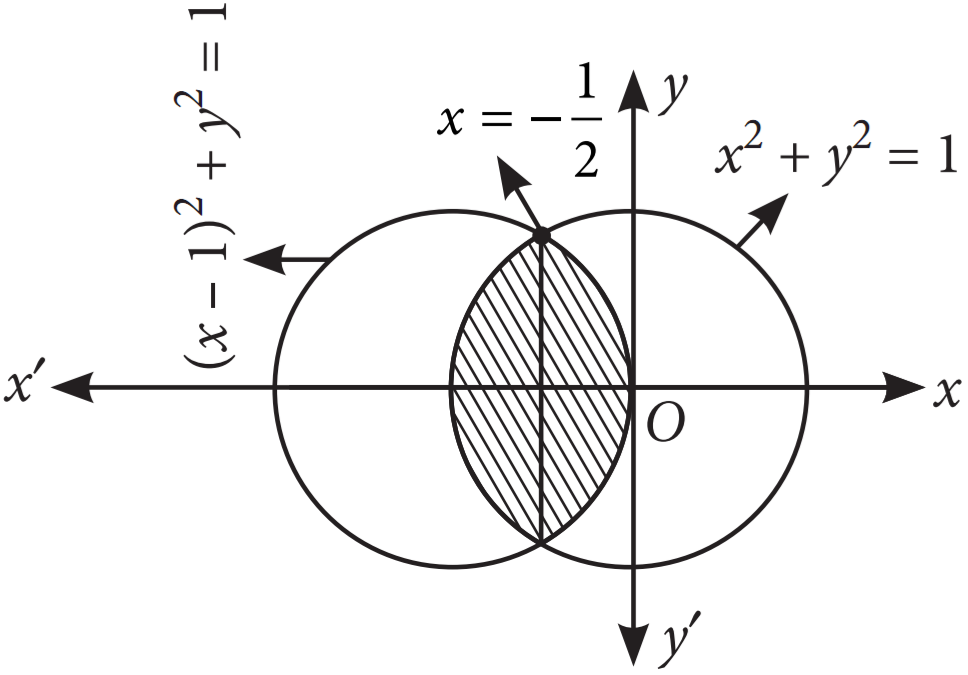
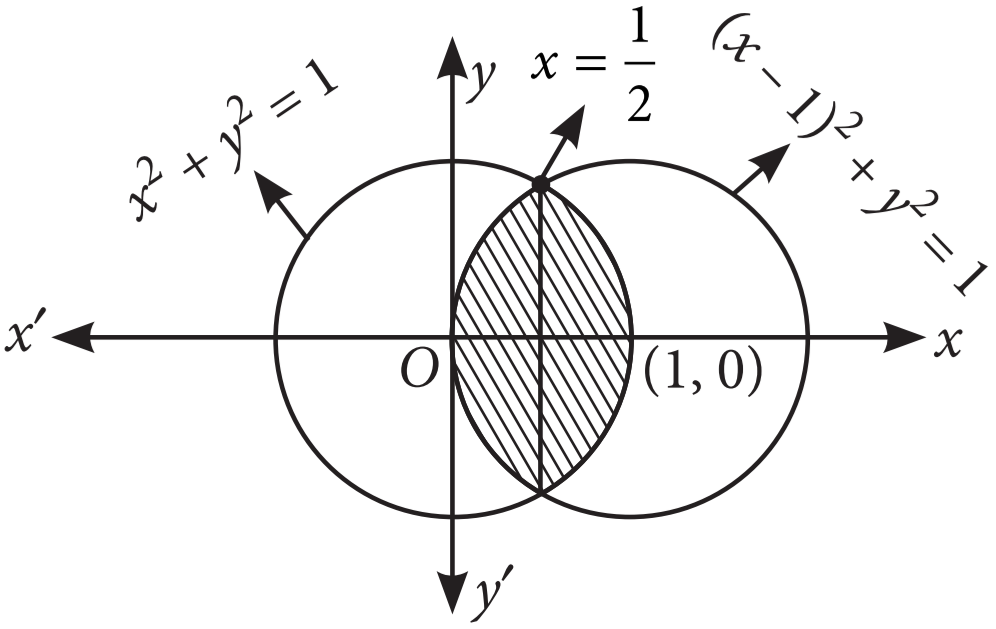
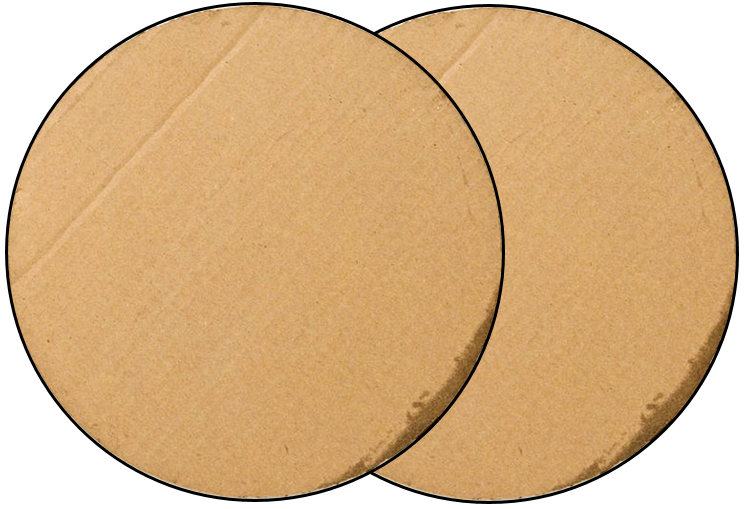
Ajay cut two circular pieces of cardboard and placed one upon other as shown in figure. One of the circle represents the equation $(x - 1)^2 + y^2 = 1,$ while other circle represents the equation $x^2 + y^2 = 1.$​​​​​​​

Based on the above information, answer the following questions.
  1. Both the circular pieces of cardboard meet each other at
  1. $\text{x}=1$
  2. $\text{x}=\frac{1}{2}$
  3. $\text{x}=\frac{1}{3}$
  4. $\text{x}=\frac{1}{4}$
  1. Graph of given two curves can be drawn as.
  1. None of these
  1. Value of $\int\limits_{0}^{\frac{1}{2}}\sqrt{1-(\text{x}-1)^2}\text{dx}$ is.
  1. $\frac{\pi}{6}-\frac{\sqrt{3}}{8}$
  2. $\frac{\pi}{6}+\frac{\sqrt{3}}{8}$
  3. $\frac{\pi}{2}+\frac{\sqrt{3}}{4}$
  4. $\frac{\pi}{2}-\frac{\sqrt{3}}{4}$
  1. Value of $\int\limits_{\frac{1}{2}}^{1}\sqrt{1-\text{x}^2}\text{dx}$ is.
  1. $\frac{\pi}{6}+\frac{\sqrt{3}}{4}$
  2. $\frac{\pi}{6}+\frac{\sqrt{3}}{8}$
  3. $\frac{\pi}{6}-\frac{\sqrt{3}}{8}$
  4. $\frac{\pi}{2}-\frac{\sqrt{3}}{4}$
  1. Area of hidden portion of lower circle is.
  1. $\bigg(\frac{2\pi}{3}+\frac{\sqrt{3}}{2}\bigg)\text{ sq.units}$
  2. $\bigg(\frac{\pi}{3}-\frac{\sqrt{3}}{8}\bigg)\text{ sq.units}$
  3. $\bigg(\frac{\pi}{3}+\frac{\sqrt{3}}{8}\bigg)\text{ sq.units}$
  4. $\bigg(\frac{2\pi}{3}-\frac{\sqrt{3}}{2}\bigg)\text{ sq.units}$