Question
Let $\text{A}=\begin{bmatrix}1&0\\2&1\end{bmatrix},$ and $U_1, U_2$ are e first and second columns respectively of a $2 \times 2$ matrix $U.$ Also, let the column matrices $U_1$ and $U_2$ satisfying $\text{AU}_1=\begin{bmatrix}1\\0\end{bmatrix}$ and $\text{AU}_2=\begin{bmatrix}2\\3\end{bmatrix}.$ Based on the above information, answer the following questions.
  1. The matrix $U_1 + U_2$​​​​​​​ is equal to:
  1. $\begin{bmatrix}1\\-1\end{bmatrix}$
  2. $\begin{bmatrix}2\\-2\end{bmatrix}$
  3. $\begin{bmatrix}3\\-3\end{bmatrix}$
  4. $\begin{bmatrix}4\\-4\end{bmatrix}$
  1. The value of $|U|$ is:
  1. $2$
  2. $-2$
  3. $3$
  4. $-3$
  1. If $\text{X}=\begin{bmatrix}3&2\end{bmatrix}\text{U}\begin{bmatrix}3\\2\end{bmatrix},$ then the value of $|X| =$
  1. $3$
  2. $-3$
  3. $-5$
  4. $5$
  1. The minor of element at the position $a_{22}$ in $U$ is:
  1. $1$
  2. $2$
  3. $-2$
  4. $-1$
  1. If $\text{U}=[\text{a}_\text{ij}]_{2\times2},$ then the value of $a_{11}A_{11 }+ a_{12}A_{12},$ where $A_{ij}$ denotes the cofactor of $a_{ij},$ is:
  1. $1$
  2. $2$
  3. $-3$
  4. $3$

Answer

  1. $(c) \begin{bmatrix}3\\-3\end{bmatrix}$
We have, $\text{A}=\begin{bmatrix}1&0\\2&1\end{bmatrix}$
Let $\text{U}_1=\begin{bmatrix}\text{a}\\\text{b}\end{bmatrix}$ and $\text{AU}_1=\begin{bmatrix}1\\0\end{bmatrix}$
$\Rightarrow\begin{bmatrix}1&0\\2&1\end{bmatrix}\begin{bmatrix}\text{a}\\\text{b}\end{bmatrix}=\begin{bmatrix}1\\0\end{bmatrix}$
$\Rightarrow\begin{bmatrix}\text{a}\\2\text{a}+\text{b}\end{bmatrix}=\begin{bmatrix}1\\0\end{bmatrix}$
$\Rightarrow a = 1$ and $2a + b = 0 $
$\Rightarrow a = 1$ and $b = -2.$
Let $\text{U}_2=\begin{bmatrix}\text{c}\\\text{d}\end{bmatrix}$ then  $\text{AU}_2=\begin{bmatrix}2\\3\end{bmatrix}$
$\Rightarrow\begin{bmatrix}1&0\\2&1\end{bmatrix}\begin{bmatrix}\text{c}\\\text{d}\end{bmatrix}=\begin{bmatrix}2\\3\end{bmatrix}$
$\Rightarrow\begin{bmatrix}\text{c}\\2\text{c}+\text{d}\end{bmatrix}=\begin{bmatrix}2\\3\end{bmatrix}$
$\Rightarrow c = 2$ and $2c + d = 3$
$\Rightarrow c = 2$ and $d = 3 - 4= -1$
Thus, $\text{U}_1+\text{U}_2=\begin{bmatrix}1\\-2\end{bmatrix}+\begin{bmatrix}2\\-1\end{bmatrix}$
$=\begin{bmatrix}3\\-3\end{bmatrix}$
  1. $(c) 3$
Clearly, $\text{U}=\begin{bmatrix}1&2\\-2&-1\end{bmatrix}$
$\therefore|\text{U}|=\begin{vmatrix}1&2\\-2&-1\end{vmatrix}$
$=-1+4$
$=3$
  1. $(d) 5$
We have, $\text{X}=\begin{bmatrix}3&2\end{bmatrix}\begin{bmatrix}1&2\\-2&-1\end{bmatrix}\begin{bmatrix}3\\2\end{bmatrix}$
$=\begin{bmatrix}3&2\end{bmatrix}\begin{bmatrix}7\\-8\end{bmatrix}=[21-16]=[5]$
$\therefore|\text{X}|=5$
  1. $(a) 1$
$a_{22}$ in $U$ is $-1$ and its minor is $1.$​​​​​​​
  1. $(d) 3$
Since, the sum of products of elements of any row $($or column$)$ with their corresponding cofactors is equal to the value of determinant.
$\therefore a_{11}A_{11} + a_{12}A_{12} = |U| = 3$

Need a full question paper?

Generate a complete, print-ready paper with questions like this in minutes — across 16+ boards, with answer keys.

Start Generating Free

Similar questions

Read the following text carefully and answer the questions that follow:
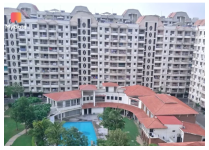
Mrs. Maya is the owner of a high-rise residential society having $50$ apartments. When he set rent at $₹ 10000$ month, all apartments are rented. If he increases rent by $₹ 250 $  month, one fewer apartment is rented.
The maintenance cost for each occupied unit is $₹ 500$  month.
Image
$i$. If $P$ is the rent price per apartment and $N$ is the number of rented apartments, then find the profit. $(1)$
$ii.$ If $x$ represents the number of apartments which are not rented, then express profit as a function of $x. (1)$
$iii.$ Find the number of apartments which are not rented so that profit is maximum. $(2)$
OR
Verify that profit is maximum at critical value of $x$ by second derivative test. $(2)$
In a bilateral cricket series between India and South Africa, the probability that India wins the first match is $0.6.$ If India wins any match, then the probability that it wins the next match is $0.4,$ otherwise the probability is $0.3.$ Also, it is given that there is no tie in any match.

Based on the above information answer the following questions.
  1. The probability that India won the second match, if lndia has already loose the first match is:
  1. $0.5$
  2. $0.4$
  3. $0.3$
  4. $0.6$
  1. The probability that India losing the third match, if India has already loose the first two matches is:
  1. $0.2$
  2. $0.3$
  3. $0.4$
  4. $0.7$
  1.  The probability that India losing the first two matches is:
  1. $0.12$
  2. $0.28$
  3. $0.42$
  4. $0.01$
  1. The probability that India winning the first three matches is:
  1. $0.92$
  2. $0.96$
  3. $0.94$
  4. $0.096$
  1. The probability that India winning exactly one of the first three matches is:
  1. $0.205$
  2. $0.21$
  3. $0.408$
  4. $0.312$
Let f(x) be a real valued function, then its
  • Left Hand Derivative (L.H.D.) : $\operatorname{Lf}^{\prime}(a)=\lim _{h \rightarrow 0} \frac{f(a-h)-f(a)}{-h}$
    Right Hand Derivative (R.H.D.) : $\operatorname{Rf}^{\prime}(a)=\lim _{h \rightarrow 0} \frac{f(a+h)-f(a)}{h}$
    Also, a function f(x) is said to be differentiable at x = a if its L.H.D. and R.H.D. at x = a exist and are equal.
    For the function $\text{f}(\text{x})=\begin{cases}|\text{x}-3|,\text{x}\geq1\\\\\frac{\text{x}^2}{4}-\frac{3\text{x}}{2}+\frac{13}{4},\text{x}<1\end{cases},$ answer the following questions.
    1. R.H.D. of f(x) at x = 1 is:
    1. 1
    2. -1
    3. 0
    4. 2
    1. L.H.D. of f(x) at x = 1 is:
    1. 1
    2. -1
    3. 0
    4. 2
    1. f(x) is non-differentiable at:
    1. x = 1
    2. x = 2
    3. x = 3
    4. x = 4
    1. Find the value of f'(2).
    1. 1
    2. 2
    3. 3
    4. -1
    1. The value of f'(-1) is:
    1. 2
    2. 1
    3. -2
    4. -1
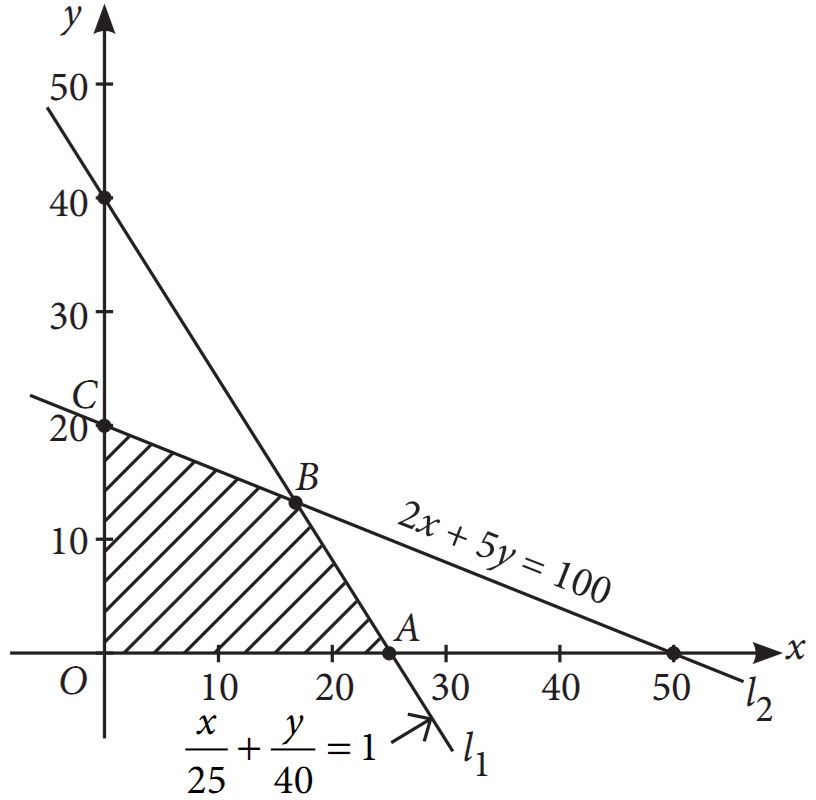
Deepa rides her car at $25 \ km/ hr.$ She has to spend $₹\ 2$ per $\ km$ on diesel and if she rides it at a faster speed of $40 \ km/ hr,$ the diesel cost increases to $₹\ 5$ per $\ km$. She has $₹\ 100$ to spend on diesel. Let she travels $x \ kms$ with speed $25 \ km/ hr$ and $y \ kms$ with speed $40 \ km/ hr.$ The feasible region for the $\text{LPP}$ is shown below:
Based on the above information, answer the following questions.
  1. What is the point of intersection of line $l_1$ and $l_2$?
  1. $\Big(\frac{40}{3},\frac{50}{3}\Big)$
  2. $\Big(\frac{50}{3},\frac{40}{3}\Big)$
  3. $\Big(\frac{-50}{3},\frac{40}{3}\Big)$
  4. $\Big(\frac{-50}{3},\frac{-40}{3}\Big)$
  1. The comer points of the feasible region shown in above graph are:
  1. $(0,25),(20,0),\Big(\frac{40}{3},\frac{50}{3}\Big)$
  2. $(0, 0), (25, 0), (0, 20) $
  3. $(0,0),\Big(\frac{40}{3},\frac{50}{3}\Big),(0,20)$
  4. $(0,0),(25,0),\Big(\frac{50}{3},\frac{40}{3}\Big),(0,20)$
  1. If $Z = x + y$ be the objective function and max $Z = 30.$ The maximum value occurs at point:
  1. $\Big(\frac{50}{3},\frac{40}{3}\Big)$
  2. $(0, 0)$
  3. $(25, 0)$
  4. $(0, 20)$
  1. If $Z = 6x - 9y$ be the objective function, then maximum value of $Z$ is:
  1. $-20$
  2. $150$
  3. $180$
  4. $20$
  1. If $Z = 6x + 3y$ be the objective function, then what is the minimum value of $Z$?
  1. $120$
  2. $130$
  3. $0$
  4. $150$
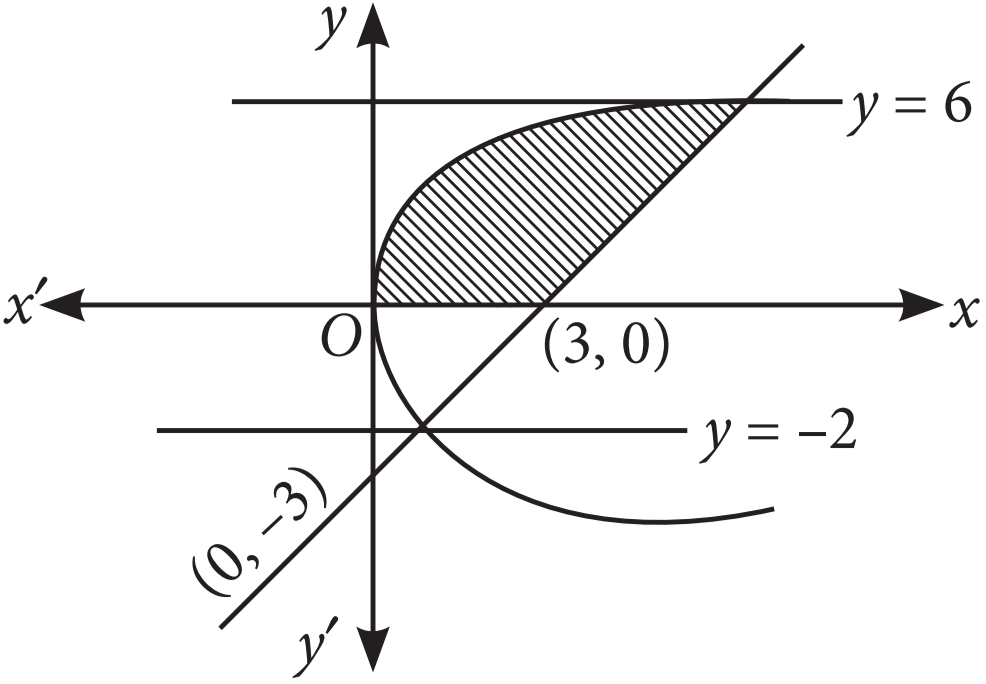
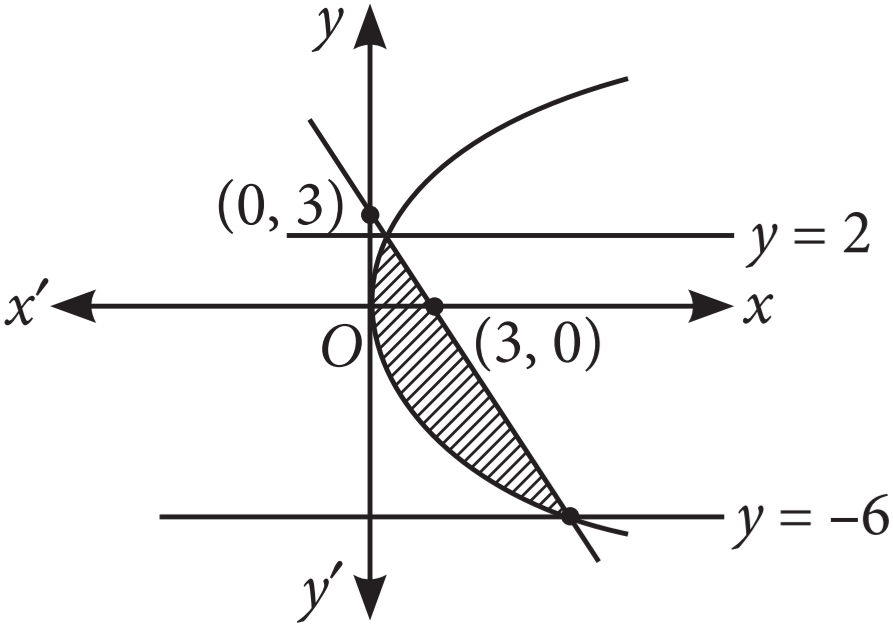
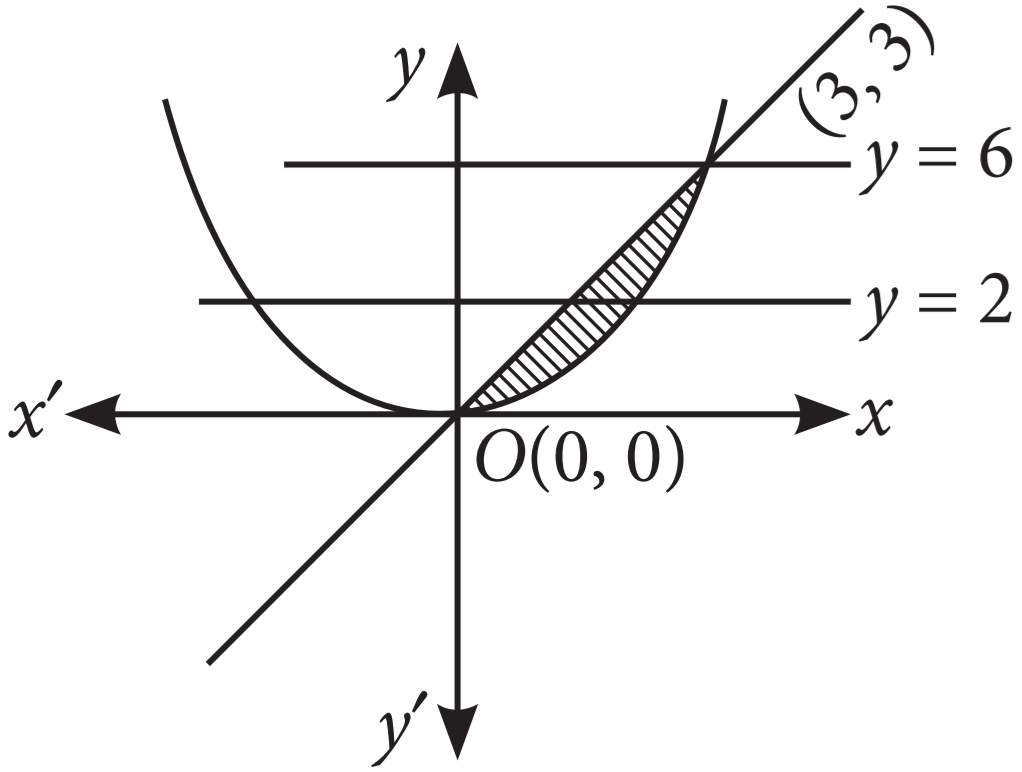
Consider the following equation of curve $y^2 = 4x$ and straight line $x + y = 3.$
Based on the above information, answer the following questions.
  1. The line $x + y = 3$ cuts the $x-$axis and $y-$axis respectively at.
  1. $(0, 2), (2, 0)$
  2. $(3, 3), (0, 0)$
  3. $(0, 3), (3, 0)$
  4. $(3, 0), (0, 3)$
  1. Point$(s)$ of intersection of two given curves is $($are$).$
  1. $(1, -2), (-9, 6)$
  2. $(2, 1), (-6, 9)$
  3. $(1, 2), (9, -6)$
  4. None of these.
  1. Which of the following shaded portion re present the area bounded by given curves?
    1. None of these
  1. Value of the integral $\int\limits_{-6}^{2}(3-\text{y})\text{ dy}$ is
  1. $10$
  2. $20$
  3. $30$
  4. $40$
  1. Value of area bounded by given curves is.
  1. $56\text{ sq.units}$
  2. $\frac{63}{5}\text{ sq. units}$
  3. $\frac{64}{3}\text{ sq. units}$
  4. $31\text{ sq.units}$
The upward speed $v(I)$ of a rocket at time $I$ is approximated by $\text{v}(\text{t})=\text{at}^2+\text{bt}+\text{c},0\leq\text{t}\leq100,$ here $a, b$ and $c$ are constants. It has been found that the speed at $\times t = 3, t = 6$ and $t = 9$ seconds are respectively $64, 133$ and $208$ miles per second..

If $\begin{bmatrix}9&3&1\\36&6&1\\81&9&1\end{bmatrix}^{-1}=\frac{1}{18}\begin{bmatrix}1&-2&1\\-15&24&-9\\54&-54&18\end{bmatrix},$ then answer the following questions.
  1. The value of $b + c$ is:
  1. $20$
  2. $21$
  3. $\frac{3}{4}$
  4. $\frac{4}{3}$
  1. The value of $a + c$ is:
  1. $1$
  2. $20$
  3. $\frac{4}{3}$
  4. None of these.
  1. $v(t)$ is given by:
  1. $\text{t}^2+20\text{t}+1$
  2. $\frac{1}{3}\text{t}^2+20\text{t}+1$
  3. $\text{t}^2+\frac{1}{3}\text{t}+20$
  4. $\text{t}^2+\text{t}+1$
  1. The speed at time $1 = 15 $seconds is:
  1. $346$ miles/ sec
  2. $356$ miles/ sec
  3. $366$ miles/ sec
  4. $376$ miles/ sec
  1. The time at which the speed of rocket is $784$ miles/ sec is:
  1. $20$ seconds
  2. $30$ seconds
  3. $25$ seconds
  4. $27$ seconds
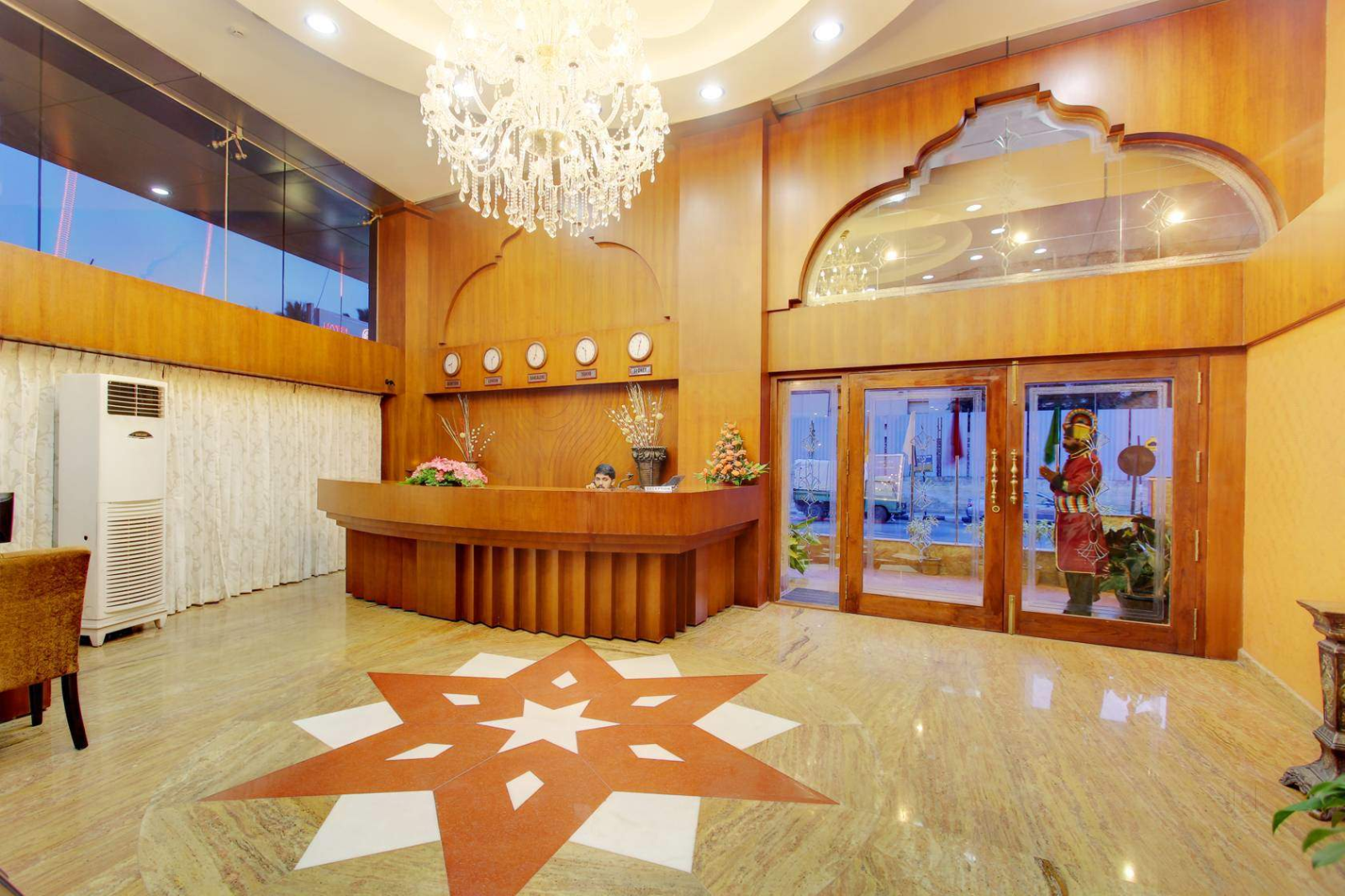
Suppose the floor of a hotel is made up of mirror polished Kota stone. Also, there is a large crystal chandelier attached at the ceiling of the hotel. Consider the floor of the hotel as a plane having equation $x - 2y + 2z = 3$ and crystal chandelier at the point $(3, -2, 1)$. Based on the above information, answer the following questions.
  1. The $d.r\ '$. of the perpendicular from the point $(3, -2, 1)$ to the plane $x - 2y + 2z = 3,$ is:
  1. $ < 1, 2, 2 > $
  2. $ < 1, -2, 2 > $
  3. $ < 2, 1, 2 > $
  4. $ < 2, -1, 2 > $
  1. The length of the perpendicular from the point $(3, -2, 1)$ to the plane $x - 2y + 2z = 3,$ is:
  1. $\frac{2}{3}$ units
  2. $3$ units
  3. $2$ units
  4. None of these
  1. The equation of the perpendicular from the point $(3, -2, 1)$ to the plane $x - 2y + 2z = 3,$ is:
  1. $\frac{\text{x}-3}{1}=\frac{\text{y}-2}{-2}=\frac{\text{z}-1}{2}$
  2. $\frac{\text{x}-3}{1}=\frac{\text{y}+2}{-2}=\frac{\text{z}-1}{2}$
  3. $\frac{\text{x}+3}{1}=\frac{\text{y}+2}{-2}=\frac{\text{z}-1}{2}$
  4. None of these
  1. The equation of plane parallel to the plane $x - 2y + 2z = 3,$ which is at a unit distance from the point $(3, -2, 1)$ is:
  1. $x - 2y + 2z = 0$
  2. $x - 2y + 2z = 6$
  3. $x - 2y + 2z = 12$
  4. Both $(b)$ and $(c)$
  1. The image of the point $(3, -2, 1)$ in the given plane is:
  1. $\Big(\frac{5}{3},\frac{2}{3},\frac{-5}{3}\Big)$
  2. $\Big(\frac{-5}{3},\frac{-2}{3},\frac{5}{3}\Big)$
  3. $\Big(\frac{-5}{3},\frac{2}{3},\frac{5}{3}\Big)$
  4. None of these
Let x = f(t) and y = g(t) be parametric forms with t as a parameter, then
$\frac{\text{dy}}{\text{dx}}=\frac{\text{dy}}{\text{dt}}\times\frac{\text{dt}}{\text{dx}}=\frac{\text{g}'(\text{t})}{\text{f}'(\text{t})},$ where $\text{f}'(\text{t})\neq0.$
On the basis of above information, answer the following questions.
  1. The derivative of $\text{f}(\tan\text{x})\text{w.r.t.}\text{ g}(\sec\text{x})\text{ at}\text{ x}=\frac{\pi}{4},$ where f'(1) = 2 and $\text{g}'(\sqrt{2})=4,$ is:
  1. $\frac{1}{\sqrt{2}}$
  2. ${\sqrt{2}}$
  3. 1
  4. 0
  1. The derivative of $\sin^{-1}\Big(\frac{2\text{x}}{1+\text{x}^2}\Big)$ with respect to $\cos^{-1}\Big(\frac{1-\text{x}^2}{1+\text{x}^2}\Big)$ is:
  1. -1
  2. 1
  3. 2
  4. 4
  1. The derivative of $\text{e}^{\text{x}^3}$ with respect to log x is:
  1. $\text{e}^{\text{x}^3}$
  2. $3\text{x}^22\text{e}^{\text{x}^3}$
  3. $3\text{x}^3\text{e}^{\text{x}^3}$
  4. $3\text{x}^2\text{e}^{\text{x}^3}+3\text{x}$
  1. The derivative of $\cos^{-1}(2\text{x}^2-1)\text{w.r.t.}\cos^{-1}\text{x}$ is:
  1. $2$
  2. $\frac{-1}{2\sqrt{1-\text{x}^2}}$
  3. $\frac{2}{\text{x}}$
  4. $1-\text{x}^2$
  1. If $\text{y}=\frac{1}{4}\mu^4$ and $\mu=\frac{2}{3}\text{x}^3+5,$ then $\frac{\text{dy}}{\text{dx}}=$
  1. $\frac{2}{27}\text{x}^2(2\text{x}^3+15)^3$
  2. $\frac{2}{7}\text{x}^2(2\text{x}^3+15)^3$
  3. $\frac{2}{27}\text{x}(2\text{x}^3+5)^3$
  4. $\frac{2}{7}(2\text{x}^3+15)^3$
Shobhit's father wants to construct a rectangular garden using a brick wall on one side of the garden and wire fencing for the other three sides as shown in figure. He has $200\  ft$ of wire fencing.

Based on the above information, answer the following questions.
  1. To construct a garden using $200 \ ft$ of fencing, we need to maximise its.
  1. Volume
  2. Area
  3. Perimeter
  4. Length of the side
  1. If $x$ denote the length of side of garden perpendicular to brick wall and $y$ denote the length of side parallel to brick wall, then find the relation representing total amount of fencing wire.
  1. $x + 2y = 150$
  2. $x + 2y = 50$
  3. $y + 2x = 200$
  4. $y + 2x = 100$
  1. Area of the garden as a function of $x,$ say $A(x),$ can be represented as.
  1. $200 + 2x^2$
  2. $x - 2x^2$
  3. $200x - 2x^2$
  4. $200 - x^2$
  1. Maximum value of $A(x)$ occurs at $x$ equals.
  1. $50 \ ft$
  2. $30 \ ft$
  3. $26 \ ft$
  4. $31 \ ft$
  1. Maxi mum area of garden will be.
  1. $2500 \ sq. ft$
  2. $4000 \ sq. ft$
  3. $5000 \ sq. ft$
  4. $6000 \ sq. ft$