In a meter bridge, the null point is found at a distance of 40 cm from A. If a resistance of 12 Ω is connected in parallel with S, the null point occurs at 50.0 cm from. Determine the values of R and S.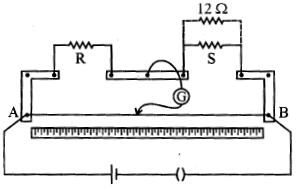
CBSE DELHI - SET 1 2010
Download our app for free and get started
$\frac{\text{R}}{\text{S}} = \frac{40}{60} = \frac{2}{3}$
$\frac{\text{R}(12 + \text{S})}{12\text{S}} = \frac{50}{50} = 1 $
$\Rightarrow\text{R} = 4 \Omega \text { and }\text{S} = 6 \Omega.$
$\frac{\text{R}(12 + \text{S})}{12\text{S}} = \frac{50}{50} = 1 $
$\Rightarrow\text{R} = 4 \Omega \text { and }\text{S} = 6 \Omega.$

Download our appand get started for free
Experience the future of education. Simply download our apps or reach out to us for more information. Let's shape the future of learning together!No signup needed.*
Similar Questions
- 1View SolutionTwo wires A and B of the same material and having same length, have their cross sectional areas in the ratio 1 : 6. What would be the ratio of heat produced in these wires when same voltage is applied across each?
- 2View Solution
- Define the term ‘conductivity’ of a metallic wire. Write its SI unit.
- Using the concept of free electrons in a conductor, derive the expression for the conductivity of a wire in terms of number density and relaxation time. Hence obtain the relation between current density and the applied electric field E.
- 3The four arms of a Wheatstone bridge $($Fig. $3.19)$ have the following resistances:View Solution
$AB =100 \Omega, BC =10 \Omega, CD =5 \Omega \text {, and } DA =60 \Omega \text {. }$
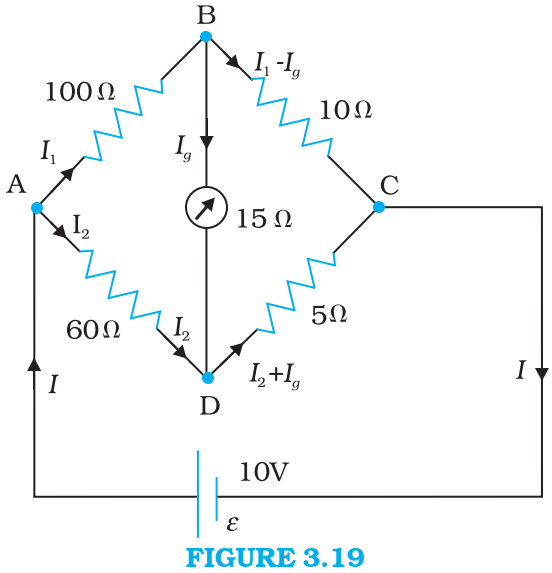
A galvanometer of $15 \Omega$ resistance is connected across $BD$. Calculate the current through the galvanometer when a potential difference of $10 V$ is maintained across $AC$. - 4n-identical cells, each of emf $\varepsilon,$ internal resistance r connected in series are charged by a dc source of emf $\varepsilon'$ using a resistance R.View Solution
- Draw the circuit arrangement.
- Deduce expressions for (a) the charging current and (b) the potential difference across the combination of cells.
- 5View SolutionA potentiometer wire of length 1 m is connected to a driver cell of emf 3 V as shown in the figure. When a cell of 1.5 V emf is used in the secondary circuit, the balance point is found to be 60 cm. On replacing this cell and using a cell of unknown emf, the balance point shifts to 80 cm.
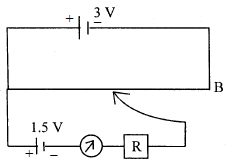
- Calculate unknown emf of the cell.
- Explain with reason, whether the circuit works, if the driver cell is replaced with a cell of emf 1 V.
- Does the high resistance R, used in the secondary circuit affect the balance point? Justify your answer.
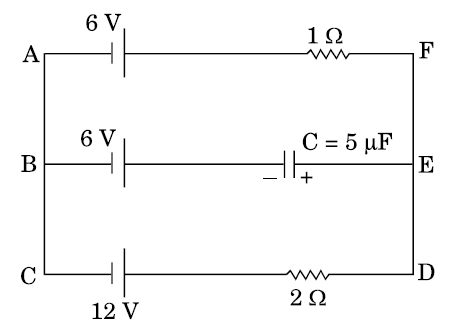
- 6View SolutionIn the given circuit, with steady current, calculate the potential difference across the capacitor and the charge stored in it.
- 7View SolutionDefine the terms (i) drift velocity, (ii) relaxation time.
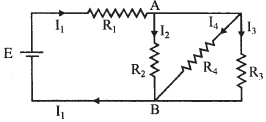
A conductor of length L is connected to a dc source of emf ε. If this conductor is replaced by another conductor of same material and same area of cross-section but of length 3L, how will the drift velocity change? - 8In the circuit shown, $R_1 = 4\Omega , R_2 = R_3 = 15\Omega , R_4 = 30\Omega$ and $E = 10V.$ Calculate. The equivalent resistance of the circuit and the current in each resistor.View Solution
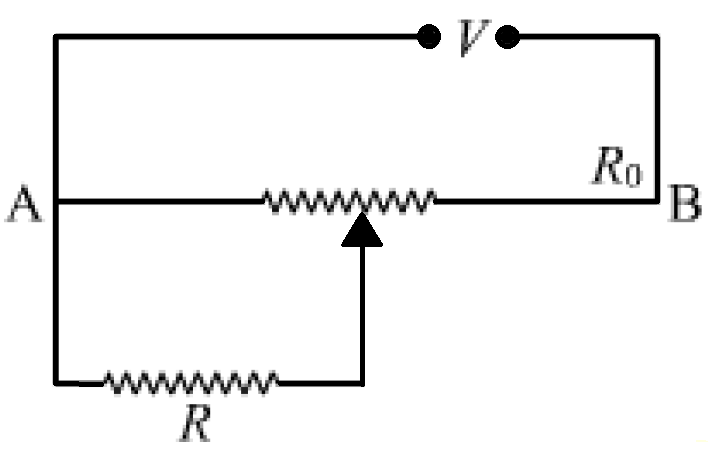
- 9A resistance of $R$ draws current from a potentiometer. The potentiometer wire, $AB,$ has a total resistance of $R_o$. A voltage $V$ is supplied to the potentiometer. Derive an expression for the voltage across $R$ when the sliding contact is in the middle of potentiometer wire.View Solution
- 10The potential difference between the terminals of a battery of emf 6.0V and internal resistance $1\Omega$ drops to 5.8V when connected across an external resistor. Find the resistance of the external resistor.View Solution