Question
A spherical shell made of plastic, contains a charge Q distributed uniformly over its surface. What is the electric field inside the shell? If the shell is hammered to deshape it without altering the charge, will the field inside be changed? What happens if the shell is made of a metal?
Answer

As the shell is made of plastic, it is non-conducting. But as the charge is distributed uniformly over the surface of the shell, the sum of all the electric field vectors at the centre due to this kind of distribution is zero. But when the plastic shell is deformed, the distribution of charge on it becomes non-uniform. In other words, the sum of all the electric field vectors is non-zero now or the electric field exists at the centre now.
In case of a deformed conductor, the field inside is always zero.

Need a full question paper?

Generate a complete, print-ready paper with questions like this in minutes — across 16+ boards, with answer keys.

Start Generating Free

Similar questions

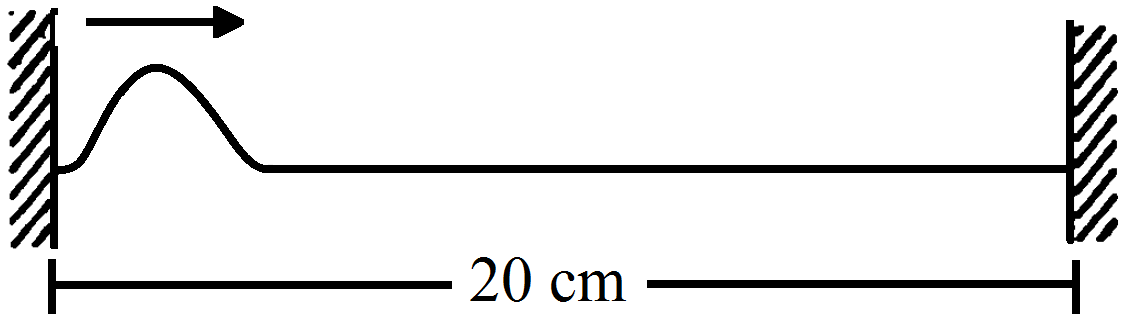
A string of length 20cm and linear mass density 0.40g/cm is fixed at both ends and is kept under a tension of 16N. A wave pulse is produced at t = 0 near an end as shown in figure, which travels towards the other end.
  1. When will the string have the shape shown in the figureagain
  2. Sketch the shape of the string at a time half of that found in part (a).
Can two equipotential surfaces cut each other?
  1. Drive the expression for electric field at a point on the equatorial line of an electric dipole.
  2. Depict the orientation of the dipole in (i) stable, (ii) unstable equilibrium in a uniform electric field.
Find the radius of gyration of a circular ring of radius r about a line perpendicular to the plane of the ring and passing through one of its particles.
What is drift velocity? Explain the dependence of drift velocity and electric field on the mobility.
Plot a graph showing the variation of binding energy per nucleon as a function of mass number. Which property of nuclear force explains the approximate constancy of binding energy in the range 30 < A < 170? How does one explain the release of energy in both the processes of nuclear fission and fusion from the graph?
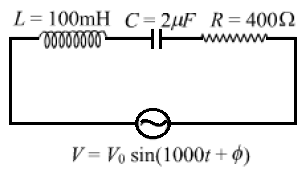
  1. Find the value of the phase difference between the current and the voltage in the series LCR circuit shown below. Which one leads in phase: current or voltage?
  2. Without making any other change, find the value of the additional capacitor $C_1,$ to be connected in parallel with the capacitor C, in order to make the power factor of the circuit unity.
Figure, shows an aluminium wire of length 60cm joined to a steel wire of length 80cm and stretched between two fixed supports. The tension produced is 40N. The cross-sectional area of the steel wire is $1.0mm^2$ and that of the aluminium wire is $3.0 mm^2$. What could be the minimum frequency of a tuning fork which can produce standing waves in the system with the joint as a node? The density of aluminium is $2.6g/cm^3$ and that of steel is $7.8g/cm^3.$​​​​​​​
Explain giving reasons for the following:
  1. Photoelectric current in a photocell increases with the increase in the intensity of the incident radiation.
  2. The stopping potential $(V_0)$ varies linearly with the frequency (v) of the incident radiation for a given photosensitive surface with the slope remaining the same for different surfaces.
  3. Maximum kinetic energy of the photoelectrons is independent of the intensity of incident radiation.
Consider earth satellites in circular orbits. A geostationary satellite must be at a height of about 36000km from the earth's surface. Will any satellite moving at this height be a geostationary satellite? Will any satellite moving at this height have a time period of 24 hours?
