Question
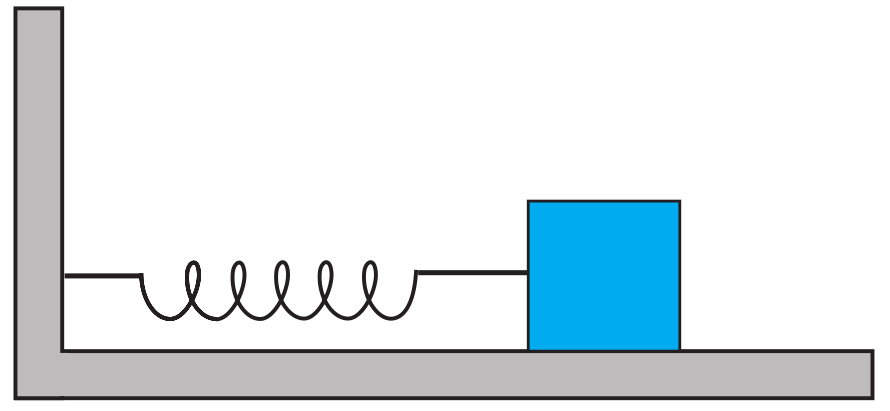
A spring having with a spring constant 1200N m-1 is mounted on a horizontal table as shown in Fig. A mass of 3kg is attached to the free end of the spring. The mass is then pulled sideways to a distance of 2.0cm and released.

Determine (i) the frequency of oscillations, (ii) maximum acceleration of the mass, and (iii) the maximum speed of the mass.

Answer

Spring constant, k = 1200N m-1

Mass, m = 3kg

Displacement, A = 2.0cm = 0.02cm

  1. Frequency of oscillation v, is given by the relation:

$\upsilon=\frac{1}{\text{T}}=\frac{1}{2\pi}\sqrt{\frac{\text{k}}{\text{m}}}$

where, T is time period

$\therefore\ \upsilon=\frac{1}{2\times3.14}\sqrt{\frac{1200}{3}}$

= 3.18m/s

Hence, the frequency of oscillations is 3.18 cycles per second.

  1. Maximum acceleration (a) is given by the relation:

$\text{a}=\omega^2\text{A}$

where,

$\omega=$ Angular frequency $=\sqrt{\frac{\text{k}}{\text{m}}}$

A = maximum displacement

$\therefore\ \text{a}=\frac{\text{k}}{\text{m}}\text{A}=\frac{1200\times0.02}{3}=8\text{ ms}^{-2}$

Hence, the maximum acceleration of the mass is 8.0m/s2.

Maximum velocity, $\text{v}_\text{max}=\text{A}\omega$

$=\text{A}\sqrt{\frac{\text{k}}{\text{m}}}=0.02\times\sqrt{\frac{1200}{3}}=0.4\text{ m/s}$

Hence, the maximum velocity of the mass is 0.4m/s.
Need a full question paper?

Generate a complete, print-ready paper with questions like this in minutes — across 16+ boards, with answer keys.

Start Generating Free

Similar questions

Explain why.
There is no atmosphere on moon.
Potassium-40 can decay in three modes. It can decay by $\beta^-$-emission, $\beta^+$-emission of electron capture.
  1. Write the equations showing the end products.
  2. Find the Q-values in each of the three cases. Atomic masses of $\text{ }^{40}_{18}\text{Ar},\text{ }^{40}_{19}\text{K}$ and $\text{ }^{40}_{20}\text{Ca}$ are 39.9624u 39.9640u and 39.9626u respectively.
The half-life of 199Au is 2.7 days.
  1. Find the activity of a sample containing $1.00\mu\text{g}$ of 198Au.
  2. What will be the activity after 7 days? Take the atomic weight of 198Au to be 198g/mol.
A person of mass 60kg wants to lose 5kg by going up and down a 10m high stairs. Assume he burns twice as much fat while going up than coming down. If 1kg of fat is burnt on expending 7000 kilo calories, how many times must he go up and down to reduce his weight by 5kg?
A body cools from $80^{\circ} C$ to $50^{\circ} C$ in 5 minutes. Calculate the time it takes from $60^{\circ} C$ to 30 ${ }^{\circ} C$. The temperature of the surroundings is $20^{\circ} C$.
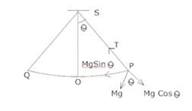
What is Simple pendulum? Find an expression for the time period and frequency of a simple pendulum?
Image
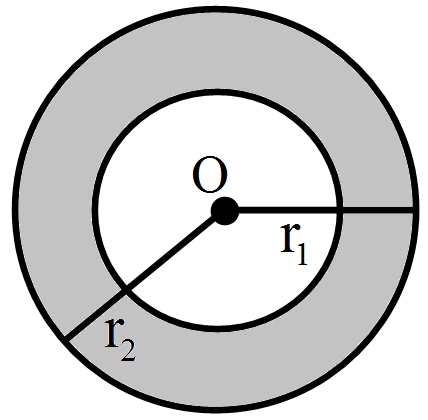
A charge Q is distributed uniformly within the material of a hollow sphere of inner and outer radii r1 and r2 (figure). Find the electric field at a point P a distance x away from the centre for r1 < x < r2 Draw a rough graph showing the electric field as a function of x for O < x < 2r2 (figure).

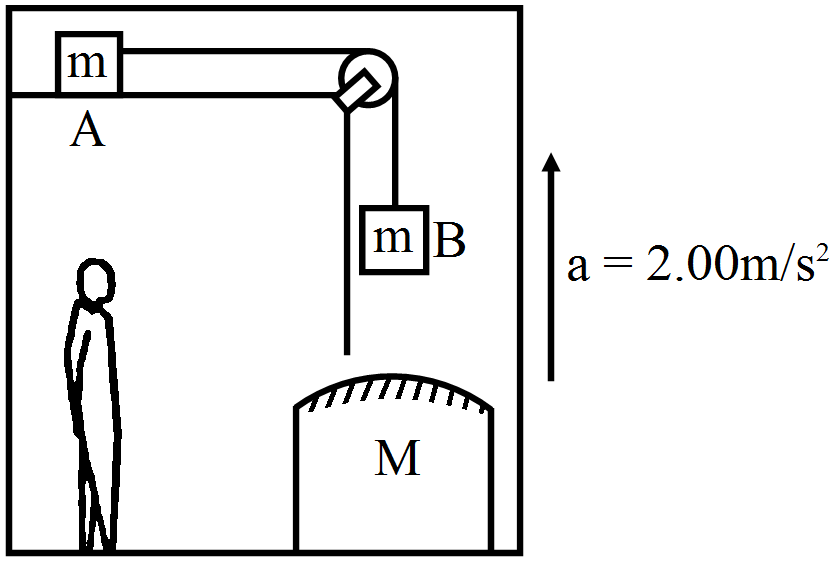
Consider the situation shown in figure. The elevator is going up with an acceleration of 2.00m/s2 and the focal length of the mirror is 12.0cm. All the surfaces are smooth and the pulley is light. The mass-pulley system is released from rest (with respect to the elevator) at t = 0 when the distance of B from the mirror is 42.0cm. Find the distance between the image of the block B and the mirror at t = 0.200s. Take g = 10m/s2.

A point source emitting alpha particles is placed at a distance of 1m from a counter which records any alpha particle falling on its 1cm2 window. If the source contains 6.0 × 10¹⁶ active nuclei and the counter records a rate of 50000 counts/ second, find the decay constant. Assume that the source emits alpha particles uniformly in all directions and the alpha particles fall nearly normally on the window.
If instead of mass, length and time as fundamental quantities, we choose velocity, acceleration and force as fundamental quantities and express their dimensions by V, A and F respectively, show that the dimensions of Young's modulus can be expressed as [FA2 V-4].