Question
A stationary charge produces only an electrostatic field while a charge in uniform motion produces a magnetic field, that does not change with time. An oscillating charge is an example of accelerating charge. It produces an oscillating magnetic field, which in turn produces an oscillating electric fields and so on. The oscillating electric and magnetic fields regenerate each other as a wave which propagates through space.
Magnetic field in a plane electromagnetic wave is given by $\vec{\text{B}}=\text{B}_0\sin(\text{kx}+\omega\text{t}) \hat{\text{j}}\text{T}.$
  1. Expression for corresponding electric field will be (Where c is speed of light).
  1. $\vec{\text{E}}=-\text{B}_0\text{c}\sin(\text{kx}+\omega\text{t}) \hat{\text{k}}\frac{\text{V}}{\text{m}}$
  2. $\vec{\text{E}}=\text{B}_0\text{c}\sin(\text{kx}-\omega\text{t}) \hat{\text{k}}\frac{\text{V}}{\text{m}}$
  3. $\vec{\text{E}}=\frac{\text{B}_0}{\text{c}}\sin(\text{kx}+\omega\text{t}) \hat{\text{k}}\frac{\text{V}}{\text{m}}$
  4. $\vec{\text{E}}=\text{B}_0\text{c}\sin(\text{kx}+\omega\text{t}) \hat{\text{k}}\frac{\text{V}}{\text{m}}$
  1. The electric field component ofa monochromatic radiation is given by $\vec{\text{E}} = 2\in_0\hat{\text{i}}\cos\text{kz}\cos\omega\text{t}.$ Its magnetic field $\vec{\text{B}}$ is then given by:
  1. $\frac{2\in_0}{\text{c}}\hat{\text{j}}\cos\text{kz}\cos\omega\text{t}$
  2. $\frac{2\in_0}{\text{c}}\hat{\text{j}}\sin\text{kz}\cos\omega\text{t}$
  3. $\frac{2\in_0}{\text{c}}\hat{\text{j}}\sin\text{kz}\sin\omega\text{t}$
  4. $-\frac{2\in_0}{\text{c}}\hat{\text{j}}\sin\text{kz}\sin\omega\text{t}$
  1. A plane em wave of frequency 25MHz travels in a free space along x-direction. At a particular point in space and time, $\text{E}=(6.3\ \hat{\text{j}})\frac{\text{V}}{\text{m}}.$ What is magnetic field at that time?
  1. $0.095\mu\text{T}$
  2. $0.124\mu\text{T}$
  3. $0.089\mu\text{T}$
  4. $0.021\mu\text{T}$
  1. A plane electromagnetic wave travelling along the x-direction has a wavelength of 3mm. The variation in the electric field occurs in they-direction with an amplitude $66Vm^1$. The equations for the electric and magnetic fields as a function of x and tare respectively.
  1. $\text{E}_\text{y}=33\cos\pi\times10^{11}\Big(\text{t}-\frac{\text{x}}{\text{c}}\Big),\\\text{B}_\text{z}=1.1\times10^{-7}\cos\pi\times10^{11}\Big(\text{t}-\frac{\text{x}}{\text{c}}\Big)$
  2. $\text{E}_\text{y}=11\cos2\pi\times10^{11}\Big(\text{t}-\frac{\text{x}}{\text{c}}\Big),\\\text{B}_\text{y}=11\times10^{-7}\cos2\pi\times10^{11}\Big(\text{t}-\frac{\text{x}}{\text{c}}\Big)$
  3. $\text{E}_\text{x}=33\cos\pi\times10^{11}\Big(\text{t}-\frac{\text{x}}{\text{c}}\Big),\\\text{B}_\text{x}=11\times10^{-7}\cos\pi\times10^{11}\Big(\text{t}-\frac{\text{x}}{\text{c}}\Big)$
  4. $\text{E}_\text{y}=66\cos2\pi\times10^{11}\Big(\text{t}-\frac{\text{x}}{\text{c}}\Big),\\\text{B}_\text{z}=2.2\times10^{-7}\cos2\pi\times10^{11}\Big(\text{t}-\frac{\text{x}}{\text{c}}\Big)$
  1. A plane electromagnetic wave travels in free space along x-axis. At a particular point in space, the electric field along y-axis is $9.3Vm^{-1}.$ The magnetic induction (B) alongz-axis is:
  1. $3.1 \times 10^{-8}T$
  2. $3 \times 10^{-5}T$
  3. $3 \times 10^{-6}T$
  4. $9.3 \times 10^{-6}T$

Answer

  1. (d) $\vec{\text{E}}=\text{B}_0\text{c}\sin(\text{Kx}+\omega\text{t}) \hat{\text{k}}\frac{\text{V}}{\text{m}}$
Explanation:
Given: $\vec{\text{B}}=\text{B}_0\text{c}\sin(\text{Kx}+\omega\text{t}) \hat{\text{k}}\frac{\text{V}}{\text{m}}$
The relation between electric and magnetic field is,
$\text{c}=\frac{\text{E}}{\text{B}}$ or E = cB
The electric 6 eld component is perpendicular to the direction of propagation and the direction of magnetic field. Therefore, the electric field component along z-axis is obtained as $\vec{\text{E}}=\text{cB}_0\sin(\text{kx}+\omega\text{t}) \hat{\text{k}}\frac{\text{V}}{\text{m}}.$
  1. (c) $\frac{2\in_0}{\text{c}}\hat{\text{j}}\sin\text{kz}\sin\omega\text{t}$
Explanation:
$\frac{\text{dE}}{\text{dz}}=-\frac{\text{dB}}{\text{dt}}$
$\frac{\text{dE}}{\text{dz}}=-2\text{E}_0\text{k}\sin\text{kz}\cos\omega\text{t}=-\frac{\text{dB}}{\text{dt}}$
${\text{dB}}=+2\text{E}_0\text{k}\sin\text{kz}\cos\omega\text{t}{\text{dt}}$
${\text{B}}=+2\text{E}_0\text{k}\sin\text{kz}\int\cos\omega\text{t}{\text{dt}}$
$=+2\text{E}_0\frac{\text{k}}{\omega}\sin\text{kz}\sin\omega\text{t}$
$\frac{\text{E}_0}{\text{B}_0}=\frac{\omega}{\text{k}}=\text{c}$
$\text{B}=\frac{2\text{E}_0}{\text{c}}\sin\text{kz}\sin\omega\text{t}$
$\therefore\text{B}=\frac{2\text{E}_0}{\text{c}}\sin\text{kz}\sin\omega\text{t}\hat{\text{j}}$
E is along y-direction and the wave propagates along x-axis.
$\therefore$ B should be in a direction perpendicular to both x and y-axis.
  1. (d) $0.021\mu\text{T}$
Explanation:
Here, $\vec{\text{E}}=6.3\hat{\text{j}};\text{c}=3\times10^8\frac{\text{m}}{\text{s}}$
The magnitude of B is:
${\text{Bz}}=\frac{\text{E}}{\text{c}}=\frac{6.3}{3\times10^8}$
$=2.1\times10^8\ \text{T}=0.021\mu\text{T}$
  1. (d) $\text{E}_\text{y}=66\cos2\pi\times10^{11}\Big(\text{t}-\frac{\text{x}}{\text{c}}\Big),\text{B}_\text{z}=2.2\times10^{-7}\cos2\pi\times10^{11}\Big(\text{t}-\frac{\text{x}}{\text{c}}\Big)$
Explanation:
Here: $\text{E}_0=66\text{Vm}^{-1},\text{E}_\text{y}=66\cos\omega\Big(\text{t}-\frac{\text{x}}{\text{c}}\Big),$
$\lambda=3\text{mm}=3\times10^{-3}\text{m},\text{k}=\frac{2\pi}{\lambda}$
$\frac{\omega}{\text{k}}=\text{c}\Rightarrow\omega=\text{ck}=3\times10^8\times\frac{2\pi}{3\times10^{-3}}$
or $\omega=2\pi\times10^{11}$
$\therefore\text{E}_\text{y}=66\cos2\pi\times10^{11}\Big(\text{t}-\frac{\text{x}}{\text{c}}\Big)$
${\text{Bz}}=\frac{\text{E}_\text{y}}{\text{c}}=\Big(\frac{66}{3\times10^8}\Big)\cos2\pi\times10^{11}\Big(\text{t}-\frac{\text{x}}{\text{c}}\Big)$
$=2.2\times10^{-7}\cos2\pi\times10^{11}\Big(\text{t}-\frac{\text{x}}{\text{c}}\Big)$
  1. (a) $3.1 \times 10^{-8}T$
Explanation:
At a particular point, $E = 9.3Vm^{-1}$
$\therefore$ Magnetic field at the same point $=\frac{9.3}{3\times10^8}$
$= 3.1 \times 10^{-8}T$

Need a full question paper?

Generate a complete, print-ready paper with questions like this in minutes — across 16+ boards, with answer keys.

Start Generating Free

Similar questions

A child has near point at 10cm. What is the maximum angular magnification the child can have with a convex lens of focal length 10cm?
When a tyre bursts, the air coming out is cooler than the surrounding air. Explain.
Suppose you are running fast in a field when you suddendly find a snake in front of you. You stop quickly. Which force is responsible for your deceleration?
Two q charges of the same nature are located at a distance d from each other, the third charge of value Q Coulomb is at the mid-point of the line joining them. For what value of Q will the system be in equilibrium?
Draw a graph showing the change in potential corresponding to the change in distance from a point charge. For the charged system shown in the figure, prove that the potential difference between points $A$ and $B$ is
Image
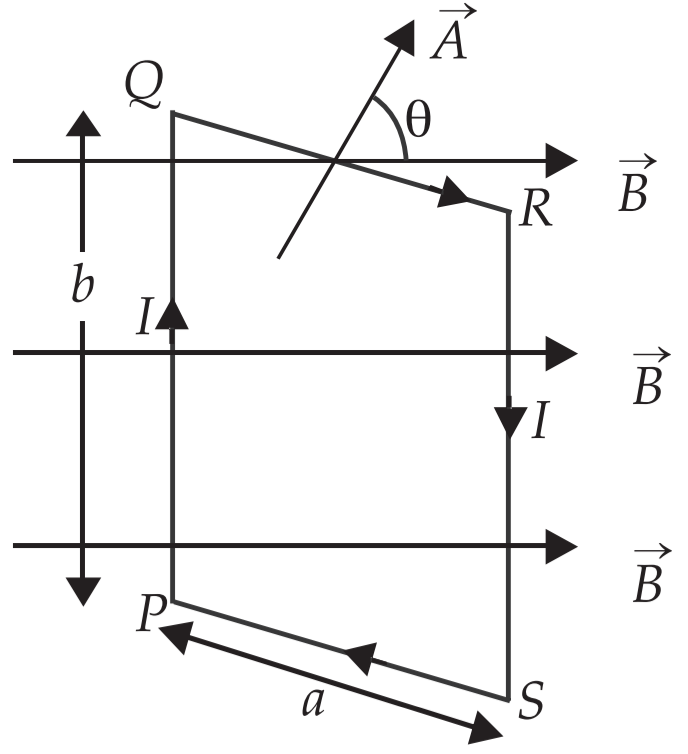
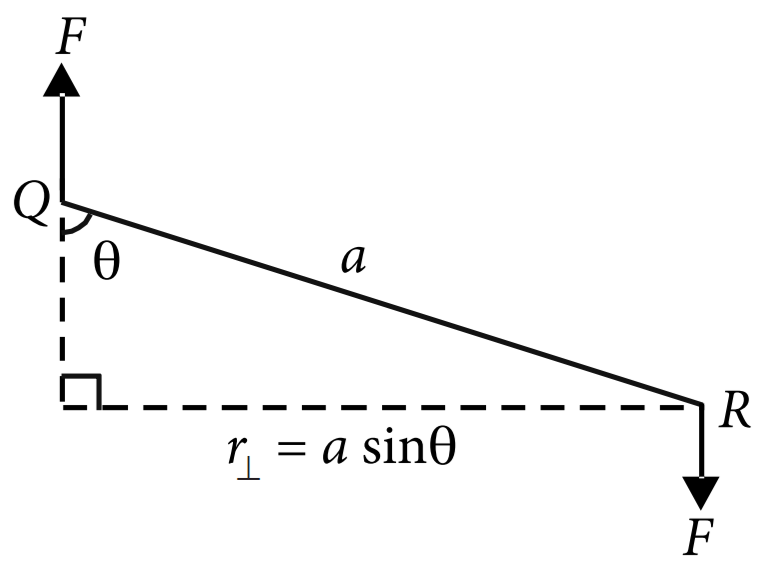
When a rectangular loop PQRS of sides' a' and' b' carrying current I is placed in uniform magnetic field B, such that area vector ii makes an angle 8 with direction of magnetic field, then forces on the arms QR and SP of loop are equal, opposite and collinear, thereby perfectly cancel each other, whereas forces on the arms PQ and RS of loop are equal and opposite but not collinear, so they give rise to torque on the loop.

Force on side PQ or RS of loop is F = JbB sin 90º = lb B and perpendicular distance between two non-collinear forces is $\text{r}_\bot=\text{a}\sin\theta$
So, torque on the loop. $\tau=\text{IAB}\sin\theta$ In vector form torque, $\vec{\tau}=\vec{\text{M}}\times\vec{\text{B}}$ Where $\vec{\text{M}}=\text{NI}\vec{\text{A}}$ is called magnetic dipole moment of current loop and is directed in direction of area vector $\vec{\text{A}}$ i.e., normal to the plane ofloop.
  1. A circular loop of area $1cm^2,$ carrying a current of 10A is placed in a magnetic field of 0.1T perpendicular to the plane of the loop. The torque on the loop due to the magnetic field is:
  1. Zero
  2. $10^{-4}Nm$
  3. $10^{-2}Nm$
  4. 1Nm
  1. Relation between magnetic moment and angular velocity is:
  1. $\text{m}\propto\omega$
  2. $\text{m}\propto\omega^2$
  3. $\text{m}\propto\sqrt{\omega}$
  4. None of these.
  1. A current loop in a magnetic field:
  1. Can be in equilibrium in two orientations, both the equilibrium states are unstable.
  2. Can be in equilibrium in two orientations, one stable while the other is unstable.
  3. Experiences a torque whether the field is uniform or non uniform in all orientations.
  4. Can be in equilibrium in one orientation.
  1. The magnetic moment of a current I carrying circular coil of radius rand number of turns N varies as:
  1. $\frac{1}{\text{r}^2}$
  2. $\frac{1}{\text{r}}$
  3. $\text{r}$
  4. $\text{r}^2$
  1. A rectangular coil carrying current is placed in a non-uniform magnetic field. On that coil the total:
  1. Force is non-zero.
  2. Force is zero.
  3. Torque is zero.
  4. ZNone of these.
The needle of a dip circle shows an apparent dip of 45° in a particular position and 53° when the circle is rotated through 90°. Find the true dip.
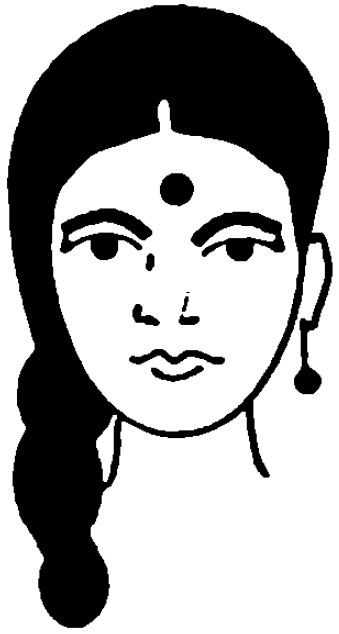
The ear-ring of a lady shown in has a 3cm long light suspension wire.
  1. Find the time period of small oscillations if the lady is standing on the ground.
  2. The lady now sits in a merry-go-round moving at 4m/s in a circle of radius 2m. Find the time period of small oscillations of the ear-ring.
An elevator is descending with uniform acceleration. To measure the acceleration, a person in the elevator drops a coin at the moment the elevator starts. The coin is 6ft above the floor of the elevator at the time it is dropped. The person observes that the coin strikes the floor in 1 second. Calculate from these data the acceleration of the elevator.
The distance between the centres of two insulated charged copper spheres ' $A$ ' and ' $B$ ' which are identical in size is 50 cm and the charge on each is $6.5 \times 10^{-7} C$. A third uncharged sphere ' C ' of the same size was first brought in contact with the sphere ' $A$ ', and then brought in contact with the second sphere ' $B$ ' and finally separated from both. Then find the magnitude of repulsive foce between ' $A$ ' and ' $B$ '.