MCQ
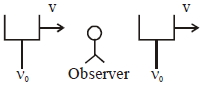
A stationary observer receives sound from two identical tuning forks, one of which approaches and the other one recedes with the same speed (much less than the speed of sound). The observer hears $2\; beats/sec$. The oscillation frequency of each tuning fork is $v_{0}=1400 \;\mathrm{Hz}$ and the velocity of sound in air is $350\; \mathrm{m} / \mathrm{s}$. The speed of each tuning fork is close to 
  • A
    $\frac{1}{8}\; \mathrm{m} / \mathrm{s}$
  • B
    $\frac{1}{2}\; \mathrm{m} / \mathrm{s}$
  • C
    $1 \; \mathrm{m} / \mathrm{s}$
  • $\frac{1}{4}\; \mathrm{m} / \mathrm{s}$
Answer

Correct option: D.
$\frac{1}{4}\; \mathrm{m} / \mathrm{s}$
d
$v_{1}=\left(\frac{c}{c-v}\right) v_{0}$

$v_{2}=\left(\frac{c}{c+v}\right) v_{0}$

beat frequency $=v_{1}-v_{2}$

$=\mathrm{cv}_{0} \quad\left(\frac{1}{\mathrm{c}-\mathrm{v}}-\frac{1}{\mathrm{c}+\mathrm{v}}\right)$

$=c v_{0}\left(\frac{c+v-c+v}{c^{2}-v^{2}}\right)=\frac{2 c v_{0}^{2} v}{c^{2}-v^{2}}$

$\approx \frac{2 \mathrm{cv}_{0} \mathrm{v}}{\mathrm{c}^{2}}=\frac{2 \mathrm{v}_{0} \mathrm{v}}{\mathrm{c}}=2$

$\Rightarrow \frac{2 \times 1400 \times v}{350}=2$

$\Rightarrow \mathrm{v}=\frac{1}{4} \mathrm{m} / \mathrm{s}$

Need a full question paper?

Generate a complete, print-ready paper with questions like this in minutes — across 16+ boards, with answer keys.

Start Generating Free

Similar questions

The particle displacement of a travelling longitudional wave is represented by $\xi  = \xi (x,t)$. The midpoints of a compression zone and an adjacent rarefaction zone are represented by the letter ‘$C’$ and $‘R’$. Which of the following is true?
The distance travelled by a particle is directly proportional to $t^{1/2}$, where $t =$ time elapsed. What is the nature of motion ?
In a vernier callipers, each $cm$ on the main scale is divided into $20$ equal parts. If tenth vernier scale division coincides with nineth main scale division. Then the value of vernier constant will be $\dots \; \times 10^{-2} \;mm$
Pressure versus temperature graph of an ideal gas is shown in figure
First law of thermodynamics:
A cubical box with porous walls containing an equal number of ${O_2}$ and $H_2$ molecules is placed in a large evacuated chamber. The entire system is maintained at constant temperature $T.$ The ratio of ${v_{rms}}$ of ${O_2}$ molecules to that of the ${v_{rms}}$ of $H_2$ molecules, found in the chamber outside the box after a short interval is
Figure below shows a body of mass $M$ moving with the uniform speed on a circular path of radius, $R$. What is the change in acceleration in going from ${P_1}$ to ${P_2}$
A simple pendulum is set up in a trolley which moves to the right with an acceleration a on a horizontal plane. Then the thread of the pendulum in the mean position makes an angle $\theta $ with the vertical
$100$ balls each of mass moving with speed $v$ simultaneously strike a wall normally and reflected back with same speed, in time $t s$. The total force exerted by the balls on the wall is
The moment of inertia of a uniform cylinder of length $l$ and radius $R$ about its perpendicular bisector is $I$. What is the ratio $l/R$ such that the moment of inertia is minimum?