A steel wire having a radius of $2.0\, mm$, carrying a load of $4\, kg$, is hanging from a ceiling. Given that $g = 3.1\pi \,m{s^{ - 2}}$ , what will be the tensile stress that would be developed in the wire?
JEE MAIN 2019, Medium


Download our appand get started for free
Experience the future of education. Simply download our apps or reach out to us for more information. Let's shape the future of learning together!No signup needed.*
Similar Questions
- 1View SolutionHook's law defines
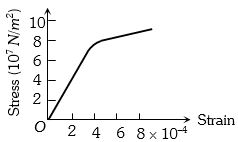
- 2Which one of the following is the Young’s modulus $($in $N/m^2)$ for the wire having the stress-strain curve shown in the figureView Solution
- 3A wire of length $5 \,m$ is twisted through $30^{\circ}$ at free end. If the radius of wire is $1 \,mm$, the shearing strain in the wire is $..........,.$View Solution
- 4A rigid bar of mass $15\,kg$ is supported symmetrically by three wire each of $2 \,m$ long. These at each end are of copper and middle one is of steel. Young's modulus of elasticity for copper and steel are $110 \times 10^9 \,N / m ^2$ and $190 \times 10^9 \,N / m ^2$ respectively. If each wire is to have same tension, ratio of their diameters will be $ ............$View Solution
- 5A wire can be broken by applying a load of $200\, N$. The force required to break another wire of the same length and same material, but double in diameter, is .......... $N$View Solution
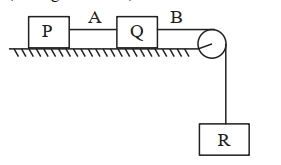
- 6Each of three blocks $P$, $Q$ and $R$ shown in figure has a mass of $3 \mathrm{~kg}$. Each of the wire $A$ and $B$ has cross-sectional area $0.005 \mathrm{~cm}^2$ and Young's modulus $2 \times 10^{11} \mathrm{~N} \mathrm{~m}^{-2}$. Neglecting friction, the longitudinal strain on wire $B$ is____________ $\times 10^{-4}$. $\left(\right.$ Take $\mathrm{g}=10 \mathrm{~m} / \mathrm{s}^2$ )View Solution
- 7View SolutionThe quality of the material which opposes the change in shape, volume or length is called
- 8To determine Young's modulus of a wire, the formula is $Y = \frac{F}{A}.\frac{L}{{\Delta L}}$ where $F/A$ is the stress and $L/\Delta L$ is the strain. The conversion factor to change $Y$ from $CGS$ to $MKS$ system isView Solution
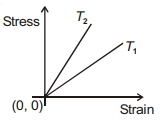
- 9View SolutionFigure shows graph between stress and strain for a uniform wire at two different femperatures. Then
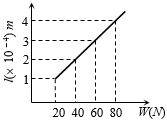
- 10The adjacent graph shows the extension $(\Delta l)$ of a wire of length $1m$ suspended from the top of a roof at one end with a load $W$ connected to the other end. If the cross sectional area of the wire is ${10^{ - 6}}{m^2},$ calculate the young’s modulus of the material of the wireView Solution