A steel wire is stretched with a definite load. If the Young's modulus of the wire is $Y$. For decreasing the value of $Y$
Easy
Download our app for free and get started
(d) It is the specific property of a particular metal at a given temperature which can be changed only by temperature variations.

Download our appand get started for free
Experience the future of education. Simply download our apps or reach out to us for more information. Let's shape the future of learning together!No signup needed.*
Similar Questions
- 1A metal wire having Poisson's ratio $1 / 4$ and Young's modulus $8 \times 10^{10} \,N / m ^2$ is stretched by a force, which produces a lateral strain of $0.02 \%$ in it. The elastic potential energy stored per unit volume in wire is [in $\left.J / m ^3\right]$View Solution
- 2An iron rod of length $2m$ and cross section area of $50\,m{m^2}$, stretched by $0.5\, mm$, when a mass of $250\, kg$ is hung from its lower end. Young's modulus of the iron rod isView Solution
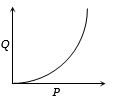
- 3The graph shows the behaviour of a length of wire in the region for which the substance obeys Hook’s law. $P$ and $Q$ representView Solution
- 4If Young's modulus of iron is $2 \times {10^{11}}\,N/{m^2}$ and the interatomic spacing between two molecules is $3 \times {10^{ - 10}}$metre, the interatomic force constant is ......... $N/m$View Solution
- 5A ball falling in a lake of depth $200\, m$ shows $0.1\%$ decrease in its volume at the bottom. What is the bulk modulus of the material of the ballView Solution
- 6A meter scale of mass $m$ , Young modulus $Y$ and cross section area $A$ is hanged vertically from ceiling at zero mark. Then separation between $30\ cm$ and $70\ cm$ mark will be :-( $\frac{{mg}}{{AY}}$ is dimensionless)View Solution
- 7A rod is fixed between two points at $20°C$. The coefficient of linear expansion of material of rod is $1.1 \times {10^{ - 5}}/^\circ C$ and Young's modulus is $1.2 \times {10^{11}}\,N/m$. Find the stress developed in the rod if temperature of rod becomes $10°C$View Solution
- 8A rod of uniform cross-sectional area $A$ and length $L$ has a weight $W$. It is suspended vertically from a fixed support. If Young's modulus for rod is $Y$, then elongation produced in rod is ......View Solution

- 9The compressibility of water is $4 \times {10^{ - 5}}$ per unit atmospheric pressure. The decrease in volume of $100$ cubic centimeter of water under a pressure of $100$ atmosphere will be ......... $cc$View Solution
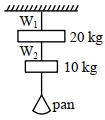
- 10Wires ${W}_{1}$ and ${W}_{2}$ are made of same material having the breaking stress of $1.25 \times 10^{9} \,{N} / {m}^{2}$ ${W}_{1}$ and ${W}_{2}$ have cross-sectional area of $8 \times 10^{-7}\, {m}^{2}$ and $4 \times 10^{-7}\, {m}^{2}$, respectively. Masses of $20 \,{kg}$ and $10\, {kg}$ hang from them as shown in the figure. The maximum mass that can be placed in the pan without breaking the wires is $.....{kg}$ (Use $\left.{g}=10\, {m} / {s}^{2}\right)$View Solution