MCQ
A steel wire of diameter $2 \,mm$ has a breaking strength of $4 \times 10^5 \,N$.the breaking force ......... $\times 10^5 \,N$ of similar steel wire of diameter $1.5 \,mm$ ?
  • $2.3$
  • B
    $2.6$
  • C
    $3$
  • D
    $1.5$

Answer

Correct option: A.
$2.3$
a
(a)

We know

$\frac{\text { Force } \times \text { Length }}{\text { Area } \times \text { young's modulus }}=$ elongation $\quad\left\{\frac{F L}{A y}=\Delta x\right\}$

$\Rightarrow F=\left(\frac{\Delta x \cdot y}{L}\right) A$

$F=\left(\frac{\Delta x \cdot y}{L} \cdot \frac{\pi}{4}\right) d^2$

We can say $F \propto d^2$

So we can use

$\frac{F_1}{F_2}=\frac{d_1^2}{d_2^2}$  $\left\{\begin{array}{l}F_1=4 \times 10^5 N \\ d_1=2 mm \\ F_2=? \\ d_2=1.5 mm \end{array}\right\}$

Substituting values

$\frac{4 \times 10^5}{F_2}=\frac{(2)^2}{(1.5)^2}$

$F_2=2.3 \times 10^5 \,N$

Need a full question paper?

Generate a complete, print-ready paper with questions like this in minutes — across 16+ boards, with answer keys.
Start Generating Free

Similar questions

The volume occupied by the molecules contained in $4.5\,kg$ water at $STP$, if the intermolecular forces vanish away is ........ $m ^{3}$
A system can be taken from the initial state $\mathrm{p}_1, \mathrm{~V}_1$ to the final state $\mathrm{p}_2, \mathrm{~V}_2$ by two different methods. Let $\Delta\text{Q}$ and $\Delta\text{W}$ represent the heat given to the system and the work done by the system. Which of the following must be the same in both the methods?
A particle moves in the $X-Y$ plane under the influence of a force such that its linear momentum is $\overrightarrow{\mathrm{p}}(t)=A[\hat{\mathrm{i}} \cos (\mathrm{kt})-\hat{\mathrm{j}} \sin (\mathrm{kt})]$, where $A$ and $k$ are constants. The angle between the force and the momentum is
There is a hole in the bottom of tank having water. If total pressure at bottom is $ 3 atm$  ($1 atm = 10^5N/m^2$) then the velocity of water flowing from hole is
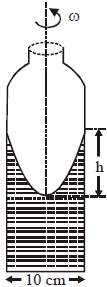
A cylindrical vessel containing a liquid is rotated about its axis so that the liquid rises at its sides as shown in the figure. The radius of vessel is $5\, cm$ and the angular speed of rotation is  $\omega\; rad \,s^{-1}$. The difference in the height, $h($ in $cm )$ of liquid at the centre of vessel and at the side will be
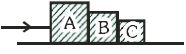
Three blocks $A, B$ and $C$ of masses $4\, kg$, $2\, kg$ and $1\, kg$ respectively, are in contact on a frictionless surface, as shown. If a force of $14\, N$ is applied on the $4\, kg$ block, then the contact force between $A$ and $B$ is .......... $N$
A spherical soap bubble of radius $3\,cm$ is formed inside another spherical soap bubble of radius $6\,cm$. If the internal pressure of the smaller bubble of radius $3\,cm$ in the above system is equal to the internal pressure of the another single soap bubble of radius $r\,cm$. The value of $r$ is.......
A car moving with a speed of $40\, km/h$ can be stopped by applying brakes after atleast $2\, m$. If the same car is moving with a speed of $80 \,km/h$, what is the minimum stopping distance............$m$
Consider two waves passing through the same string. Principle of superposition for displacement says that the net displacement of a particle on the string is sum of the displacements produced by the two waves individually. Suppose we state similar principles for the net velocity of the particle and the net kinetic energy of the particle. Such a principle will be valid for:
Mercury does not wet glass, wood or iron because