MCQ
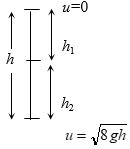
A stone is dropped from a height $h$. Simultaneously, another stone is thrown up from the ground which reaches a height $4 \,h$. The two stones cross each other after time
  • $\sqrt {\frac{h}{{8g}}} $
  • B
    $\sqrt {8g\,h} $
  • C
    $\sqrt {2g\,h} $
  • D
    $\sqrt {\frac{h}{{2g}}} $

Answer

Correct option: A.
$\sqrt {\frac{h}{{8g}}} $
a
(a) For first stone $u = 0$ and

For second stone $\frac{{{u^2}}}{{2g}} = 4h \Rightarrow {u^2} = 8gh$

$\therefore u = \sqrt {8gh} $

Now, ${h_1} = \frac{1}{2}g{t^2}$

${h_2} = \sqrt {8gh} t - \frac{1}{2}g{t^2}$

where, $t =$ time to cross each other.

$\because {h_1} + {h_2} = h$

==> $\frac{1}{2}g{t^2} + \sqrt {8gh} t - \frac{1}{2}g{t^2} = h$ ==> $t = \frac{h}{{\sqrt {8gh} }} = \sqrt {\frac{h}{{8g}}} $

Need a full question paper?

Generate a complete, print-ready paper with questions like this in minutes — across 16+ boards, with answer keys.

Start Generating Free

Similar questions

A thin lens is made with a material having refractive index $\mu=1.5.$ Both the sides are convex. It is dipped in water $(\mu=1.33).$ It will behave like:
  1. A convergent lens.
  2. A divergent lens.
  3. A rectangular slab.
  4. A prism.
Two particles $A$ and $B$ are projected simultaneously from a fixed point of the ground. Particle $A$ is projected on a smooth horizontal surface with speed $v$, while particle $B$ is projected in air with speed $\frac{2 v}{\sqrt{3}}$. If particle $B$ hits the particle $A$, the angle of projection of $B$ with the vertical is
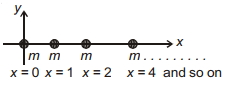
A large number of identical point masses $m$ are placed along $x$-axis, at $x=0,1,2,4$, The magnitude of gravitational force on mass at origin $(x=0)$, will be ............
A glass flask is filled up to a mark with $50\, cc$ of mercury at $18°C.$ If the flask and contents are heated to $38°C.$ ......... $cc$ mercury will be above the mark $?$ $(\alpha$ for glass is $ 9 × 10^{-6}{°}C^{-1}$ and coefficient of real expansion of mercury is $180 × 10^{-6}{°}C^{-1})$ 
Three capacitors of capacitances $6\mu\text{F}$ each are available. The minimum and maximum capacitances, which may be obtained are:

  1. $6\mu\text{F},\ 18\mu\text{F}$

  2. $3\mu\text{F},\ 12\mu\text{F}$

  3. $2\mu\text{F},\ 12\mu\text{F}$

  4. $2\mu\text{F},\ 18\mu\text{F}$

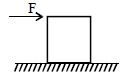
A force $F$ is applied on the top of a cube as shown in the figure. The coefficient of friction between the cube and ground is $\mu$. If $F$ is gradually increased the cube will topple before sliding then range of $\mu$ is:-
A $1\, kg$ stone at the end of $1\, m$ long string is whirled in a vertical circle at constant speed of $4\, m/s$. The tension in the string is $6\, N$ when the stone is at $(g = 10\, m/s^2)$
The acceleration due to gravity at pole and equator can be related as
A black body is heated from ${27^o}C$ to ${127^o}C$. The ratio of their energies of radiations emitted will be
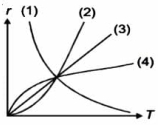
Which graph best represents the variation of radius $r$ of a circular orbit of a satellite against its time period $T$ ?